Wholesaler vs Trader vs Factory: Who Should You Buy Jewelry From?
One of the first decisions a new jewelry buyer faces is also the most confusing: who, exactly, are they buying from? A supplier replies on Alibaba, a booth in a trade show, a contact on a B2B platform, a recommended vendor from a friend, and they all call themselves "factories." But the reality is that only some of them actually own the workshop, the casting machines, and the bench jewelers. Behind the glossy front of a jewelry supply business, you may find a true manufacturer, a middleman trader who resells, or a wholesaler who buys finished stock and resells it. Choosing the wrong type costs you margin, flexibility, and control, often without you realizing it.
This guide breaks down the three main types of jewelry suppliers, what each actually does, where each makes its money, when each is the right choice, and how to tell them apart before you commit. If you have ever wondered why two quotes for the same-looking piece differ by double, or why one supplier can customize and another cannot, this is the answer. Knowing who you are buying from is the foundation of a healthy wholesale jewelry business.
The True Manufacturer (Factory)
A true jewelry factory owns the entire production chain under its own roof or directly under its management: casting, stone setting, polishing, plating, and quality control. It employs bench jewelers, owns vulcanizers and casting machines, and controls the process from wax to finished piece. When you work with a factory, you can customize designs, adjust plating thickness, request alloy changes, and directly influence quality because you are talking to the people who make the product. Factories charge tooling for custom work, hold MOQs, and quote lead times measured in weeks, because they are scheduling real production capacity. Our guide to auditing suppliers explains how to confirm a factory is what it claims.
Buying directly from a factory is usually the lowest unit cost at meaningful volumes, because there is no middleman margin baked in. It is also the most flexible: if a setting breaks in production, the factory fixes it; if you want a thinner shank, the modeler adjusts the wax. The trade-offs are MOQs, tooling fees, longer lead times, and a steeper onboarding process. Factories are ideal for established brands with repeat volume, private-label programs, and designs they intend to reorder for years. They are less ideal for a tiny shop testing ten pieces, because the minimums and tooling do not make sense yet. Our private label guide walks through the factory-direct relationship.
It is worth noting that "factory" claims are often exaggerated. Many businesses that call themselves factories are trading companies with a website and a showroom, subcontracting production elsewhere. The distinction matters, because a subcontracting layer costs you margin and slows communication. A real factory can show you its workshop, its casting and plating stations, and its production schedule. Our industry insights explain how jewelry is actually made, which helps you judge a supplier's reality.
The Trader or Middleman
A trader does not manufacture anything. They are a sourcing office or agent that collects orders from buyers, places them with one or more subcontract factories, and resells the finished jewelry with a margin added. Traders range from one-person agents to sophisticated companies with showrooms, sample rooms, and sales teams. Their value is convenience: they aggregate many factories under one roof, offer a wide catalog of stock pieces, handle communication across time zones, and smooth over production problems you would otherwise manage yourself. For a small buyer who wants one point of contact and a broad ready-made range, a good trader is genuinely useful. Our private label sourcing discussion compares this to direct factory work.
The cost of a trader is margin and control. Because the trader adds a layer between you and the actual maker, the unit price is higher, and every customization request has to travel through two parties, which slows decisions and introduces misunderstandings. Traders are also less likely to absorb tooling refunds or long-term design ownership, because they do not own the molds. On the positive side, a trader may be able to offer smaller MOQs, faster samples, and a wider mix than a single factory, and they can be the right partner while you are still testing your market. The mistake is paying factory-direct prices to a trader who has not told you they are not the maker.
How do you spot a trader? They rarely invite you to a real workshop floor, their catalog is broad across many unrelated categories, they cannot answer technical questions about alloy or plating, and their quotes arrive faster than production capacity would allow. This does not make them bad partners; it makes them a different kind of partner, with different pricing and service. The healthy approach is to know what you are paying for and choose accordingly, not to be misled by the word "factory."
The Wholesaler of Stock Jewelry
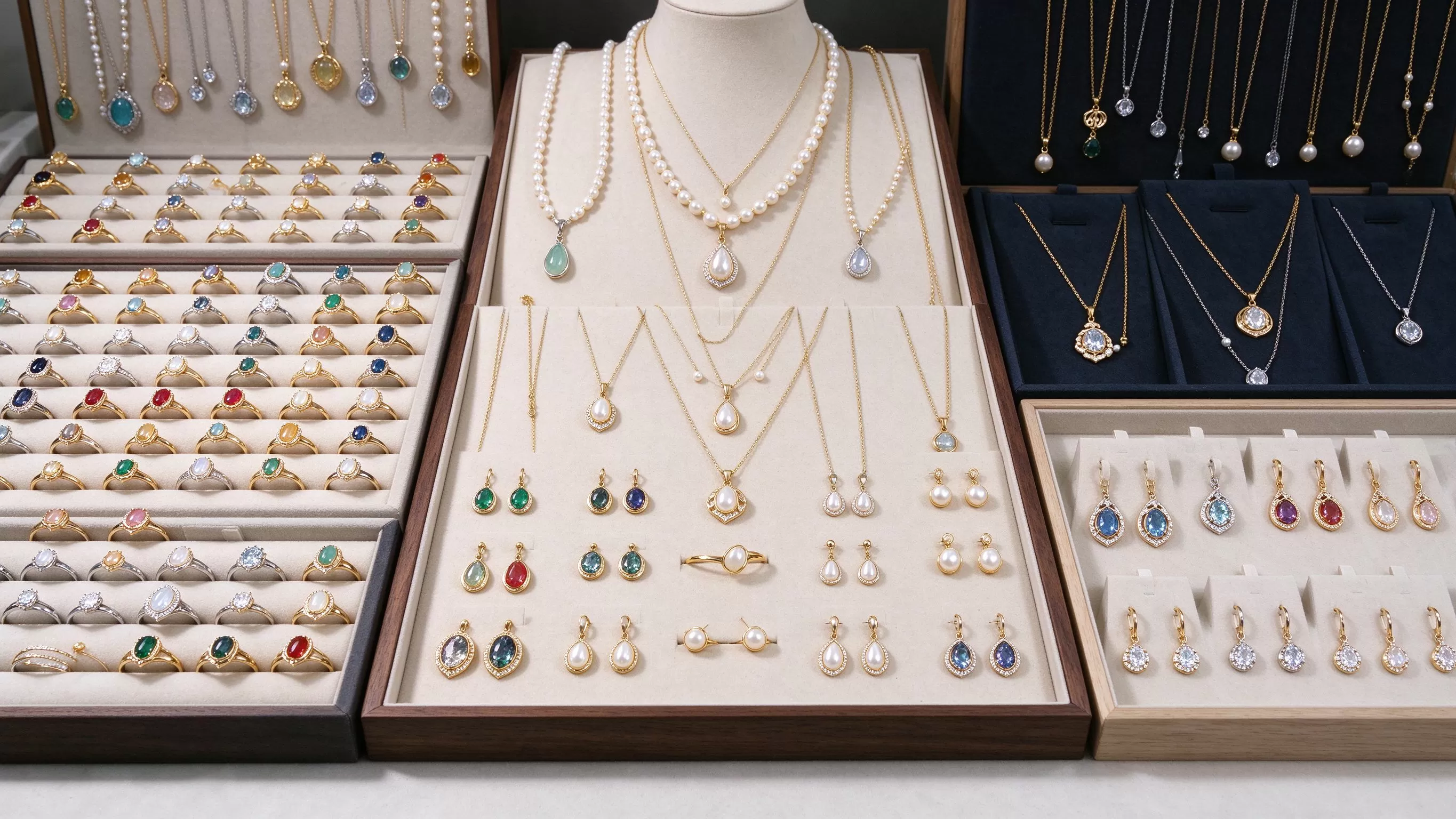
A wholesaler buys finished, ready-made jewelry in bulk from many sources and resells it from a catalog. They do not customize, they hold stock on shelves, and they ship within days rather than weeks. Their business is assortment and availability: you browse a catalog, pick styles you like, and receive them quickly at a modest per-unit cost. Wholesalers are the fastest way to fill a boutique or a pop-up, and they require no tooling, no sample approval cycle, and no minimum design commitment. Our look at the Shenzhen Shuibei market describes the kind of wholesale environment where this model thrives.
The limitations of wholesaling are differentiation and consistency. Because the same stock is available to every buyer, your customers can find the same pieces elsewhere, and your brand has no unique product. Quality is what it is, you cannot change the plating or the alloy, and when a style sells out you may or may not be able to restock it. Wholesalers are perfect for launching, testing demand, and filling shelves cheaply, but they are a weak long-term strategy for a brand that wants to stand for something. The smartest buyers use wholesalers to test which styles sell, then move the winners into private-label factory production where they can own them.
There is also a hybrid: a wholesaler who offers basic private label on top of stock, like adding your logo or choosing a plating finish. This sits between pure stock resale and true manufacturing, and it can be a good middle step for a growing brand. It is cheaper than full custom tooling and more differentiated than plain stock, though the designs remain the supplier's. Our OEM versus ODM guide covers exactly this spectrum.
Matching the Supplier to Your Stage
The right supplier depends almost entirely on where your business is. At the very start, with a tiny budget and no sales history, a wholesaler is the pragmatic choice: fill a few shelves or an online shop, see what sells, and avoid tooling risk. Once you have a sense of which styles your customers actually buy, a trader or a hybrid supplier can help you start private labeling those winners without a huge commitment. When a style is a proven repeat seller and you want the best margin and full control, that is when you graduate to a direct factory relationship. Trying to start at the factory, with tooling and MOQs, before you know your market, is how new brands get stuck holding inventory nobody wants. Our sample order strategy helps you test without overcommitting.
Many buyers run all three at once, and that is often the strongest model. Use wholesalers for quick fills and trend testing, use a trader for a broader curated range, and use a direct factory for your signature private-label bestsellers. Each relationship serves a different job, and the mix evolves as your brand grows. The mistake is treating one supplier type as universally best, or paying factory prices for what is really a stock wholesaler. Know the job you need done, and pick the partner that does it.
How to Verify Who You Are Really Buying From
Because suppliers often overstate their manufacturing capability, verification matters. Ask for a live video tour of the workshop while production is running, not a pre-recorded film. Ask technical questions: what alloy do they use, how thick is the plating, what is their casting process, how do they control quality between runs. A real factory answers comfortably; a trader deflects or refers to a partner. Request references from comparable buyers, and ask whether they can produce a technical sample to your spec before bulk order. Our audit checklist lists the specific questions that separate makers from resellers.
Also check the order itself. A genuine factory will quote tooling, hold a clear MOQ, and give a real lead time; a pure wholesaler quotes from stock with no tooling and immediate dispatch. If a supplier offers unlimited customization at wholesale prices with no tooling and instant shipping, something does not add up, and you are likely dealing with a trader or reseller. That is not a dealbreaker, but it should set your expectations about margin and control. Transparency about who they are, more than their marketing, is the best signal of a trustworthy partner.
Above all, treat the relationship as transparent rather than adversarial. A supplier who openly says, "we source some pieces from partner workshops," is more trustworthy than one who claims everything is self-made. That honesty about capability is exactly what lets you plan around their strengths. Over time, the best wholesale partnerships become collaborative: the factory learns your taste, the trader learns your assortment, and the wholesaler learns what you reorder. The distinction between them matters less than the clarity of who is doing what, which is what turns a transaction into a stable supply chain.
Frequently Asked Questions
What is the difference between a factory and a trader? A factory actually casts, sets, polishes, and plates the jewelry itself, employing bench jewelers and owning equipment. A trader manufactures nothing; it collects your order and places it with subcontract factories, adding a margin. Traders offer convenience and breadth; factories offer lower cost, customization, and control at volume.
Is it better to buy directly from a factory? At meaningful repeat volume, yes, because there is no middleman margin and you control design and quality. But factories carry MOQs, tooling fees, and longer lead times, so wholesalers or traders are often the better choice when you are just starting out or testing demand.
What does a jewelry wholesaler actually sell? Ready-made, finished stock from a catalog, shipped quickly with no customization. Wholesalers are fast and cheap for filling shelves, but the same pieces are available to other buyers, so they offer little differentiation.
How do I know if a "factory" is really a trader? Ask for a live video workshop tour, ask technical questions about alloy, plating, and casting, and watch whether they offer tooling and MOQs. Traders rarely show a running workshop, deflect technical questions, and resell stock rather than producing it.
Can I use more than one type of supplier? Yes, and most growing brands do. Use wholesalers for quick fills and testing, a trader for a curated range, and a direct factory for your proven private-label bestsellers. Match the supplier to the job rather than picking one forever.
Know Who You Are Paying
The single most useful thing a wholesale buyer can understand is the difference between the people who make jewelry and the people who resell it. A factory, a trader, and a wholesaler each have a legitimate role, and the smartest brands use each at the right stage of growth. The failure mode is paying factory-direct prices to a middleman, or overcommitting to tooling before the market has proven a style. Know what each type offers, verify who you are really talking to, and choose the partner that matches what your business actually needs today. We are a manufacturer with our own Shenzhen workshop, transparent about what we build and what we resell, and we help brands move from stock testing to private label over time. If you want an honest assessment of whether your next order belongs with a wholesaler, a trader, or a factory, write to service@holycome.com, and explore more in our Wholesale Sourcing library.