Aquamarine vs Blue Topaz: Which Blue Gem Deserves Your Ring?
Walk into any jewelry store and the blue gemstone case looks deceptively uniform: row after row of transparent blue stones priced from thirty dollars to three thousand. Two of those blues, aquamarine and blue topaz, are the ones most buyers actually choose, because both are clean, bright, and free of the anxiety that surrounds a sapphire purchase. Yet the two minerals have almost nothing in common once you look past the color. One is a beryl born in granite veins, the other is a silicate that starts out colorless and is turned blue in a reactor. Their hardness numbers are close, their prices are not, and the way each one behaves on a hand you wash a hundred times a day is different.
This comparison exists because most shoppers do not realize they are choosing between two blue worlds. If you are staring at a light blue solitaire and a deep royal blue solitaire side by side, wondering why one costs ten times the other, the answer is usually aquamarine versus blue topaz, and the gap is about origin, treatment, and rarity rather than marketing. By the end of this article you should know which stone survives a waitress shift, which one holds value, which skin tone each flatters, and what to ask a dealer before you hand over a credit card. For background on either stone on its own, our aquamarine buying guide and our full topaz color guide cover the details this comparison skips.
How Each Stone Actually Forms
Aquamarine is the blue to green variety of beryl, the same mineral family that produces emerald and morganite. It crystallizes in granite pegmatites, those coarse-grained veins of magma that cool slowly and allow enormous crystals to grow. Some aquamarine crystals have been recovered measuring a foot or more, which is why large, clean aquamarine exists on the market and why the price climbs only gently as carat weight rises. Its color comes from iron trapped inside the beryl lattice, and the stone reaches the jeweler largely as nature made it. For the manufacturer's view of the mineral, our aquamarine value and price article explains how that size advantage changes pricing.
Topaz, by contrast, is an aluminum fluorosilicate that forms in cavities inside volcanic rocks and in pegmatites alongside tourmaline and quartz. Natural topaz occurs most often in sherry, brown, pale yellow, or colorless forms; genuinely blue natural topaz is scarce enough that it barely appears in commercial trade. The deep, electric blue topaz dominating jewelry counters is made by taking colorless or pale gray topaz and subjecting it to irradiation followed by heat. The treatment rearranges the stone's electrons and produces a blue that is permanently fixed. That is not a flaw in the stone so much as the reason the stone is affordable: raw material is cheap, and the treatment is industrial.
The practical consequence of these origins is that aquamarine is sold as a natural color gem, while blue topaz is sold as a treated gem. A buyer who wants an untreated, earth-blue stone is shopping for aquamarine. A buyer who wants the most saturated blue for the least money is almost always shopping for treated topaz. Neither choice is wrong, but they are different purchases dressed in the same color.
Color: Sea-Water Blue Versus Electric Royal Blue
Aquamarine's name says it all: water of the sea. Fine material shows a soft, slightly greenish blue that ranges from pale near-white to a saturated sky or Swiss-blue tone. The most coveted aquamarine is a moderately saturated blue with just a whisper of green, often described as "Santa Maria" after the Brazilian deposit that first produced it. Heavy green undertones cheapen the stone, and very light aquamarine can look like glass in dim indoor light. Aquamarine color rarely reaches the depth of a sapphire; its charm is clarity and freshness, not darkness.
Blue topaz comes in named intensity levels that dealers rely on to price it. "Sky blue" is the palest, a light airy blue close to aquamarine but without the green undertone. "Swiss blue" is brighter and more saturated, the blue most people picture when they think of topaz. "London blue" is the darkest, a grayish royal or inky blue that reads almost navy. Because the color is engineered, producers can dial it to almost any depth, which means a buyer can choose exactly how bold they want the blue to be. That consistency is one reason blue topaz dominates mass-market jewelry: a producer knows exactly what color they will get from a given batch.
The color difference also changes styling. Aquamarine's pale blue disappears against a deeply colored outfit, so it reads best as a delicate accent rather than a statement stone. Swiss and London blue topaz, by contrast, are loud enough to anchor an entire outfit, which is why topaz pendants and cocktail rings tend to be larger and bolder. If your goal is an everyday ring that goes with everything, aquamarine's softness is an advantage; if you want color people notice from across a room, topaz wins.
Hardness and Everyday Durability
On paper the two stones are close. Aquamarine sits at 7.5 to 8 on the Mohs scale, and topaz sits at 8. That places both well above quartz, the scratching agent in household dust, which ranks 7. In other words, neither stone will scuff just from being carried around in a pocket or worn against a counter. Both are far safer than opal (5.5) or pearl (2.5), and both outperform peridot (6.5 to 7). For the full ranking that helps you choose, read our complete guide to hardness in jewelry.
The difference is hidden beneath the hardness number. Topaz has one direction of perfect cleavage, meaning a sharp blow delivered at the right angle can split the stone the way a piece of calcite splits. Aquamarine has no such cleavage and is more uniformly tough, so it absorbs knocks that would concern a jeweler about a topaz. In a ring that catches on steering wheels and door handles, aquamarine is the safer bet. In earrings and pendants, where the stone takes almost no abuse, topaz's cleavage is a non-issue.
Both stones dislike sudden temperature changes and harsh chemicals. Clean either one with warm soapy water and a soft brush. Ultrasonic cleaning is generally safe for topaz but riskier for aquamarine if the stone has internal fractures, and steam cleaning is best avoided for both. Perfume, hairspray, and chlorinated pool water dull the polish and should be rinsed off after exposure. The good news is that neither stone is as demanding as an emerald or an opal, so a normal cleaning routine is enough to keep it bright for decades.
Clarity and Inclusions
Both gems are usually sold eye-clean. Aquamarine commonly contains feather fractures and small crystal inclusions, but fine material is remarkably transparent, and large eye-clean stones are one of the reasons aquamarine is beloved for pendants. Heavily included aquamarine is cut into cabochons or beads, and the clean faceted material is what reaches ring settings. If an aquamarine has a visible cloud or a dark body, it is priced down accordingly.
Blue topaz is almost always eye-clean because the raw colorless material is chosen for transparency before treatment. In fact, topaz is so clean that a heavily included blue topaz is suspicious: it may indicate a cheap synthetic or a glass imitation. The tradeoff is that topaz's clarity is too perfect, which can read as "glass-like" to someone used to natural stones. That is part of why aquamarine carries more prestige: its slight natural character signals a real gem rather than an industrial one.
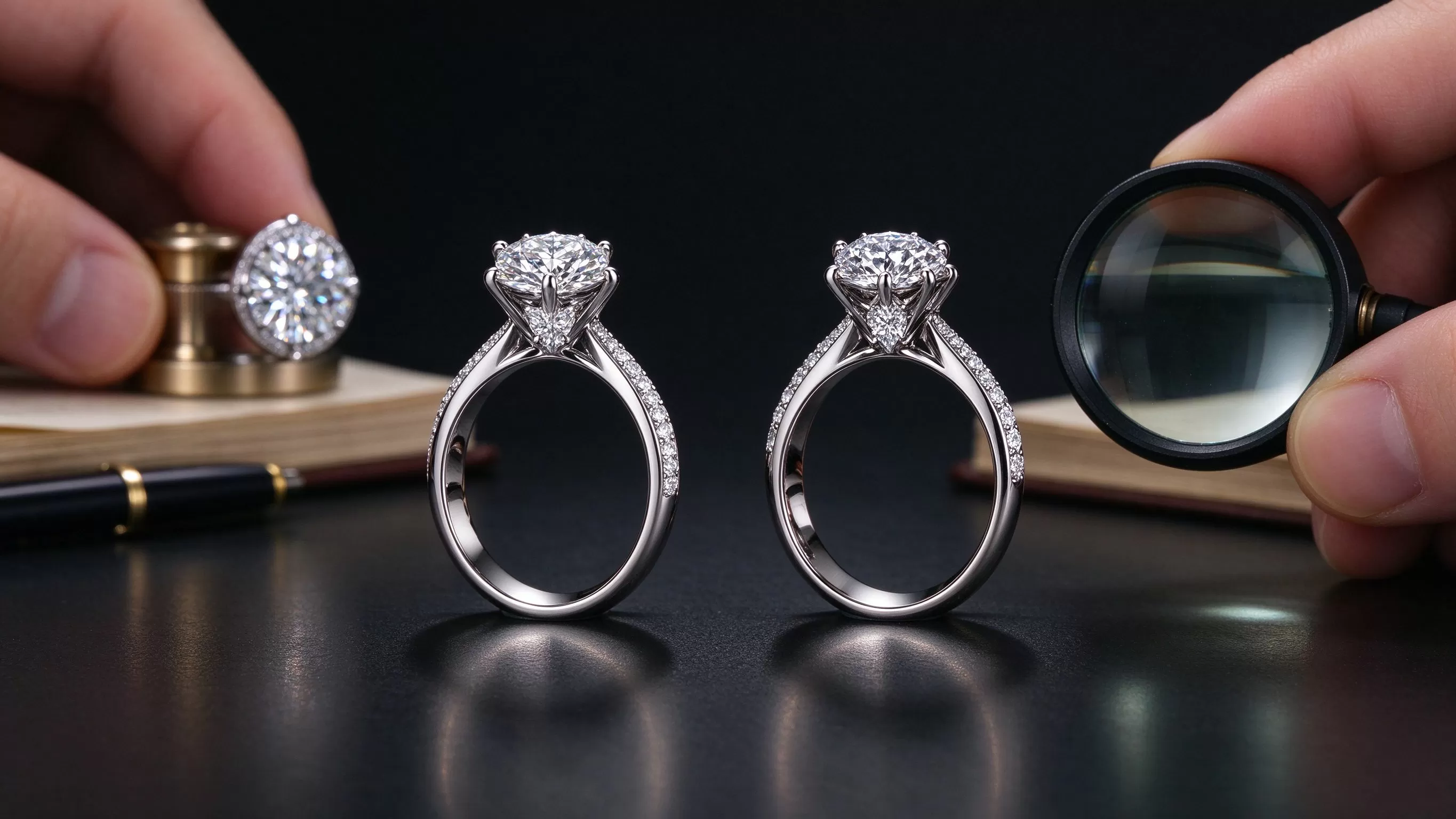
When you inspect either stone under a loupe, look for fractures reaching the surface, because those can deepen over time and weaken the setting. Aquamarine with a surface-reaching feather should be avoided in a ring. Blue topaz with a surface crack is even riskier because of its cleavage, so pass on it unless it is set in a fully protective bezel.
Carat Size and Price Structure
This is where the two stones diverge most sharply. Because aquamarine grows in large pegmatite crystals, a three-carat clean stone is not rare, and the price per carat climbs steadily rather than exponentially. Still, fine Santa Maria aquamarine above two carats with saturated color costs several hundred dollars per carat at retail, and exceptional material pushes into the thousands. Color is the price driver: a pale, greenish stone is cheap, while a vivid, moderately saturated blue is genuinely valuable.
Blue topaz is dramatically cheaper. A three-carat Swiss blue topaz in a retail setting often costs less than a tenth of a comparable aquamarine, and London blue, because it is slightly darker, can command a modest premium over Swiss. The treatment process is scalable, so supply is essentially unlimited. That makes topaz the practical choice for anyone who wants a large visible stone, especially in earrings or a pendant, without a budget conversation. If you want a ten-carat blue statement piece, aquamarine will cost a fortune, and topaz will cost a few hundred dollars.
One nuance for buyers who care about resale: aquamarine, especially untreated fine color, holds value better than treated topaz, which is essentially a commodity. Neither is an investment like a sapphire, but if you might one day sell or reset the stone, aquamarine is the more liquid choice. For wholesale buyers comparing margins, our article on natural versus treated gemstones explains how disclosure changes resale.
Treatments: What to Ask in Writing
Every responsible buyer should ask one question: "Is this stone treated, and will you put that on the invoice?" For blue topaz, the honest answer is almost always yes, the stone was irradiated and heated, and that treatment is stable. For aquamarine, the answer is usually that the color is natural, although very pale material is sometimes heat-treated to improve or remove greenish undertones. That heat treatment is stable and standard, but it should be disclosed.
Beware the seller who presents a deep, saturated "aquamarine" at a topaz price. Either the stone is topaz sold under a looser label, or it is a synthetic beryl. Conversely, do not overpay for a pale sky-blue topaz described as "rare natural blue topaz," because genuine natural blue topaz is uncommon and should be priced accordingly. A certificate from a recognized laboratory settles the species, and for colored stones that sit at the higher end of your budget, the small cost of a lab report is worth it. Our overview of gemstone treatments and certifications walks through what the reports disclose.
Which Flatters Which Skin Tone
Aquamarine's soft blue reads beautifully on cool skin tones, where it echoes the pink and blue undertones naturally present, and it also warms up nicely against rose gold for neutral and warm skin. Because the color is pale, it tends to complement rather than compete with a tan or a deeper complexion, which is why aquamarine bridal pieces remain popular for spring and summer weddings. It is less dramatic, but it is rarely unflattering.
Blue topaz, especially Swiss and London blue, is higher contrast and works hardest on deeper and warm skin tones, where the saturated blue creates a striking counterpoint. Pale skin can sometimes look washed out by a very dark London blue in a large size, so a lighter Swiss or sky blue balances the palette. In white gold or platinum, topaz's contrast effect is amplified; in yellow gold, the blue softens into a more vintage, 1970s palette.
Engagement Rings: The Practical Choice
If you are choosing one of these as an engagement ring, durability and upkeep matter more than color drama. Aquamarine at 7.5 to 8 with no cleavage is the more robust everyday stone, and its softer color reads as timeless rather than trendy. Many modern aquamarine engagement rings are set in rose gold with a diamond halo, a combination that photographs beautifully and costs a fraction of a same-size sapphire ring. Just choose a protective bezel or heavy prongs, and remove the ring for gym work.
Blue topaz is acceptable in an engagement ring for someone with a desk job and active hands that rarely take a beating, but its cleavage makes it a slightly riskier choice for a lifetime of ring wear. It shines instead in right-hand rings, pendants, and earrings, where a large Swiss blue stone looks luxurious and costs little. If you love the deep blue and want it on the finger, London blue topaz set in a sturdy bezel is the compromise. For more alternatives at this price point, our colored gemstone engagement guide compares the full field.
Buying Checklist: Aquamarine and Blue Topaz
- Decide what you want first: natural soft blue (aquamarine) or engineered saturated blue (topaz). Do not compare them as if they were substitutes.
- For aquamarine, favor moderately saturated blue with minimal green; reject stones that look pale or glassy indoors.
- For blue topaz, choose Sky, Swiss, or London blue by how bold you want the color, and confirm irradiation and heat treatment in writing.
- Check for surface-reaching fractures under a loupe, especially in any stone intended for a ring.
- Choose a protective setting for either stone in a ring, and remember topaz is the more cleavage-sensitive of the two.
- Match the metal to the color: white metals amplify topaz, rose and yellow gold soften aquamarine.
Frequently Asked Questions
Is aquamarine better than blue topaz? Aquamarine is harder, more valuable, and untreated in color, while blue topaz is cheaper, more saturated, and almost always irradiated. Pick aquamarine for value and a soft sea-blue, and topaz for a bold royal blue at a low price.
Can blue topaz be worn every day? Yes. At 8 on the Mohs scale it resists scratching well. Its only real weakness is perfect cleavage, so avoid sharp blows; earrings and pendants are ideal, and rings work with a protective setting.
Why is blue topaz so much cheaper than aquamarine? Raw topaz is common and the deep blue is produced industrially by irradiation and heating, so supply is cheap and scalable. Aquamarine is a rarer beryl whose natural blue color commands a premium.
Which looks best in white gold or platinum? Deep Swiss or London blue topaz contrasts strongly against white metals, while aquamarine's soft blue is warmer in rose or yellow gold.
Does irradiated blue topaz color fade? No. Modern irradiation and heat treatment produce a stable blue that does not fade in sunlight, though the treatment should still be disclosed on your invoice.
The Bottom Line
Aquamarine and blue topaz are not really competitors so much as two answers to the same wish: a beautiful blue gem that costs less than a sapphire. Aquamarine answers with a natural, soft, valuable stone that wears easily and holds up; blue topaz answers with a saturated, engineered, affordable stone that scales to statement sizes. Choose aquamarine if you want something timeless, untreated, and ring-friendly. Choose blue topaz if you want the deepest, brightest blue your budget will buy, especially in earrings, a pendant, or a right-hand ring. If you are still unsure, the safest move is to see both stones in natural daylight before deciding, because a photo cannot show how either one moves on your hand. We are based in Henggang, Longgang, Shenzhen, and we manufacture aquamarine and blue topaz set pieces in both sterling silver and gold. If you want a quote on a custom ring, pendant, or earrings, or advice on which blue suits your setting, write to us at service@holycome.com. More side-by-side comparisons live in our Comparisons library.