Assortment Planning for Wholesale Jewelry: Build a Product Line That Sells
Most new jewelry buyers fail not because their pieces are ugly, but because they buy the wrong mix. They fall in love with twenty beautiful styles, order them all, and end up with a few that sell out immediately and a pile that never moves. The difference between a healthy jewelry business and a stalled one is rarely taste; it is assortment planning, the deliberate construction of a product line with the right balance of price points, categories, and risk levels. A planned assortment converts your buying budget into sell-through, while an unplanned one converts it into dead stock on shelves. This guide explains how to plan a jewelry assortment that actually sells through.
Whether you run a boutique, an online shop, or a growing brand, the same principles apply. You need traffic drivers, profit drivers, trend pieces, and staples, all balanced against your capital and your customers. This is the business of wholesale jewelry buying, and it is far more learnable than people assume. Read on for the framework that turns a closet of unsold stock into a replenished, sell-through product line.
Why Assortment Matters More Than Any Single Piece
It is tempting to think that if each piece is beautiful, the whole line will sell. But a product line is a system, and the system's output depends on how the pieces relate to one another. A line of twenty equally expensive statement necklaces gives customers nothing to add on, and nobody buys. A line of cheap, interchangeable pieces gives you no margin and no reason to return. The assortment has to offer choices at different price points and roles, so a customer who comes for one item can find another that fits their budget. Assortment planning is the design of that menu. Our private label sourcing discussion assumes you already know the shape of that menu.
A well-planned assortment also makes the business easier to run. When you know which pieces are staples that reorder forever, which are seasonal trends, and which are loss-leader traffic drivers, you buy with purpose instead of guessing. You stop ordering emotionally every season and start restocking based on roles. That discipline turns jewelry buying from a series of risky gambles into a predictable operation. The buyers who survive and grow are the ones who manage the mix, not the ones who pick the prettiest items.
The Core Roles in a Jewelry Assortment
A healthy jewelry line is built from distinct roles. Traffic drivers are affordable, on-trend pieces that draw customers in and get them to buy their first item. They carry low margin but high volume, and they get people into the door or onto the page. Staples are the everyday pieces you reorder in the same styles forever: simple studs, thin bands, classic chains. They are reliable, low-risk, and form the backbone of sales. Profit drivers are the higher-price, higher-margin pieces that carry the business, and trend pieces are the seasonal novelties that keep the line feeling current. Our MOQ guide shows how these roles map to ordering quantities.
The mistake is putting all your budget into one role. A line of only staples never feels new and loses repeat customers to more exciting shops. A line of only trend pieces burns out every season and has no reliable baseline. A line of only profit drivers is too expensive for most foot traffic. The art is balancing them: staples as the base, traffic drivers to bring people in, trend pieces to refresh, and a smaller number of profit pieces to carry margin. Most successful jewelers run this mix deliberately, often roughly in proportion to what their customers spend. When you plan by role rather than by piece, the line starts to feel complete.
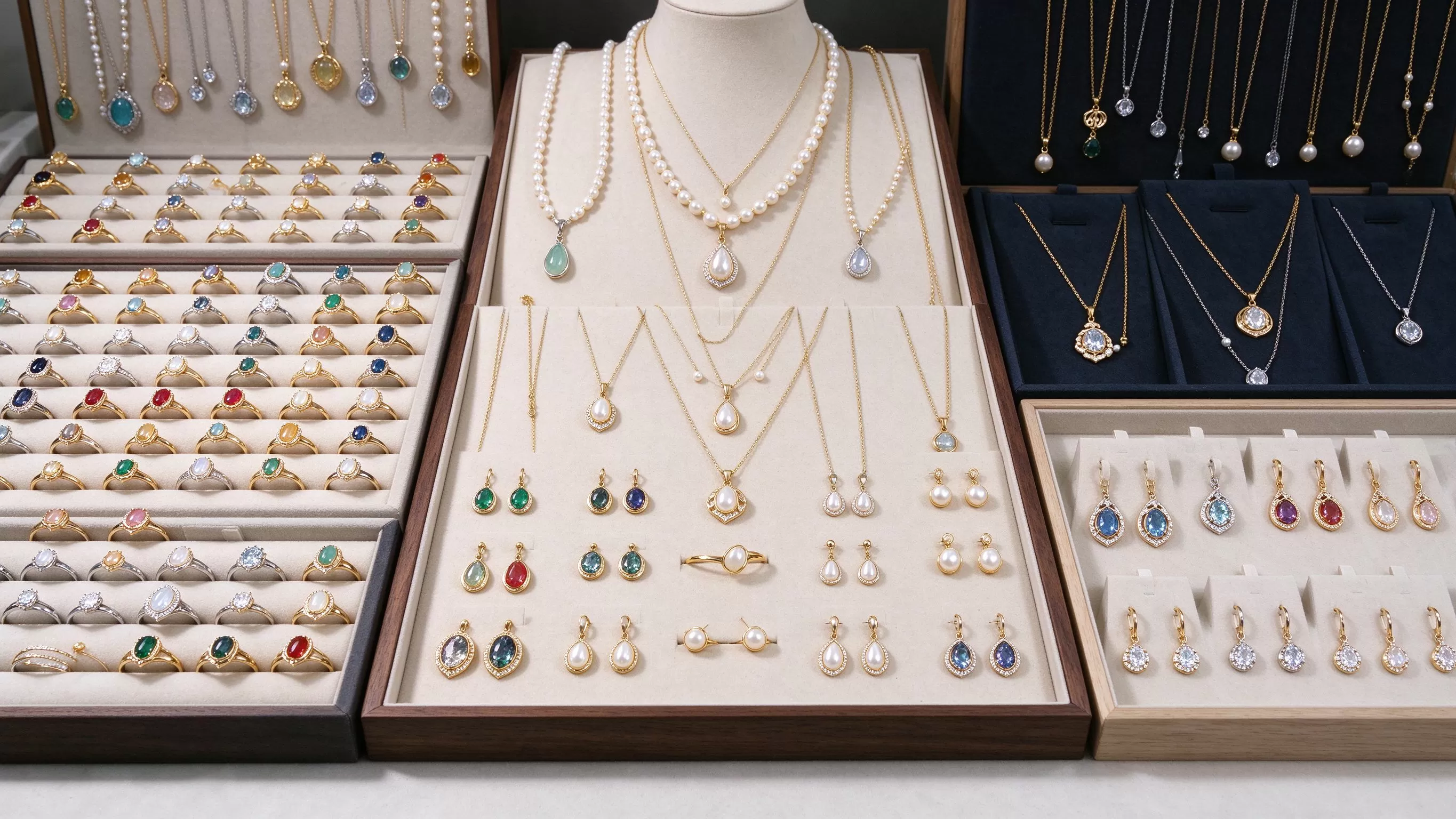
Price-point spread is the other half of the design. If everything in your shop is the same price, customers either all leave or all buy the cheapest. A deliberate spread, from an accessible entry point to a few statement pieces, lets customers trade up. A customer who comes for a stud at entry price may, if they like your taste, return for a pendant at mid-price. Without that ladder, there is nowhere for them to go. Plan your assortment as a price ladder, not a flat wall, and watch average order value rise. Our buying guides can help you price each tier realistically.
Right Sizing Your Risk
New buyers over-order on the pieces they personally love, which is usually the most expensive and least proven. The disciplined approach is to risk little on unproven styles and reinvest in what sells. Start trend and novelty pieces in small quantities, see how they move, and reorder the winners. Staples, because they are low-risk, can be held in deeper stock. This way, your capital follows actual sell-through rather than your taste. The sample order strategy is how you test styles before committing to depth.
The 80/20 rule dominates jewelry: a small number of styles drives most of your sales, and the rest are filler. Once you see which few styles reorder, concentrate your buying there and thin the slow ones. Resist the urge to keep slow pieces out of loyalty; they tie up capital and shelf space that your winners could use. A lean assortment of proven sellers outperforms a wide one with dead weight every time. The goal is not to carry everything, but to carry the right things deeply enough to never stock out on your bestsellers.
Seasonality matters too. Jewelry has clear seasonal peaks: gifting holidays, wedding season, summer for lighter pieces. Plan trend pieces to arrive before their season, and hold staples through the year. Buying a heavy winter piece in March is dead until next November. Map the calendar to your assortment, and time each role to when customers actually buy it. This planning turns inventory into seasonal money rather than stock that sits for half the year.
Planning the Mix Against Your Capital
Assortment planning is ultimately a capital allocation exercise. You have a fixed buying budget, and every dollar goes to a role. A useful starting split is a majority to staples and proven sellers, a smaller slice to traffic drivers, a modest slice to trend pieces, and a reserve for reordering what unexpectedly takes off. This keeps the business stable while leaving room to chase winners. The buyers who run out of cash mid-season usually put it all into a single risky bet instead of reserving for reorders. Our wholesale guides cover the cash flow side of this planning.
Do not confuse assortment width with depth. New buyers spread a thin budget across many styles at shallow quantities, so every bestseller stocks out immediately and every slow item is dead stock. It is usually better to carry fewer styles, but deeper on the ones that sell, and add new ones only as you prove them. A tight, well-stocked range beats a wide, half-stocked one. Customers buy what is available, and a bestseller that is out of stock is a lost sale and a lost customer. Plan for depth on your winners, and breadth only where it serves the mix.
Measuring Sell-Through So You Buy Smarter Next Season
Assortment planning is not a one-time decision; it is a loop measured by sell-through. Sell-through is the percentage of a style you actually sold in a period, and it tells you which roles are working. A staple that sells ninety percent should be reordered deeper. A trend piece that sold twenty percent should be cut next season. By tracking sell-through by style, not just total revenue, you turn guesswork into data. At the end of each season, sit down with the numbers: what sold, what sat, and why. The why matters, because a slow piece may be slow because it was badly placed rather than badly chosen. Our MOQ negotiation guide shows how sell-through justifies deeper reorders.
The most useful habit is to tag every style by its role when you buy it, then measure sell-through per role. If your traffic drivers do not actually drive volume, they are not doing their job. If your staples keep selling out, you are under-ordering them. If your profit pieces are ignored, the price ladder is wrong. This role-by-role measurement is what makes next season's plan better than this season's. Buyers who skip this step repeat the same mistakes every year, because they never connect what they bought to what sold. The data is the cheapest improvement you will ever make.
Avoiding the Common Assortment Traps
One trap is over-trending. Chasing every passing fad fills your shelves with pieces that date instantly and leave you with next season's unsellable stock. The fix is to keep trend pieces a small slice of the assortment, and to choose trends that adapt to your customers rather than jumping on whatever is viral. Another trap is brand confusion: carrying too many disjointed aesthetics so the shop feels like a random market stall. A coherent point of view, even within a range of price points, tells customers what your brand is. Narrowing the aesthetic usually improves sales, because people know what to expect from you. Our private label guide helps you sharpen that identity.
The third trap is emotional reordering: restocking a slow style because you love it, even though customers do not. Sell-through does not lie. If a style you adore sells poorly, it is worth keeping one or two for consistency, not deep stock. Similarly, do not cut a winner just because a new, exciting piece catches your eye. Protect your proven sellers and add new ones around them, rather than replacing winners with untested favorites. The discipline to follow the data instead of your heart is the hallmark of a professional buyer, and it is what keeps the assortment healthy year after year.
Treat each season as a lesson, not a verdict. Even slow styles teach you something about your customer, and the next assortment is built on what you learned. Over a few cycles, your range becomes a reflection of real demand rather than instinct.
Frequently Asked Questions
What is assortment planning in jewelry? It is deliberately designing your product line with the right balance of price points and roles: traffic drivers, staples, profit pieces, and seasonal trends. It ensures customers have options at every budget and your capital follows what actually sells.
What are the main roles in a jewelry line? Traffic drivers bring people in at low margin, staples are reliable everyday pieces you reorder forever, profit drivers carry your margin, and trend pieces refresh the line seasonally. A healthy assortment balances all four rather than betting on one.
How do I avoid buying dead stock? Order unproven trend pieces in small quantities, reorder what sells, and thin slow styles quickly. Let your capital follow real sell-through rather than personal preference, and reserve budget for reordering unexpected winners.
Should I carry many styles or a few stocked deeply? Fewer styles, stocked deeply on proven sellers, usually beats a wide shallow range. Bestsellers that stock out are lost sales, so depth on winners matters more than endless variety.
How does price point affect the assortment? Build a price ladder from an accessible entry point up to a few statement pieces, so customers can trade up. If everything costs the same, there is nowhere for customers to grow, and average order value stays low.
Plan the Mix, Then Let Sales Guide You
Assortment planning is the invisible discipline that separates profitable jewelers from those left holding unsold inventory. By balancing traffic drivers, staples, profit pieces, and trends, and by allocating capital to proven sellers rather than personal favorites, you turn a pile of pretty jewelry into a sell-through product line. Start small on new styles, go deep on winners, and refresh the trend slice each season. Over time, the line you build becomes self-replenishing. We help brands plan balanced assortments across price points, from affordable staples to statement pieces, and we support reorders so your bestsellers never stock out. If you want help designing a sell-through product line within your budget, write to service@holycome.com, and read more in our Wholesale Sourcing library.