Jewelry CAD Design and 3D Printing: From Digital Model to Castable Wax
Thirty years ago, a jewelry idea lived or died under a carver's graver. A designer sketched a ring on paper, a wax modeler carved the shape by hand in soft wax, and from that wax a caster pulled a metal one-off. Every tweak meant shaving away more wax, and once you cut too much you started over. The process was slow, silent, and heavily dependent on the hands of one or two artisans. Today that same journey begins on a monitor, and the wax arrives on a platform bed of a resin printer rather than under a blade. Jewelry CAD design and 3D printing have not replaced the bench, but they have quietly rebuilt the middle of the manufacturing process, and the shift explains why custom rings now arrive in two weeks instead of two months.
This guide walks through what actually happens between a customer's sketch and a castable wax, why factories invest heavily in CAD workstations, where the digital pipeline still relies on human judgment, and what buyers should ask a supplier about their design-to-casting workflow. Whether you run a brand that needs a new line each season or you are simply curious how a one-of-a-kind ring goes from a photograph of an idea to something you wear, understanding the CAD and 3D printing step removes most of the mystery from modern jewelry making.
How Jewelry CAD Changed the Bench
Computer-aided design in jewelry did not arrive all at once. Early programs in the 1990s were clunky, expensive, and limited to the largest Italian and New York workshops. They could model a simple solitaire but struggled with the undercuts, galleries, and hand-engraved details that make a piece feel crafted. For nearly a decade, CAD was a tool for high-production manufacturers, while independent designers kept carving wax by hand. The inflection point came around 2010, when specialized jewelry CAD packages matured and resin-based wax printers dropped in price from luxury industrial equipment to machines a mid-size factory could justify.
The effect was not that machines started making jewelry. The effect was that the most time-consuming and error-prone step, translating a flat idea into a three-dimensional wax, became editable. A designer who models a ring on screen can adjust the shoulder angle, widen the shank, and add a hidden halo in seconds, then re-print the wax without starting from scratch. That reverses the old economics: previously, each revision cost a day of hand work, so factories charged steep redesign fees and discouraged buyers from iterating. Now revisions are cheap, and the customer can approve a near-final 3D render before any metal is poured. For context on what happens after the wax exists, see our walkthrough of lost-wax investment casting.
The CAD Designer's Workflow: Sketch to Solid Model
A professional jewelry CAD session usually starts with reference material, not a blank screen. The designer gathers a hand sketch, a dimensioned reference ring, a stone list with exact measurements, and a mood board of finishes. Unlike industrial CAD, where parts are functional and dimension-driven, jewelry CAD is half sculpture and half engineering. The designer must make the ring look hand-finished while ensuring the final piece will actually cast, fit a customer's finger, and hold its stones under daily wear. Those two goals pull in opposite directions: beautiful organic curves rarely cast cleanly, and rigid geometric models often look cold.
The modeling itself builds the piece in layers that mirror how a jeweler would construct it. The shank, or ring band, is formed first and sized to the customer's millimeter. The head, where the stones sit, is built next, with prong positions measured against the exact diamond or gemstone dimensions so the seat matches. Galleries, undercarriage, and decorative rails come after, because they must support the head without adding weight where the ring touches the finger. A skilled operator can produce a detailed solitaire in a few hours, while an ornate bridal piece with pavé, milgrain, and hidden details may take two or three days. The final file is exported as a watertight mesh, the digital equivalent of a solid object that can be printed without holes or floating surfaces.
Buyers rarely see the model itself, but they see its output: a photorealistic render. A good factory presents the design from several angles, with the correct metal color and the actual gemstones the customer selected. This render is the approval document. Once the buyer signs off, the file goes to the printer. The discipline of approving a render before printing is what separates professional factories from shops that guess and cast, and it is worth confirming a supplier offers this step before you pay a deposit.
Wax Printing and the Bridge to Lost Wax
The printer itself is smaller than most buyers expect. Most jewelry shops use stereolithography or DLP machines, which cure thin layers of photopolymer resin under a light source, building the ring upside down on a movable platform layer by layer. The resulting object is not the dark green or red plastic people associate with hobby printers; it is a precise, slightly flexible resin pattern that behaves much like traditional carved wax during casting. Factories refer to it as "printed wax" even though the chemistry is resin, because it serves the same role in the foundry.
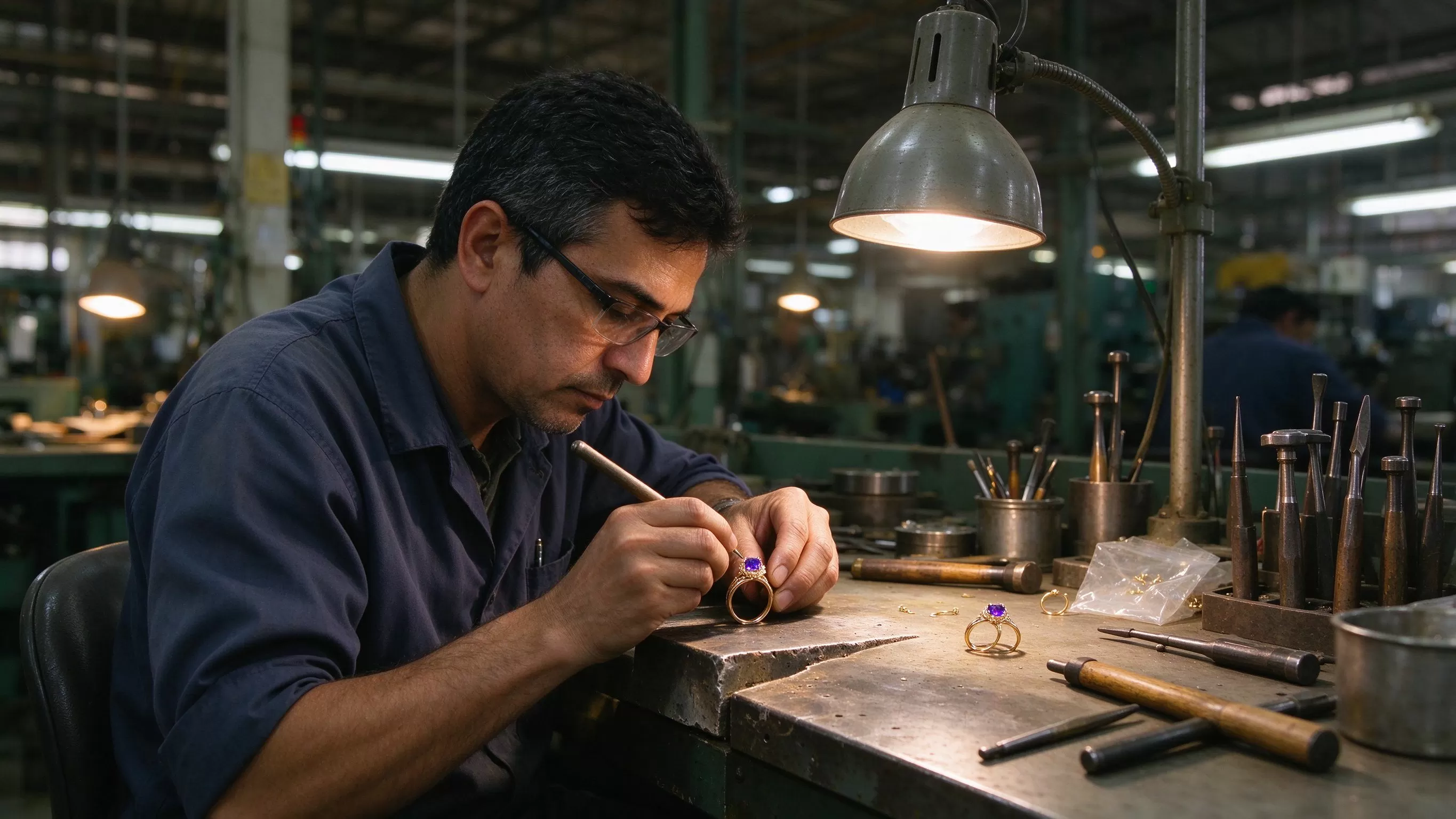
After printing, the support structures that held the delicate ring upright are removed, and the pattern is washed and cured. A caster then attaches dozens of these patterns to a central wax tree, encases the whole tree in plaster-like investment, burns out the resin in a kiln, and pours molten metal into the void left behind. The cast ring emerges as a rough metal shell covered in a thin layer of plaster and sprue remnants, which the bench jeweler then trims, files, and polishes. This is exactly the manufacturing sequence that has defined fine jewelry for a century; what changed is how the first positive model arrived on the tree.
Printed patterns have one advantage hand wax cannot match: repeatability. If a factory needs fifty of the same ring for a wholesale order, the digital file prints fifty identical patterns, so the resulting cast pieces differ only by the normal variation in hand finishing. Hand-carved versions of the same ring would drift noticeably from piece to piece, because each carver interprets the shape slightly differently. That consistency is the quiet reason mid-market brands moved to CAD: it lets them promise a reorder in six months will match the original sample.
Where CAD Beats Hand Carving
CAD wins on precision first. A digital model places each pavé seat to a fraction of a millimeter, so when the stones arrive, they drop in without reworking. Hand carving pavé seats is slow and depends on the carver's experience, and even excellent carvers occasionally misjudge a seat by enough that a stone sits crooked. CAD also captures symmetry effortlessly: a mirror-image left and right side of a ring is a one-click command, whereas carving two matching shoulders by hand is a test of patience. For bridal work, where a matched pair of bands must nest together, that symmetry is nearly impossible to achieve consistently by hand across a production run.
The second advantage is revision speed. A customer who wants the ring slightly taller, or the prong style changed, can be shown a new render in a day. In the old workflow, that request meant recarving the wax, which cost both time and money, so many buyers settled for a design they only partly loved. CAD turns jewelry design into an iterative conversation, and that is why engagement rings have grown dramatically more personalized in the last decade. The customer is no longer choosing from a case of pre-made molds; they are co-designing a model that gets refined until it is right.
The third advantage is file permanence. A hand-carved wax is a physical object that can break, burn out, or be lost. A CAD file lives in the cloud and on backup drives, and it can be reprinted at any time, in any metal, years after the original order. For a brand selling a signature design, this means a successful style can be reproduced forever without re-researching the geometry. That permanence reshapes how brands think about inventory: they hold digital files rather than physical molds, which costs almost nothing to store.
Where Human Hands Still Win
For all of CAD's precision, the final piece still passes through human fingers, and some jobs remain stubbornly hand-only. Deep hand engraving, the kind of fine script and scrollwork that covers an antique band, is extremely difficult to reproduce convincingly in CAD because the engraver's tool leaves a specific, slightly irregular undercut that software tends to smooth into a generic texture. Artisan brands that sell "hand-engraved" as a feature still keep an engraver on the bench, even when the base ring was printed and cast. The CAD model gets the geometry right; the engraver gives it soul.
Cast pieces also need a human to clean up. When metal comes out of the mold, it carries sprues, seams, and a matte cast surface that no render can predict exactly. A bench jeweler files the seams, smooths the prongs, and decides whether a piece should be high-polished, brushed, or hammered. The finish of a metal surface is chosen and executed by hand, and two operators polishing the same CAD-printed ring will produce subtly different results. Factories that understand this keep experienced finishers; factories that treat the bench as a cheap afterthought ship pieces that look computer-generated and flat.
There is also the matter of taste. A CAD operator can make a ring that is geometrically perfect but visually dull, because software rewards symmetry and smoothness while jewelry character often lives in deliberate asymmetry and texture. The best design teams pair a CAD modeler who understands geometry with an art director who understands proportion, and the back-and-forth between them is where a good design becomes a memorable one. Buyers should look at a supplier's portfolio, not just their machine list, to judge whether they have that artistic eye.
Cost, Lead Time, and What It Means for Buyers
CAD and printing have changed the price structure of custom jewelry in a way most buyers do not fully appreciate. The old model charged a high one-time carving fee, because hand carving was labor-intensive. The new model separates design from production: a CAD setup fee covers the digital model, and once that file exists, printing additional waxes is nearly free. For a single custom ring, the CAD fee is a modest fraction of the total, and the customer gets multiple revisions included. For a wholesale brand launching ten styles, the design cost is amortized across every reorder, which is why private-label lines have become so affordable to start.
Lead time is the more visible change. A fully custom ring today typically moves from approved render to cast, set, and polished piece in two to four weeks. Five years ago the same journey stretched to six to eight weeks, and a complex hand-carved commission could take three months. The compression comes almost entirely from the design and wax-making stage, where days of carving became hours of printing. The casting, stone setting, and polishing steps have not sped up dramatically, because those remain hands-on processes, but they no longer wait on a queue of hand-carved waxes.
For a buyer, the practical lesson is to use the revision window well. Because the render stage is cheap for the factory and free to you, ask for views from the side and back, ask to see the ring on a scaled hand, and request the exact stone measurements be overlaid. Catching a problem on screen costs nothing; catching it after casting means restarting the metal. A supplier that rushes you to approve a first render before you have lived with it is not saving you time; they are skipping the step that prevents expensive remake fees later.
Tolerances, File Hygiene, and Quality Control
The digital pipeline hides a trap that buyers rarely see. A CAD file that looks perfect on screen can fail in casting if it is not watertight, if its walls are too thin, or if it has unsupported overhangs that collapse during printing. Good factories run the file through a mesh-checking step before printing, healing any geometry errors and confirming the minimum wall thickness is realistic for the metal. Gold and silver shrink as they cool, and a modeler who ignores that shrinkage will produce a ring that casts too small. Experienced teams build shrink compensation into the file, which is one reason a cheaper shop can deliver a ring that does not match the approved render even though "the design was the same."
Stone seats are the other precision detail. A CAD operator measures the actual gemstone or diamond, not an assumed size, because a seat built for a 6.5 millimeter round will fail when the actual stone measures 6.7. Reputable factories request the physical stones or exact certified dimensions before finalizing the head. This is also where a supplier's quality control shows: the manufacturer QC checklist should verify that printed patterns match the approved render, that cast pieces match the wax, and that stones sit flush before final polishing. Skipping any one of those checks is how a "perfect CAD design" becomes a crooked finished ring.
File ownership matters for brands, too. When you pay for a custom design, ask who owns the CAD file. A transparent factory will hand over the production file, or at least guarantee they can reprint it for you on demand, rather than holding your design hostage and charging a new modeling fee every time you reorder. For a brand building a signature line, the file is your intellectual property, and securing it in writing prevents an awkward conversation six months later when a style takes off and you need to scale production.
Frequently Asked Questions
Is 3D printed jewelry lower quality than hand-carved jewelry? No. The wax or resin pattern is only the first step; the final metal piece is cast, set, and polished by hand exactly as a hand-carved piece would be. The difference is in how accurately the original shape is captured, and CAD printing is generally more repeatable than hand carving.
How long does the CAD design stage take? A simple solitaire can be modeled and rendered in one to two days. An ornate bridal piece with pavé, milgrain, or hidden details may take two to three days of modeling before the first render is ready for your approval.
Can I request revisions after seeing the 3D render? Yes, and you should. Reputable factories include several render revisions in the design fee because changing a digital file is cheap. Ask for side and back views and scaled-on-hand previews before approving the file for printing.
Does CAD work for custom pieces in gold or platinum? Yes. The printed pattern is burned out during investment casting regardless of the metal poured, so CAD works equally well for sterling silver, 14k or 18k gold, and platinum. Shrink compensation is adjusted per metal.
Who owns the CAD file after my order? This should be agreed in writing before production. A transparent manufacturer will let you keep or reorder from the file, rather than charging a full new modeling fee on every reorder.
Design the File, Then Trust the Bench
Jewelry CAD and 3D printing have not turned making jewelry into a button-pushing operation. What they have done is remove the slowest, least predictable step from the old workflow: hand-carving a wax that might not survive the casting. The digital model now carries precision and editability, while the bench still carries judgment, finishing, and craft. The best factories treat the two as partners, not replacements, and the finished ring shows it in the symmetry of the shank and the warmth of the polish. If you are developing a custom line or a single one-of-a-kind piece, the question to ask your manufacturer is not whether they use CAD, but how their designers and bench jewelers work together. We build custom CAD jewelry in our Shenzhen-area workshop, with render approval before casting and transparent file ownership, and we are happy to walk you through a design from sketch to finished ring. Reach our team at service@holycome.com, or explore more of our Industry Insights to understand how modern jewelry is made.