Moissanite vs White Sapphire: Which Diamond Alternative Wins?
You are standing in front of a case of colorless engagement rings, and two stones keep coming up: moissanite and white sapphire. Both are marketed as diamond alternatives, both cost a fraction of a diamond, and both look white from across the room. Up close, they are completely different stones. Moissanite flashes rainbow fire and stays brilliant forever, while white sapphire looks softer, whiter, and more subdued. The choice between them is not about which is better, but about which look and which tradeoff you actually want to live with.
This guide breaks the comparison down the way a gem lab and a jewelry factory would: what each stone is made of, how it handles light, how it wears over ten years, what it costs, and which setting suits each one. By the end you should know whether you want the intense sparkle of moissanite or the quiet milky white of white sapphire, and you should understand why a jeweler might steer you toward one based on your lifestyle and your budget. If you already know you want a diamond alternative but have not decided which, this is the comparison to read.
What Each Stone Actually Is
Moissanite is silicon carbide, a laboratory-grown crystal that does not occur in any meaningful quantity in nature. Every moissanite sold in jewelry is created in a controlled growth process, cut into gemstones, and graded for color and clarity. It was first discovered in a meteor crater, which is where the romantic story comes from, but commercial moissanite has always been a lab product. That origin is why it is so consistent: the color, clarity, and size you see are engineered, not hunted through rough.
White sapphire, by contrast, is corundum. Corundum is the same mineral that gives us ruby and blue sapphire, and white sapphire is simply corundum without the chromium or iron that produces color. It occurs naturally, and it is also grown in laboratories for jewelry. Natural white sapphire is usually slightly grey or milky rather than brilliant white, and lab-grown white sapphire is cleaner and brighter. The key difference to hold onto: moissanite is a man-made optical performer, while white sapphire is a natural gemstone family member that happens to be colorless.
That difference in origin sets up everything else. Moissanite is built to be optically dramatic, and white sapphire is a tough, traditional gem that happens to look understated. Our moissanite guide covers its full properties if you want the deep dive, and our sapphire guide does the same for the corundum family.
Brilliance and Fire: The Most Visible Difference
Look at the two stones side by side in bright light and the gap is immediate. Moissanite has a refractive index of about 2.65, higher than diamond at 2.42, which means light bends and bounces inside it more dramatically. That produces intense dispersion, the rainbow flashes that gem people call fire. A moissanite in a well-cut round will throw flashes of green, yellow, and red as it moves, and that is the quality people notice first when they see it in person.
White sapphire has a refractive index of about 1.77, which is lower than both diamond and moissanite. It returns light as a soft, gentle white glow rather than sharp sparkle, and it has almost no fire. Under the same lights, a white sapphire looks like a quiet, milky-white stone. It does not read as diamond to a trained eye, and it does not try to. The look is closer to a very clean moonstone or a frosted pearl, but in a hard faceted form. Some buyers love that softness; others feel it looks dull next to a diamond.
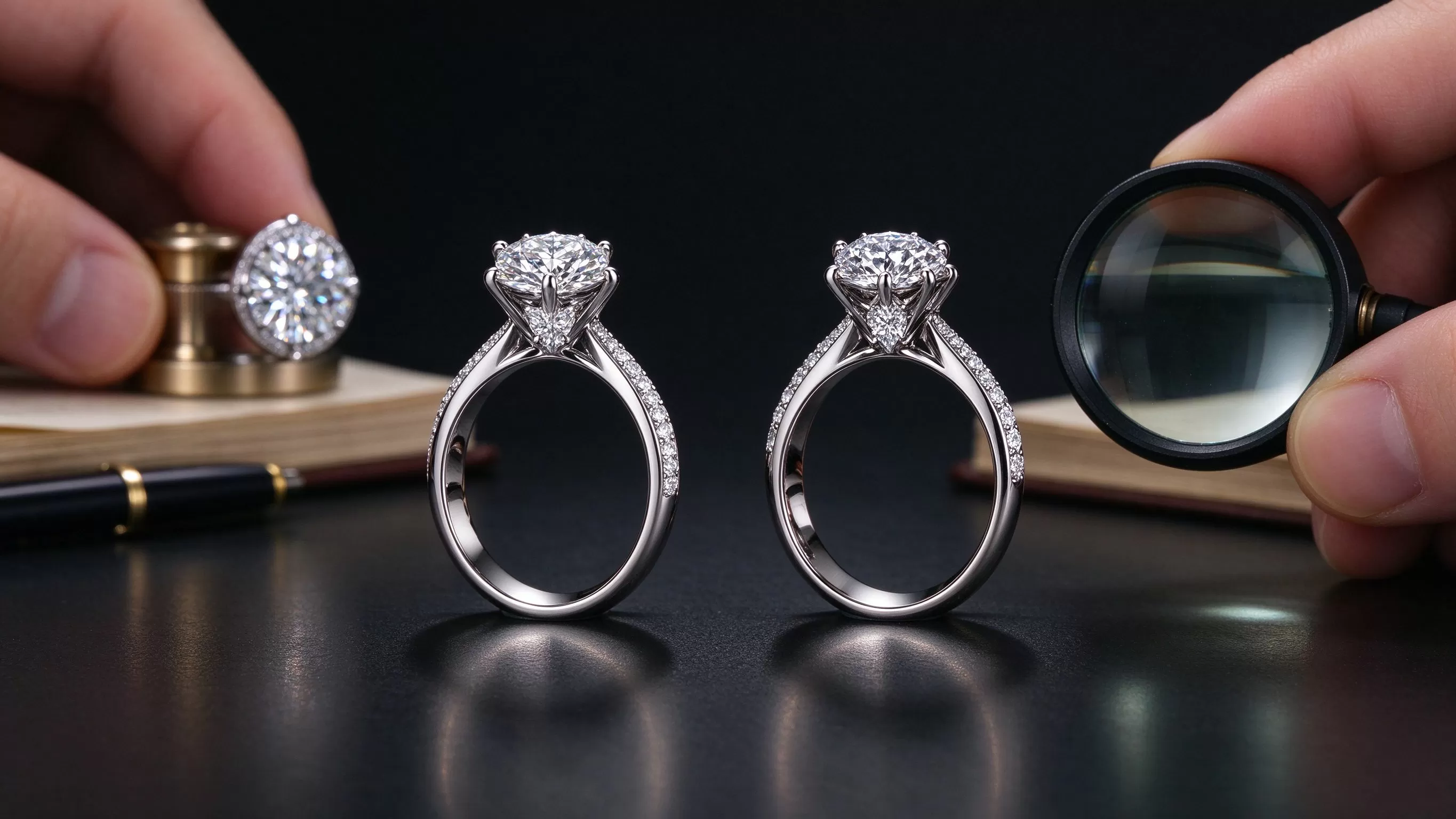
Here is the tradeoff in plain terms. If you want the stone to sparkle, catch light, and look unmistakably brilliant, moissanite wins by a wide margin. If you want a subtle, elegant white stone that does not compete with a diamond but still looks fine, white sapphire gives you that calm look. The mistake buyers make is expecting white sapphire to mimic moissanite; it will not, because it is optically not built to. For a fuller read on how moissanite light performs, see our moissanite vs diamond data comparison.
Hardness and Durability
Both stones are durable enough for an everyday ring, but they sit at different points on the Mohs scale. Moissanite ranks 9.25, which is below diamond at 10 but above almost everything else, including sapphire at 9. In practice the gap between 9 and 9.25 is small, and both stones resist scratching from normal office and city wear. You will not scratch either one by brushing against a counter or typing at a keyboard.
The durability differences show up in two subtler ways. Moissanite has a different cleavage pattern than corundum, and a sharp hard knock can chip it if the blow lands on a thin edge or corner, though it chips less easily than most colored gems. White sapphire is extremely tough, and it is one of the hardest-wearing gemstones in existence, which is why sapphires have been used in industrial abrasives. For a ring that takes a beating, white sapphire is slightly the safer bet.
| Property | Moissanite | White Sapphire |
|---|---|---|
| Mohs hardness | 9.25 | 9 |
| Refractive index | 2.65 | 1.77 |
| Fire / dispersion | Very high | Very low |
| Color look | Bright white with rainbow flashes | Soft milky white |
| Origin | Always lab-grown | Natural or lab-grown |
| Price at 1 ct | Low-moderate | Very low |
| Wear risk | Chips on sharp knocks | Extremely tough |
For either stone, the setting matters more than the stone when it comes to long-term survival. A bezel or a well-rounded prong arrangement protects the girdle, and a high exposed solitaire risks a chip on any hard knock. If you choose moissanite, ask the jeweler to round the prongs; if you choose white sapphire, you have a little more freedom because the stone itself is so tough.
Color: White, Off-White, and the Grey Question
Buyers shopping for a colorless stone want it to look white, and this is where the two stones behave differently. Moissanite is graded on its own color scale, and high-grade moissanite looks very white, though lower grades can carry a slight yellow or grey tint, especially visible through the pavilion in larger sizes. Reputable manufacturers sell near-colorless and colorless grades, and the premium for the whiter grade is modest.
White sapphire has a permanent color issue of its own: most natural white sapphire is not actually white, it is a very light grey or a milky grey. The truly colorless, brilliant white material usually comes from lab growth, or from very rare clean natural rough. If you buy a cheap natural white sapphire, you may get a stone that looks faintly grey under daylight, and that is not a flaw, it is how natural corundum behaves. Lab-grown white sapphire solves this and is much whiter, but at that point the stone is manufactured, just like moissanite.
The practical takeaway: if absolute whiteness is your goal, buy a graded near-colorless moissanite or a lab-grown white sapphire, not a cheap natural one. View the stone in natural daylight before you buy, because showroom bulbs flatter both stones. Our Mohs hardness scale guide and our sapphire color guide explain how color and hardness move through the corundum family.
Price: What Each One Costs
Both stones are dramatically cheaper than a diamond, but they sit at different price points. A one-carat, well-cut, near-colorless moissanite typically costs a few hundred dollars, and prices climb gently with size because large clean crystals are available. A three-carat moissanite ring is affordable for most people shopping engagement rings, which is one of its main selling points.
White sapphire is even cheaper. A one-carat white sapphire can cost under a hundred dollars, and larger sizes remain inexpensive because clean corundum rough is not rare. The tradeoff is that the low price comes with the softer look described above. You are not paying for sparkle; you are paying for a tough, traditional white stone. A white sapphire is the budget option that lets you spend more of your ring budget on the metal and the setting.
Where the price story changes is resale and perceived value. Neither stone commands diamond-level resale, and that is fine if you are buying to wear rather than to invest. Moissanite holds its cosmetic look for decades, so you are not throwing money away, but do not expect a trade-in value. White sapphire is so inexpensive that the question barely comes up. If resale or investment is part of your thinking, a genuine diamond is the only option in this comparison, and our lab diamond vs moissanite showdown covers that middle ground.
Setting and Metal Pairings
The two stones play differently with metals. Moissanite's rainbow fire looks best in white gold, platinum, or silver, because a cool metal background lets the flashes read clearly. Yellow gold can warm the fire and make it look a little too rainbow for some tastes, though that is a matter of preference. A halo setting suits moissanite extremely well, because the extra row of small stones amplifies the already high sparkle.
White sapphire looks its best in yellow or rose gold, where the warm metal complements the soft, milky white. A white sapphire in white metal can disappear a little, because there is no fire to separate it from the setting. Vintage and Art Deco style rings, with their detailed filigree and warm yellow gold, are a natural home for white sapphire. If you want a ring that looks inherited and quiet rather than bright and modern, white sapphire in yellow gold is the way to go.
For the setting style itself, both stones work in prong and bezel settings. Moissanite's durability lets it handle a pavé or halo setting with small side stones, and white sapphire's toughness means it can be set in a snug bezel without fear of chipping. The choice of setting should follow the look you want: bright and modern points to moissanite and a halo, soft and vintage points to white sapphire and a bezel.
Cleaning and Long-Term Care
Care for both stones is straightforward, because neither is fragile. Moissanite resists chemicals and heat extremely well, and you can clean it with warm soapy water and a soft brush, or even an ultrasonic machine if the setting is secure. The one thing that dulls moissanite is everyday oil and lotion film, which is why weekly cleaning restores its fire. Our moissanite ring cleaning guide walks through the exact routine.
White sapphire is equally easy to clean, and because it is corundum it shrugs off chemicals, heat, and ultrasonic cleaning without concern. The milky look that some people mistake for damage is usually just surface film, and a gentle wash brings it back. The only long-term note for white sapphire is that over decades the facet edges can soften from abrasion, and a jeweler can repolish the stone cheaply. Moissanite, being slightly harder, keeps its edges a little sharper over very long wear.
Storage follows the same rule for both: keep each piece in its own pouch so it does not scratch softer neighbors. Moissanite is hard enough to scratch gold, silver, and many other stones, so it should never tumble in a jewelry box with pearls, opals, or soft gems. White sapphire is nearly as hard and follows the same separation rule. Our gemstone storage guide has the full list.
Grading, Certification, and What to Ask For
Because both stones are cheaper than diamond, buyers sometimes assume certification does not matter, but it is still the easiest way to avoid a disappointing purchase. Moissanite is graded by the manufacturer on its own color and clarity scale, and reputable sellers include a certificate that states the carat, color grade, and cut. Ask for that document, and treat a seller who offers no paperwork as a warning sign. The grade tells you whether you are buying a colorless stone or a lower grade that will show tint, and it is worth the small premium to buy a graded piece.
White sapphire buyers should ask a different question: natural or lab-grown? Natural white sapphire comes with its own story and may carry a small certificate of origin, but most commercial white sapphire jewelry uses lab-grown material, which is cleaner and whiter. There is nothing wrong with lab-grown sapphire, but you should know what you are paying for. If a seller prices a white sapphire as if it were rare and natural, ask for documentation. Our guide to colored gemstone certificates explains what the papers actually mean for stones like these.
A practical buying habit: ask for the stone in writing. A short note on the invoice that states the species, whether it is natural or lab-grown, and the carat weight protects you long after the sale. Moissanite is always lab-grown, so the main check is its color grade. White sapphire needs the natural-versus-lab note. With both, a daylight photograph and a written description are worth more than any marketing claim, because the look of the stone is the entire product.
Ethics and Origin: The Conflict-Free Question
Ethics matter more to some buyers than others, but the two stones score differently here. Moissanite is 100 percent laboratory-grown, so there are no mining ethics attached to it at all. It does not rely on artisanal mining, remote labor conditions, or mine-to-market chains, and it uses far less water and land than any mined gem. For buyers who want a stone with no mining footprint, moissanite is the cleanest possible choice on this list.
White sapphire is more nuanced. Lab-grown white sapphire shares the same ethical advantages as moissanite, because it is grown rather than mined. Natural white sapphire, by contrast, comes from traditional mining, usually in places like Sri Lanka, Madagascar, or Thailand. Natural corundum mining can be done responsibly, and the Kimberley-style tracing that applies to colored stones has improved in recent years, but it is not automatically conflict-free in the way a lab stone is. If ethical sourcing is central to your decision, ask whether the sapphire is lab-grown or mined, and if mined, ask for the origin.
The environmental comparison also favors lab-grown material on both sides. Modern growth furnaces use a controlled amount of energy but avoid the digging, soil disturbance, and tailings that come with mining. Neither moissanite nor lab sapphire is zero-impact, but both are dramatically lighter on the earth than a mined diamond or a large mined colored stone. For a fuller picture of how mined and lab gems compare on footprint, see our sustainable jewelry manufacturing guide.
Who Should Choose Which?
Choose moissanite if you want the brightest possible stone, love visible sparkle, want a larger carat for your budget, and do not care that the stone is laboratory-grown. It is the right call for an engagement ring where you want the ring to stop conversations, and for anyone who likes the idea of a conflict-free, durable white stone that will never fade or yellow. It is also the better choice if you want a modern, halo, or solitaire look in white metal.
Choose white sapphire if you prefer a subtle, soft white look, want something that feels like a traditional gemstone rather than a diamond alternative, are on a tight ring budget, or love vintage and warm-gold styling. It is also the safer pick if you work with your hands and want a stone that is essentially indestructible. It will not flash like moissanite, and that is exactly the point for the buyers who love it.
A useful gut check: try both stones on in the same light, ideally daylight. If your eye is drawn to the flashing rainbow stone, you are a moissanite person. If you find yourself preferring the calm, soft white and thinking it looks elegant rather than flashy, you are a white sapphire person. Trust the reaction in natural light, not the showroom. Our engagement ring buying guide walks through the wider budget and style decisions around this choice.
Common Mistakes Buyers Make
The first mistake is buying white sapphire expecting it to look like diamond or moissanite. It will not, and returning it because it looks milky means you picked the wrong stone rather than the wrong piece. The second mistake is buying a cheap, lower-grade moissanite that carries a yellow tint, because that tint is most visible around the edges and is hard to live with. Always choose a colorless or near-colorless grade from a reputable maker.
The third mistake is ignoring the setting. A beautiful moissanite on a flimsy prong is a stone waiting to fall out, and a white sapphire hidden in a busy setting will disappear. The fourth is buying sight-unseen, because the look of both stones depends so heavily on the exact cut and grade. Ask for daylight photos, and if the seller will not provide them, walk away. Neither stone is expensive enough to justify a blind purchase.
Frequently Asked Questions
Is moissanite or white sapphire closer to a diamond? Visually, moissanite is closer in brilliance, though its rainbow fire is more intense than a diamond's. White sapphire looks softer and less sparkly, so it is the least diamond-like of the three. If diamond-like sparkle is the goal, moissanite is the closer look.
Can you tell moissanite from a diamond with the naked eye? Sometimes, because moissanite's fire is unusually strong. A trained jeweler can also spot the double refraction under a loupe. To an untrained eye at normal distance, a well-cut moissanite reads as a very bright white stone, and many people cannot tell the difference.
Is white sapphire a real gemstone? Yes. White sapphire is natural corundum, the same mineral family as ruby and blue sapphire. Lab-grown white sapphire is also sold, and it is cleaner and whiter than most natural material, but both are genuine sapphire rather than a simulacrum like cubic zirconia.
Do either stones fade or change color over time? No. Moissanite is chemically stable and will not fade, yellow, or cloud. White sapphire is corundum and is essentially inert. A stone that looks dull is dirty, not degraded, and a clean wash restores its look.
Choosing the Stone That Fits Your Hand
Moissanite and white sapphire both solve the same problem, an affordable white stone for a ring you wear every day, but they solve it in opposite directions. Moissanite gives you maximum sparkle and size for the money, in a modern, durable, laboratory-grown package. White sapphire gives you a quiet, tough, traditional white gem, especially beautiful in warm gold and vintage settings. There is no wrong answer, only the answer that matches how you want the ring to look and feel.
If you are deciding between a moissanite and a white sapphire ring, our factory can show you both stones in the same setting so you can compare them directly. We cut and set both stones for engagement rings, pendants, and studs, and we are happy to walk you through grades, sizes, and metal options. Write to us at service@holycome.com with the style and budget you have in mind, and explore more stone comparisons in our Comparisons library.