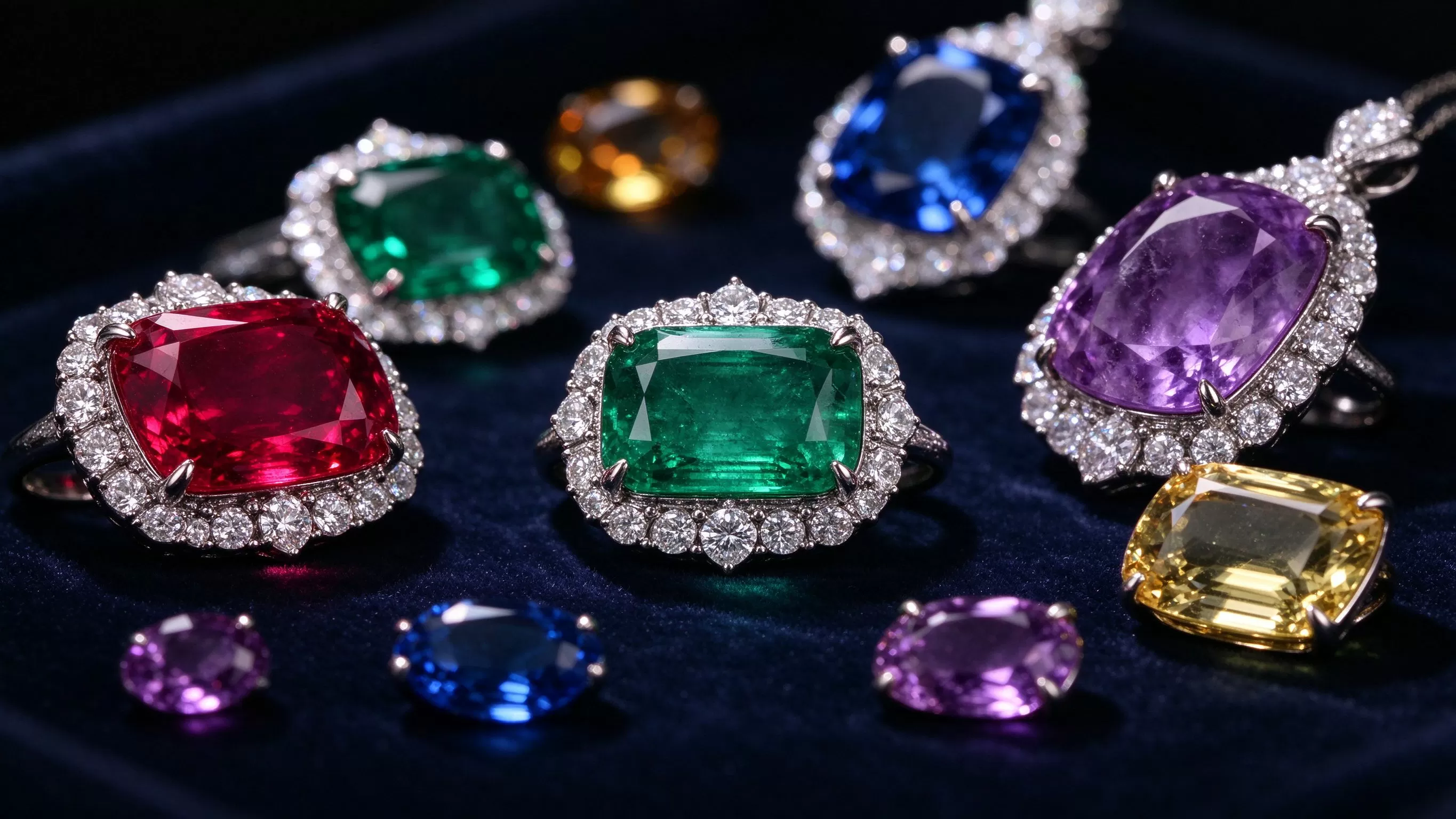
Two popular fancy shapes, cushion and radiant, look almost identical in a thumbnail. Both are square with cropped corners, both read white in a showroom, and both sit in bridal settings at overlapping price points. The difference buyers feel is light performance: how the stone throws brightness, fire, and scintillation across a room.
Facet structure decides the behavior
The cushion cut is a square or rectangle with softly rounded corners and typically 58-64 facets, often with a large open culet and chunky step-like crown facets. The radiant cut, introduced by Henry Grossbard in 1977, combines a stepped pavilion with a brilliant crown and runs 61-70 facets, including diagonal cross facets that break up light more aggressively. More small facets means more scintillation flashes; fewer large facets means broader blocks of color and brightness.
Brightness, fire, and scintillation
Radiants win on white brilliance and live movement. Under overhead light, a well-cut radiant flickers with small sharp flashes as the hand moves. Cushions win on fire — the rainbow color play — because the larger crown facets split light into broader spectral bands. In warm indoor lighting, a cushion looks romantic and soft; in cool store lighting, a radiant reads crisp and icy.
Cushions are also more forgiving of color: the rounded corners and chunky facets hide faint yellow body tint better than a radiant of the same grade, so buyers often drop a cushion from G to H color while keeping a radiant at D-F. Clarity matters more on radiants because the dense facet grid makes small inclusions visible.
Proportion targets
Trade cutters aim cushions at table 55-68%, depth 60-70%, with a slightly thick girdle to protect the soft corners. Radiants target table 62-70%, depth 60-68%, with crown angles around 34-36 degrees and pavilion angles around 40-41 degrees. A cushion deeper than 70% looks dark through the table; a radiant shallower than 59% looks glassy and flat. Cut-quality context is covered in our shapes guide, and color-grade trade-offs in the 4Cs reference. Cut geometry definitions follow GIA cut-grade documentation.
Setting styles that flatter each cut
Cushions pair best with halos or vintage bezels because the rounded corners soften into a continuous outline and the halo amplifies the fire. Radiants pair best with four-prong solitaire heads that expose the cropped corners; the corners are where most of the scintillation comes from, and covering them in a bezel wastes the cut. Pavé bands next to a cushion look romantic; pavé next to a radiant reads busy because the stone already throws enough small flashes. Wholesale buyers stocking both cuts should also stock two head styles, not one universal solitaire, or the stones will return looking "duller than the photo."
FAQ
Which cut looks bigger, cushion or radiant?
Radiants of the same carat usually face up larger because their table percent runs higher. Cushions look slightly smaller for the weight.
Which cut hides inclusions better?
Cushions hide color and small inclusions better; radiants show inclusions more because of the dense facet grid.
Are cushion and radiant cuts more expensive than round?
Both typically cost 10-25% less per carat than a round brilliant of the same grade, because rough utilization is higher.
Which is better for an engagement ring?
Radiant if the client wants crisp, lively brilliance; cushion if they want soft fire and a vintage feel.
Set expectations on the product page
Show two lifestyle shots per shape — one under warm light, one under cool overhead — so buyers see the actual light behavior. Mention that color grade can step down on cushions; that single note reduces returns. For wholesale sourcing, both shapes ship in calibrated lots; see moissanite shape availability for non-diamond programs.
Wholesale note: gemmanufacturer.com stocks cushion and radiant cuts in moissanite and lab-grown diamond, from 1.0 to 3.0 carats, MOQ from 10 pieces per shape/grade.
Retailers often ask which shape moves faster. In 2025-2026 bridal data, radiants outsell cushions roughly two to one in US markets because of the bright, modern sparkle; cushions hold stronger in vintage-inspired and Asian bridal markets where fire and a softer look sell. Stock the shape that matches your existing clientele rather than chasing the trend headline.
One buying tip: cushion cuts hide color so well that buying an H-I colored cushion often looks identical to an E-F radiant side by side. That single substitution saves 15-25% on loose cost without changing the face-up look.
Clarity is the opposite trade. A VS1 radiant shows small inclusions near the table that a VS1 cushion hides under chunky facets. Buy radiants at VS2-or-better; cushions can safely step down to SI1 eye-clean.
Proportion rule of thumb from cutters: a cushion with table 60% and depth 63% looks best; a radiant with table 65% and depth 61% looks best. Outside those bands, the stone loses 10-15% of its face-up price.