Diamond necklaces span a wider range of construction types than any other jewelry category—from a simple solitaire pendant on a lightweight cable chain to an 18-inch full-coverage tennis necklace with dozens of individually set stones, from dainty chokers to statement bib designs worn once to a black-tie event. That variety makes necklace manufacturing one of the most complex jewelry categories to source well: different constructions require different soldering, stone-setting, and clasp-security techniques, and the wrong chain or clasp choice on a heavy pendant will cause premature failure.
HOLYCOME manufactures diamond, lab-grown diamond, and moissanite necklaces across pendants, tennis necklaces, chains, chokers, rivières, station necklaces (Y-neck, By-the-Yard), and lariat designs from our Guangzhou factory (with chain production sourced from our partnered chain factory in Sihui, China's chain-making hub). This article walks through our necklace production capabilities, chain types and use cases, stone setting for different necklace constructions, clasp security, plating and finishing, MOQ, and OEM services.
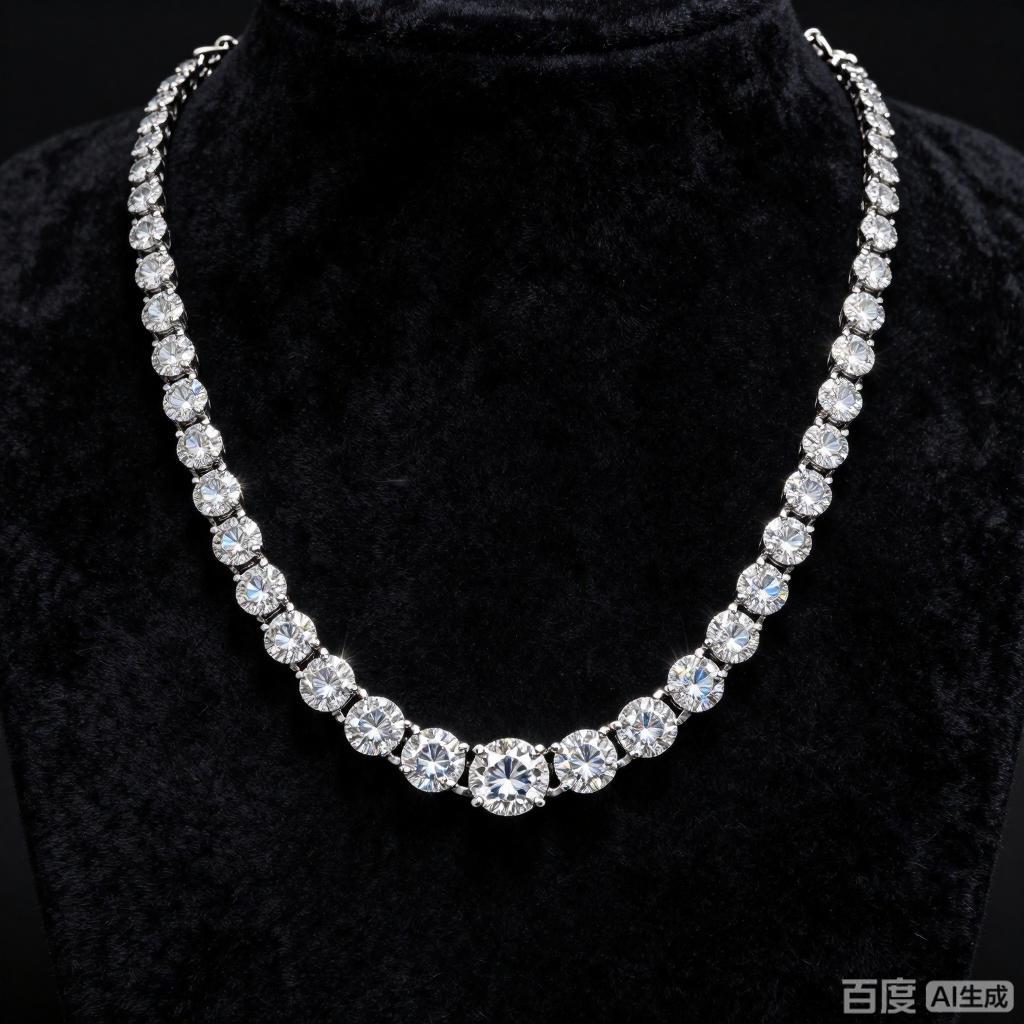
Necklace Types We Manufacture
Our necklace production covers seven major categories:
- Solitaire pendants: Single-stone pendants (prong-set or bezel-set) on a chain. The most-produced necklace SKU. Sizes from 3mm (0.10ct) to 12mm (5ct+ equivalent) in round, oval, cushion, emerald, pear, princess, heart, and marquise.
- Halo pendants: Center stone surrounded by a halo of small melee stones. Often paired with a small bail set with additional diamonds.
- Tennis necklaces (rivières): Continuous line of individually set stones (rounds in 4-prong or channel) running the length of the necklace, from 16 to 20 inches. Available in uniform stone size (3mm, 4mm, 5mm most popular) or graduated (larger at center, smaller toward clasp).
- Station necklaces: Stones set at intervals along a chain ("By the Yard" style, station pendants, Y-neck lariats). Stations can be single stones, halos, or clusters.
- Chokers and rivières: Tight-fitting necklaces 14–16 inches, worn high on the neck, with stones across the full front (choker rivières) or as a single front panel (bib/panel chokers).
- Nameplate/initial pendants: Personalized letter pendants, name necklaces, block letter and script styles, often set with small stones on the letter face.
- Chains (sold alone): Cable, curb/cuban, rope, box, figaro, snake, herringbone, mariner, popcorn, wheat, franco—from 0.8mm ultra-light to 8mm heavy, in silver and gold.
Chain Types and Their Applications
Selecting the right chain for a pendant is more than a stylistic decision—it is a structural decision. A chain that is too thin will break under a heavy pendant; a chain that is too heavy overwhelms a small pendant. The wrong chain style can kink, snap, or wear prematurely where it passes through the pendant bail.
| Chain type | Construction | Strength | Kink resistance | Best for |
|---|---|---|---|---|
| Cable | Simple oval links, uniform size | Good | Good | Everyday pendants up to 3g; versatile, classic |
| Rolo / belcher | Round or oval links, thicker than cable | Good | Good | Pendants 2–5g; chunkier casual look |
| Curb / cuban | Interlocked flattened links | Very strong | Excellent | Heavier pendants 5g+, standalone chains, men's |
| Box (Venetian) | Square links from flat wire folded into boxes | Good | Poor (kinks permanently if bent) | Light pendants; smooth, modern look (avoid heavy pendants) |
| Snake | Tightly joined curved plates forming flexible tube | Medium | Poor (kinks easily) | Dainty pendants; wear-with-care; avoid heavy stones |
| Rope | Multiple strands twisted into rope pattern | Very strong | Good | Heavy pendants 5g+, standalone chains |
| Figaro | Alternating small round links and larger elongated links | Good | Good | Mediterranean/Italian style; pendants up to 4g |
| Mariner / anchor | Oval links with horizontal bar (anchor shape) | Strong | Good | Nautical look; pendants up to 5g |
| Franco | V-shaped four-sided curb, tight weave | Very strong | Excellent | Heavy pendants, men's pendants; most durable chain style |
| Wheat / spiga | Four strands braided into wheat-shape | Very strong | Excellent | Mid-weight pendants, standalone chains |
| Popcorn / coreana | Puffed rounded links with stretch | Medium | Medium (stretches over time) | Light fashion pendants; affordable sparkle |
| Herringbone | Flat V-shaped snake chain | Poor | Poor (kinks very easily) | Standalone choker; not for pendants; wear-with-care |
Chain Gauge (Thickness) Guidelines
For pendant chains, the chain thickness must be rated to the pendant weight:
- Pendants under 1g (small solitaires under 0.25ct): chains 0.8–1.0mm (cable, box, snake)
- Pendants 1–3g (solitaires 0.25–1ct, small halos): chains 1.0–1.3mm (cable, curb, rolo)
- Pendants 3–5g (halos 0.5–1ct, medium pendants): chains 1.3–1.8mm (curb, rolo, figaro)
- Pendants 5–10g (large halos 1–3ct, heavier settings): chains 1.8–2.5mm (curb, rope, franco)
- Pendants over 10g (statement pendants, large stone settings 3ct+): chains 2.5mm+ (cuban curb, rope, franco, wheat)
We specify minimum chain gauges per pendant at the quoting stage and refuse orders where customers request chains too thin for the pendant weight—because such orders generate disproportionate warranty returns.
Pendant Manufacturing: From CAD to Finished Piece
1. CAD and Bail Design
Pendant CADs share design principles with rings and earrings, but one component makes or breaks a pendant: the bail (the loop that slides onto the chain). Bail specifications:
- Bail inner diameter: Must accommodate the target chain thickness plus a small clearance—we size bails 0.5–1.0mm larger than the maximum chain thickness the pendant is intended for. A bail too small prevents the chain from passing through; a bail too large lets the pendant flop forward on the neck.
- Bail style: Fixed bail (soldered directly to pendant top, most secure), hidden bail (set behind the pendant for cleaner look, suitable for pendants under 8g), snap/detachable bail (allows pendant to be removed from chain for chain changes, slightly less secure over time), enhancer bail (hinged bail that clips over beads/pearl necklaces).
- Bail strength: Bail wire thickness of minimum 0.8mm for pendants under 3g, 1.0mm for 3–8g, 1.2mm+ for over 8g.
2. Casting, Assembly, and Stone Setting
Pendants are cast via the same lost-wax investment casting process used for rings and earrings, with casting orientation chosen to minimize porosity at the bail-pendant junction (the highest-stress point in a pendant). After casting, sprue removal, and pre-polish:
- The bail is soldered or laser-welded to the pendant body. For premium gold pieces and all pendants over 5g, we use laser welding (rather than torch soldering) for bail attachment to eliminate fire-scale and produce a stronger joint.
- Center stone and any halo/accent stones are set in the same setting styles as rings (prong, bezel, pavé, channel). Pendants receive the same stone-tightness testing as rings—pull-tested with a stone pusher before finishing.
- For halo pendants, melee stones are hand-set (for premium pieces) or machine-set (for volume production in silver) and tested for tightness individually.
3. Chain Assembly and Soldering
Most chain is purchased in bulk from chain manufacturers (Sihui in Guangdong province is China's primary chain production hub, producing over 70% of jewelry chain used globally). We receive bulk chain in spools and process it in-house:
- Chain is cut to length (16", 18", 20", 22", 24" standard for necklaces; chokers 14–16") with heavy-duty shear cutters.
- Clasp is attached to one end via a jump ring or soldered connector; a tag (with hallmark and brand stamp) is attached to the other end near the clasp.
- Jump rings connecting clasp to chain are soldered closed (not just pressed together) for pendants over 5g and all gold pieces. Unsoldered jump rings can open under load, dropping the pendant.
- For chains sold without pendants, a clasp and tag are attached and both ends are soldered closed.
4. Clasp Selection and Security
Clasp failure is the most common necklace warranty claim. We offer seven clasp types:
| Clasp type | Description | Security | Best for |
|---|---|---|---|
| Spring ring | Circular spring-loaded ring with trigger | Fair (small spring can weaken over time) | Light chains under 3g; budget price points |
| Lobster claw | Larger claw-shaped clasp with spring trigger | Good (stronger spring, bigger opening) | Most chains 2–10g; our default for silver production |
| Box clasp with safety | Tab slides into a box with a figure-8 safety latch | Very high | Tennis necklaces, heavy chains 10g+ |
| Fishhook / pearl clasp | Hook inserts into a figure-8 safety | Good | Pearl strands, delicate necklaces |
| Toggle | Bar slides through ring | Fair (can come undone if tugged) | Fashion pieces; not for high-value |
| Magnetic | Magnetic clasp closure | Fair (can release under load or near other magnets) | Fashion necklaces; arthritis-friendly |
| Barrel / screw | Two ends screw together | High | Mid-weight chains; secure but slightly slower to fasten |
Our default clasp policy: lobster claw for silver chains under 5g; box clasp with figure-8 safety for all gold chains, all tennis necklaces, and all pieces with stone value over $100 wholesale. We refuse to ship high-value necklaces (tennis necklaces with over 5ct total stone weight) on spring rings or toggles.
All clasps are tug-tested after assembly (3kg horizontal pull for 5 seconds) to confirm they do not open or detach.
Tennis Necklace Specifics
Tennis necklaces deserve special mention because they are the most technically demanding necklace construction. A 4mm 18-inch tennis necklace contains approximately 110–130 stones, each individually set. Quality failures on tennis necklaces are costly: if one stone falls out, the entire necklace needs re-setting, and a single missing stone in a continuous line is immediately visible.
Our tennis necklace production standards:
- Stones matched for size (within ±0.02mm), color (same grade), and clarity (within one grade) across the entire necklace.
- Setting: 4-prong (classic look, maximum light) or channel (smoother, more secure for active wear). Shared-prong (two stones share each prong) is available but less secure than independent 4-prong.
- Links between settings are flexible (snap-down or articulated links) so the necklace drapes naturally rather than sitting stiff.
- Box clasp with two figure-8 safety latches as standard.
- Optional extender chain (1–2 inch) to adjust length.
Production time for tennis necklaces is 25–40 days depending on metal and stone size (18–28 days for silver with moissanite/lab-grown melee; 30–45 days for gold).
Plating, Polishing, and Quality Control
Necklaces receive the same polishing and plating process as other jewelry categories, with special attention to:
- Chain polishing: Bulk chains are barrel-polished before cutting to reach a uniform finish; after assembly, clasps and soldered areas are hand-polished and the full chain is re-polished to a uniform luster.
- Plating: Rhodium plating for white gold and silver; e-coat anti-tarnish on silver chains (adds 6–12 months of tarnish resistance vs. non-coated silver). Chain links must be free to move after plating—over-plating in gaps between links makes chains stiff.
- Chain flexibility test: After plating, chains are flexed through their full range of motion to confirm plating has not locked links together.
Final QC check for necklaces includes:
- Stone tightness (every stone checked with a pusher, especially on tennis necklaces and halos).
- Chain pull-test (5kg pull for 5 seconds on the entire chain to confirm no link opens).
- Clasp function (opens and closes properly, safety latches engage, tug-test on closed clasp).
- Soldered joint inspection (jump rings, bail attachment, clasp connectors).
- Length verification (measured laid flat, ±6mm tolerance).
- Kink check (chain runs freely through fingers without catching or kinking).
- Pair matching (for earring-necklace sets or bracelet-necklace sets).
MOQ and Lead Times
| Order type | MOQ | Lead time |
|---|---|---|
| Sample pendants | 1 piece | 7–14 days |
| Sample chains (no pendant) | 1 piece | 3–7 days (stock chains) |
| Stock pendants (sterling silver) | 2 per SKU / $500 total | 10–18 days |
| Stock pendants (gold) | 10 per SKU / $3,000 total | 18–28 days |
| Tennis necklaces (silver) | 3 pieces per length/size | 18–28 days |
| Tennis necklaces (gold) | 5 pieces per length/size | 28–40 days |
| Custom OEM pendants | 30 per SKU (silver), 50 per SKU (gold) | 25–40 days |
| Bulk chains (plain, no pendant) | 10 pieces per style/length | 7–14 days |
| Nameplate/initial necklaces (custom engraved) | 10 per design (silver), 20 per design (gold) | 18–28 days |
FAQ
What length necklace should I stock as standard?
For women's pendants in the US market, 18 inches is the standard "princess" length (falls at the collarbone on most women) and should be your default SKU. 16 inches (choker/short, falls high on collarbone) and 20 inches (matinee, falls below collarbone) are secondary stock lengths. For men's pendants, 22–24 inches is standard.
What is the strongest chain type for heavy pendants?
Franco chains (four-sided V-shaped curb) and cuban curb chains are the strongest chain constructions, because the interlocking link pattern distributes tension across multiple link faces. For pendants over 10g, we recommend 2.5mm+ franco or cuban in gold, or 3mm+ in silver. Herringbone and box chains should never be used for heavy pendants.
Do tennis necklaces lay flat or flip on the neck?
Properly constructed tennis necklaces with articulated (flexible) links between settings lay flat against the neck when sized correctly. Stiff one-piece tennis necklaces flip and twist; we use individual articulated settings for all our tennis necklaces above 3mm stone size to prevent flipping. For necklaces with larger stones (5mm+), we also add a slight weight differential (slightly heavier back section near the clasp) to keep the front centered.
Can I order pendant-only (no chain) for pendants my customers will pair with their own chains?
Yes. Pendants can be ordered without chains at reduced pricing. Bail size should be specified (default inner diameter is 3.5mm, which fits most chains up to 2.5mm thick).
How do you prevent chain tarnish on sterling silver necklaces?
All our silver chains receive e-coat (electrophoretic anti-tarnish coating) after rhodium plating, providing 6–12 months of tarnish resistance under normal wear. We also ship silver necklaces in anti-tarnish poly bags to prevent oxidation during warehouse storage. Even with these protections, sterling silver will eventually tarnish with exposure to air and sulfur; we include a silver polishing cloth with every silver jewelry order for end customers.
Can you produce matching necklace-bracelet-earring sets (parures)?
Yes. We produce matching tennis sets (tennis necklace + tennis bracelet + stud earrings in the same stone size), pendant sets (pendant necklace + matching drop earrings + matching ring), and bridal sets. Set orders receive priority matching—stones are pulled from the same production batch to guarantee color and clarity consistency across all three pieces.
Necklaces are the category where structural choices (chain type, chain thickness, clasp, bail strength) most directly determine how long a piece lasts in the real world. A beautiful pendant on a chain that is too thin or a clasp that pops open becomes a warranty claim and a disappointed customer. Our approach is to specify chain and clasp conservatively, to solder every high-stress connection, to pull-test every chain and clasp, and to ship necklaces that can hold up to daily wear—not just photography. Contact our necklace manufacturing team for catalogs, pricing, or to discuss custom pendant or tennis necklace designs.
For background on how lab-grown diamonds are produced, the Wikipedia article on synthetic diamonds explains the HPHT and CVD growth methods.
Related reading: Diamond Tennis Necklace Manufacturer QC Guide, Pendant Necklace Buying Guide: Chain Length, Bail and Stone Shape, Diamond Tennis Bracelet Manufacturer QC Guide.