A Shopify accessories brand asked us last quarter whether to swap their cubic zirconia studs over to moissanite. The two stones look alike in a photo and both sit well below diamond on price. Twelve months later their buy-back rate told the real story: the CZ wall turned over four times a year, the moissanite wall turned over once, and the return rate on the moissanite studs was twice as high because customers expected diamond-level brilliance at diamond-level lighting.
What the two stones are
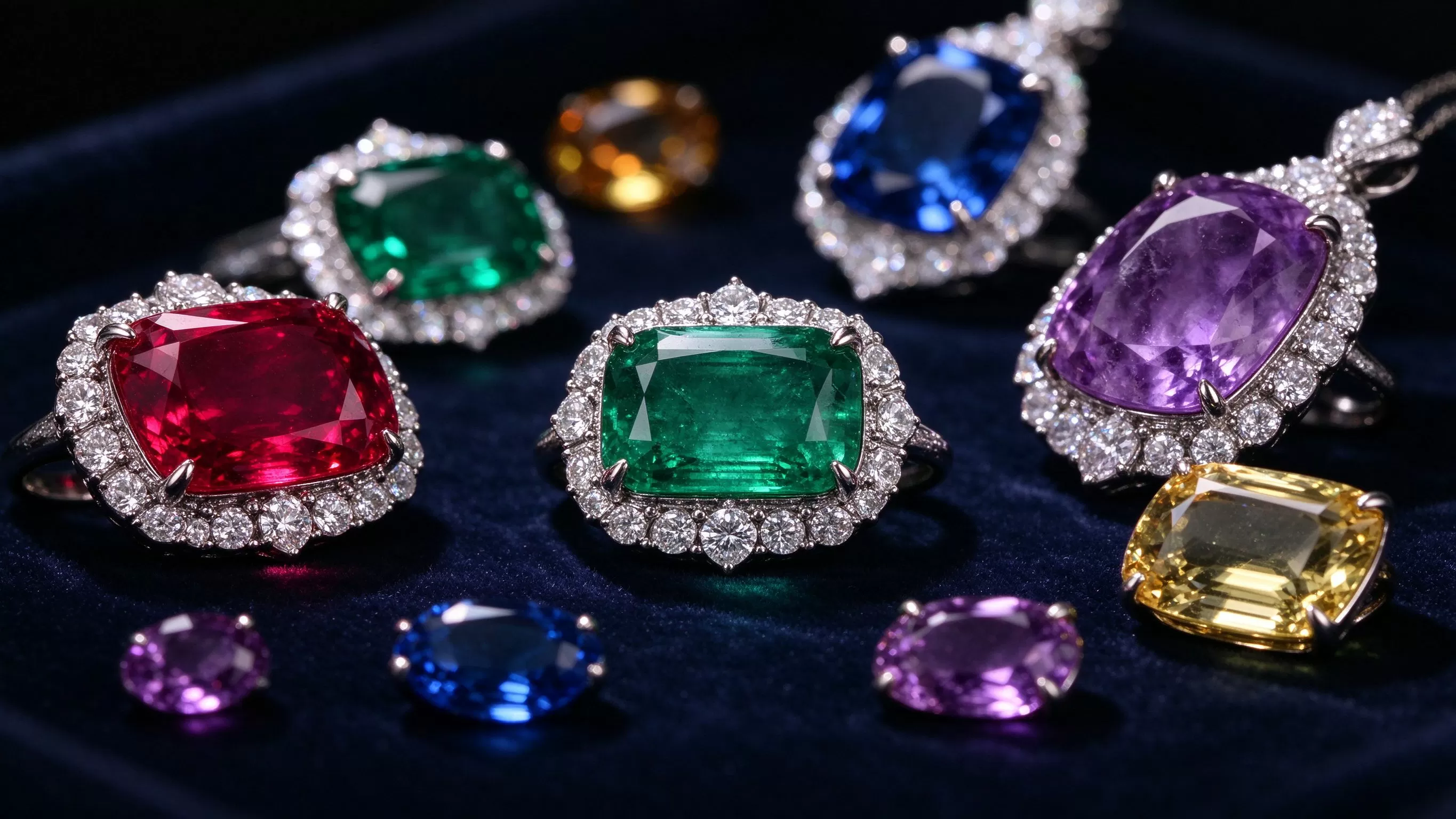
Moissanite is silicon carbide, produced in a controlled growth process and graded on its own cut standards because its double refraction makes the GIA 4C framework read differently. Its refractive index of about 2.65 to 2.69 gives it more fire (rainbow flash) than diamond. Cubic zirconia is a crystalline zirconium oxide, doped with stabilizers, and it is the most produced simulant on earth. Its refractive index is about 2.15 to 2.18, lower than moissanite, and its Mohs hardness of 8 versus moissanite's 9 means it scratches faster. The technical baseline is summarized on the moissanite reference.
Wholesale cost per carat: the margin gap
A 6.5 mm calibrated moissanite (roughly equivalent to a 1 carat diamond) typically lands in the $12 to $35 wholesale band for loose stones depending on cut grade and origin certificate. The same size CZ lands at $0.40 to $2.00 per piece. At retail, a CZ stud set sells for $19 to $49; a moissanite stud set sells for $199 to $499. That is the difference between a loss-leader wall and a margin wall, and it dictates where each stone lives in the store. CZ belongs in the impulse earring tray and the page-one price point. Moissanite belongs in the case with the solitaire settings and the certificate sleeve. Compare the cut and fire angle in CZ versus moissanite cut cost and fire, and the side-by-side buyer framing in moissanite versus CZ side by side.
Return rate and the lighting problem
Moissanite reads very differently under different light sources. Under cool white LED display strips it looks icy and bright; under warm incandescent it reads slightly yellow and the double refraction gives the pavilion a soft "look-through" that some customers mistake for a flaw. CZ is more forgiving because its lower fire means it looks the same in home lighting as it did in the case. The practical fix for a retailer is to light the moissanite case at 5500K daylight and to photograph moissanite listings under the same temperature. Do not display CZ and moissanite on the same pendant hook, because the customer will compare fire and blame the cheaper stone.
Stocking recommendation
A balanced program for a mid-size store: 60% of the lookalike wall in CZ studs, hoops and pendant drops for $19 to $79 retail; 30% in moissanite solitaires and three-stone rings for $299 to $899 retail, each with a printed origin certificate; 10% in moissanite wedding bands that pair with the solitaire settings. Tie the display lighting and cleaning rules to moissanite ultrasonic and steam safety, and price the program against the per-carat trade method in loose gemstone pricing per carat.
Is moissanite a good diamond alternative?
Yes for customers who want fire and durability below the diamond ticket. It is not a diamond lookalike under direct light; the rainbow flash is the giveaway, and that is a feature, not a flaw.
Will CZ stones cloud over time?
Lower-cost CZ can scratch and cloud after 6 to 18 months of daily wear because of its Mohs 8 hardness. Higher-end hand-finished CZ holds up longer but still scratches faster than moissanite.
Do I need a certificate with moissanite?
Retail buyers expect one. Supply the origin and growth report from the manufacturer, and do not call it a diamond certificate; describe it as a moissanite grading note.
Which is better for a fast-turnover earring wall?
CZ. The wholesale unit cost is low enough to absorb returns, and the $19 to $49 price point moves without sales-floor explanation.
How the two stones price in a catalog sheet
On a supplier quote sheet, CZ is usually sold by the gross (144 pieces) and moissanite by the carat or by the piece. That unit difference changes how you read the quote. A CZ line item of $18 per gross works out to about $0.13 per stone; a moissanite line item of $22 per stone is not 170 times the price, it is a different product tier entirely. When you build your cost spreadsheet, convert both to a per-finished-pendant number before you compare margin. Also ask whether the moissanite price includes the certificate sleeve: some suppliers charge $1.50 to $3 per certificate, and on a 100-piece order that line item alone erases 1.5% to 3% of margin. Ask the same question about CZ: does the price include matched sizes, or are you paying a surcharge for a calibrated 6.5 mm round that fits your existing setting trays?
Need a lookalike program that splits CZ turnover from moissanite margin cleanly? HOLYCOME supplies calibrated CZ and moissanite in consistent lots with origin notes and low first-order MOQ. Read our first-order checklist or ask for a stone sample card.
Frequently Asked Questions
Is moissanite a good diamond alternative for retail buyers?
Yes for price-sensitive customers who want brilliance and hardness. Moissanite ranks 9.25 on the Mohs scale, holds up to daily wear and costs a fraction of a natural diamond of the same size, so it resells fast in bridal and fashion lines.
What is the minimum order for wholesale moissanite?
MOQ starts at 50 pieces per design for stock items. Custom cuts and private-label settings usually start at 100–300 pieces depending on the mold.
Do you provide certificates with moissanite stones?
Yes. Every parcel ships with GRA or IGI documentation listing carat weight, color grade and cut. We recommend passing the certificate to your end customer for trust.
How long does sample and bulk production take?
Samples ship in 3–5 days. Bulk runs take 15–20 days under 500 pieces, and 25–30 days for custom work.