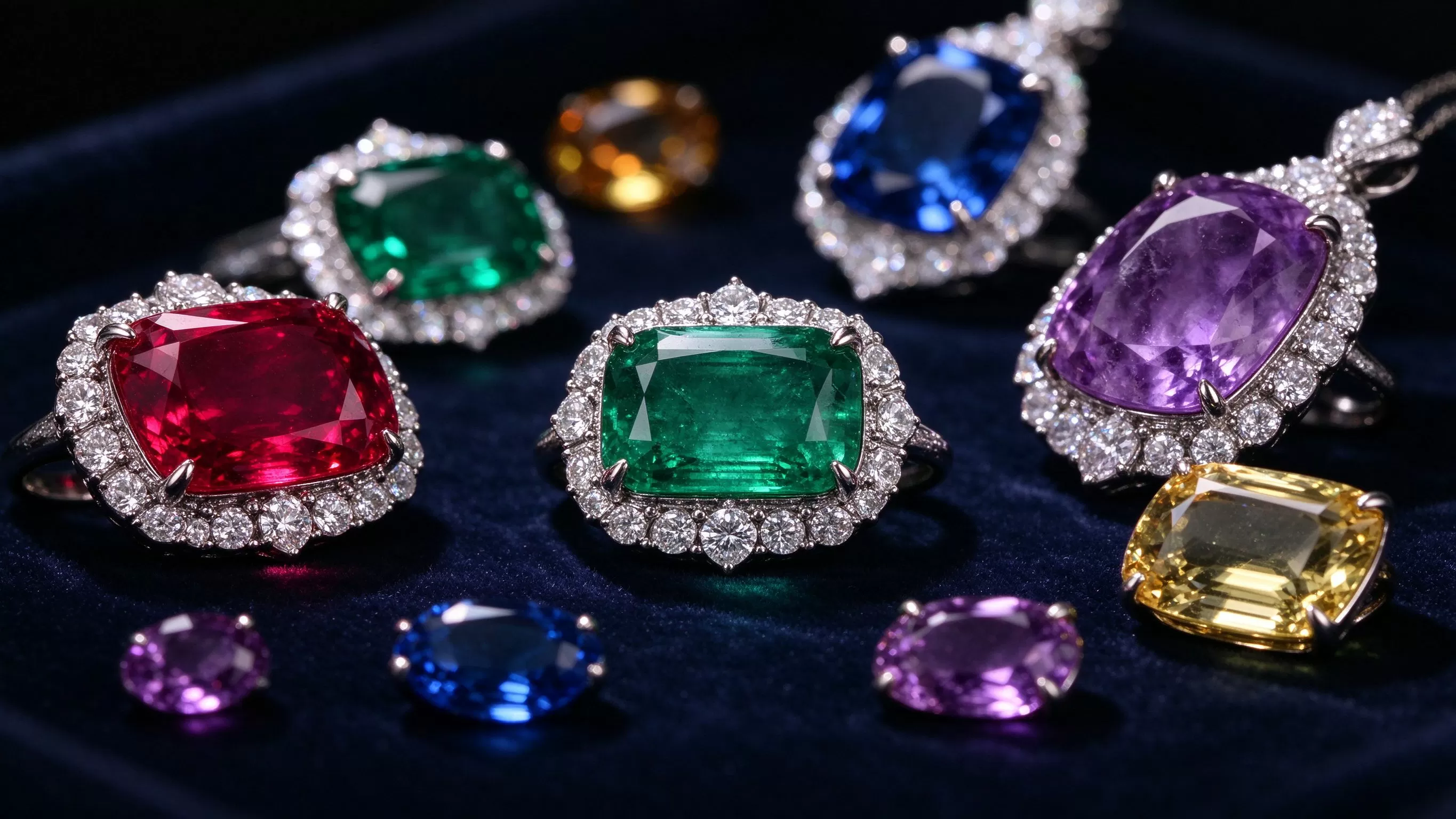
A value-line buyer had to decide whether to fill a 100-piece bridal order with moissanite or cubic zirconia (CZ). Both are white, both are cheap next to diamond, and both will sparkle under a store light. The decision came down to refractive index, hardness, and what the repeat customer comes back for. Here is the side-by-side, measured rather than adjectival.
Optics: fire, brilliance, and refractive index
Cubic zirconia has a refractive index around 2.15-2.18. Moissanite measures about 2.65-2.69, which is higher than diamond's roughly 2.42. That higher index is why moissanite shows strong rainbow "fire" and, under some lighting, a slightly doubled look through the crown because of its birefringence. CZ is bright and white but reads as a softer, flatter sparkle. The Wikipedia entry on moissanite and the entry on cubic zirconia list the refractive indices and physical constants side by side.
For merchandising, moissanite is sold as a diamond alternative with a grading story; CZ is sold as fashion. If your customer wants a one-season cocktail ring, CZ wins on price. If they want a look that lasts years, moissanite wins on optics retention. Compare the diamond-adjacent options in moissanite vs white sapphire.
Hardness and wear over time
CZ sits around 8-8.5 on Mohs. Moissanite sits at 9.25. That gap matters after months of wear: CZ rounds over its facet edges and clouds, while moissanite keeps its cut edges. CZ also scratches more easily in a jewelry box against harder stones. Expect a CZ fashion piece to look tired within a season; a moissanite piece to look good for years. This is exactly why we cover moissanite's position on the scale in why moissanite is rated 9.25 on Mohs.
Cleaning differs too. CZ can be cleaned gently but is porous over time; moissanite tolerates more. See moissanite ultrasonic and steam safety before you set a cleaning policy.
Price, grading, and customer expectations
CZ costs a few dollars per stone. Moissanite costs more, often with a certificate or card from a lab. The IGI lab grades some moissanite and diamond-alternative goods, and buyers should confirm what paperwork comes with each stone. The pricing split is already covered in our comparison of CZ vs moissanite on cut, cost, and fire. The takeaway for a buyer: CZ is a consumable fashion SKU; moissanite is a value bridal SKU with a longer return visit. Do not price them in the same bucket, and do not expect a CZ customer to ask about grading paperwork.
How customers actually use each stone
CZ earns its place as a consumable. A customer buys a CZ cocktail ring for a wedding season or a holiday, wears it hard for three months, and does not expect it to survive a year. Stock it in trend-forward shapes and colors and price it for impulse purchase. Moissanite earns its place as a considered purchase: the engagement or promise ring that sits on the finger for years and goes through hand-washing, gym sessions, and travel. Sell moissanite with the certificate and the stone dimensions, and price it so the customer understands they are buying durability, not just sparkle. If you mix the two in one display, label them clearly; the most common complaint is a buyer who thought they paid bridal prices for a fashion stone.
Measuring fire in store light
Fire reads differently under halogen, LED, and daylight. A moissanite that looks rainbow-heavy under store LED may look softer in a customer's home. When you buy a parcel, ask for a video filmed under neutral 5500K light rather than a studio shot, because studio lighting exaggerates fire. That sample video is also what you hand to staff so they set realistic expectations. CZ, by contrast, looks much the same everywhere: bright, white, and flat. That predictability is part of why it works as a fashion buy.
One last buying rule: do not choose between the two stones by price alone. A cheap CZ in a bad cut looks dull next to a modest moissanite, and a customer who feels shorted will not come back. Buy the cut first, then the material. Test the parcel under both store light and daylight before you commit, and keep the sample for staff training.
FAQ: Moissanite vs cubic zirconia
Is moissanite the same as cubic zirconia?
No. Moissanite is silicon carbide with a higher refractive index and Mohs 9.25. CZ is zirconium dioxide, softer and less optically refractive.
Which looks more like a diamond?
Moissanite has more fire than diamond and can show doubling; CZ looks bright but flatter. Under loupe inspection they are distinguishable from diamond.
Which lasts longer?
Moissanite. CZ softens and clouds over a season of wear; moissanite retains its facet edges for years.
Which should a value bridal line stock?
Moissanite for the value-engagement customer who wants durability and a certificate. CZ for fashion pendants and one-season pieces.
HOLYCOME supplies both moissanite and CZ stones by the parcel, with cut grade and dimensions listed per SKU. Mix them in one order: moissanite for bridal, CZ for fashion. Read our moissanite wholesale MOQ and factory audit guide, then request a matched sample set.
Frequently Asked Questions
Is moissanite a good diamond alternative for retail buyers?
Yes for price-sensitive customers who want brilliance and hardness. Moissanite ranks 9.25 on the Mohs scale, holds up to daily wear and costs a fraction of a natural diamond of the same size, so it resells fast in bridal and fashion lines.
What is the minimum order for wholesale moissanite?
MOQ starts at 50 pieces per design for stock items. Custom cuts and private-label settings usually start at 100–300 pieces depending on the mold.
Do you provide certificates with moissanite stones?
Yes. Every parcel ships with GRA or IGI documentation listing carat weight, color grade and cut. We recommend passing the certificate to your end customer for trust.
How long does sample and bulk production take?
Samples ship in 3–5 days. Bulk runs take 15–20 days under 500 pieces, and 25–30 days for custom work.