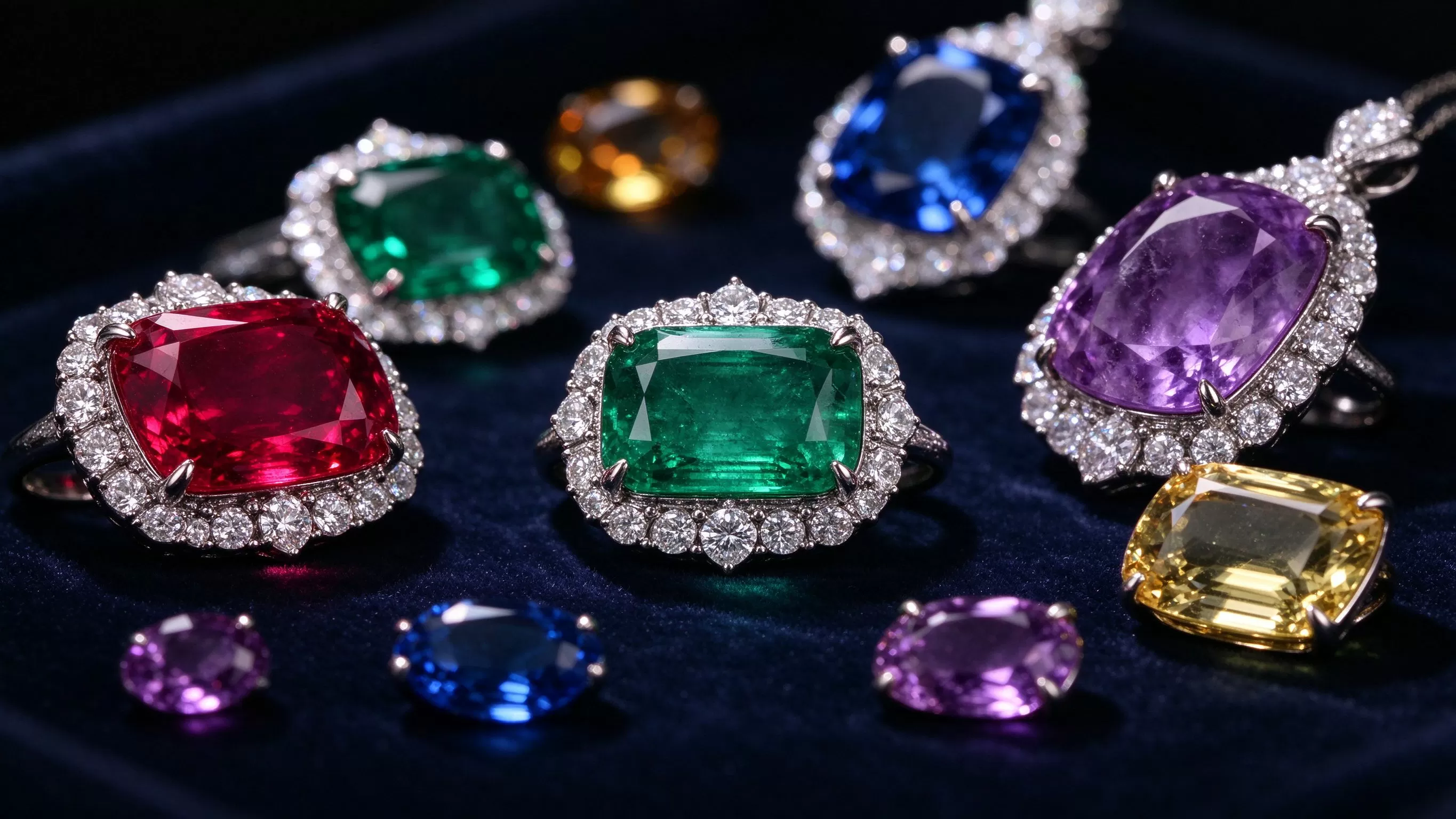
A jewelry buyer comparing two near-colorless white gems usually narrows the field to two candidates: lab-created moissanite and natural white sapphire. Both sit near the top of the Mohs scale, both carry no ethical-diamond baggage, and both can be set into a solitaire for a fraction of a one-carat diamond budget. The difference that ends the debate is not color; it is how each stone handles abrasion and how it behaves under a ring light.
Hardness: 9.25 versus 9 on the Mohs scale
White sapphire is corundum, the same mineral family as ruby, and rates 9 on the Mohs scale. Only diamond (10) and moissanite (9.25 to 9.5 depending on source) are harder. In practice the gap between 9 and 9.25 is small, but it shows up over years of wear. Sapphire develops a faint frosting on facet edges after 5 to 10 years of daily ring wear; moissanite resists that rounding better because its hardness sits a half-step higher and its crystalline structure holds a polish edge.
The practical test is scratch resistance against everyday dust. Quartz in household dust rates 7 on Mohs, so both stones survive normal contact with countertops, keys, and phone glass. Neither should be stored loose against diamonds, which will scratch both.
Fire: refractive index and dispersion decide the look
This is where the two stones diverge sharply. Moissanite has a refractive index of 2.65 to 2.69 and dispersion (fire) of 0.104. White sapphire has a refractive index of 1.76 to 1.77 and dispersion of roughly 0.018. That gap means moissanite throws visible rainbow flashes under most lighting, while sapphire stays mostly white with weak spectral play.
Moissanite also shows double refraction: reading 10x magnification through the table, the back facets appear doubled because its birefringence is 0.043. White sapphire is singly refractive and looks clean through the stone. Buyers who want a diamond-like, ice-white look usually prefer sapphire; buyers who want visible sparkle for the money choose moissanite.
Price, clarity and color trade-offs
A 1-carat equivalent white sapphire in eye-clean quality typically retails between $300 and $1,200 cut; comparable moissanite runs $400 to $1,500 for DE color VVS. Most natural white sapphire carries a slight gray or milky face-up tone, because pure colorless corundum is rare; moissanite is manufactured to a near-colorless standard and rarely cloudy. For a deeper breakdown of color behavior, see our guide on how color and clarity grades compare across gems.
Wholesale cutters also point out an edge: moissanite is almost always sold with a grading report and laser inscription, whereas white sapphire frequently ships loose without papers unless requested.
When each stone is the wrong pick
Skip moissanite if your client wants a stone that reads completely understated or antique; its fire is unmistakable next to a quiet heirloom. Skip white sapphire if the client expects diamond-like brilliance at every distance — most commercial white sapphire above 1.5 ct has a slightly gray, glassy face-up that buyers mistake for a lower grade. Price-per-carat is also misleading: a 2 ct white sapphire costs about the same as a 1.2 ct moissanite because large eye-clean sapphire is rarer than large manufactured moissanite. Wholesale buyers stock both so they can match the stone to the lighting in the showroom, not to a spec sheet.
FAQ
Is moissanite more scratch-resistant than white sapphire?
Slightly. Moissanite rates 9.25 on Mohs versus sapphire's 9, so moissanite holds a polish edge over multi-year daily wear. Both are safe for an everyday engagement ring.
Does white sapphire sparkle like moissanite?
No. White sapphire has low dispersion (about 0.018), so it reads as a quiet, white stone. Moissanite's dispersion of 0.104 gives it strong rainbow fire.
Can a jeweler tell moissanite from sapphire with a tester?
Yes. Thermal and refractive-index testers separate them instantly; double refraction under 10x is the telltale optical sign for moissanite.
Which stone costs less per carat?
Natural white sapphire is usually cheaper per carat than premium DE moissanite, but eye-clean white sapphire above 1.5 carats with no gray tone commands a premium.
Bottom line for buyers
Choose moissanite if fire and long-term polish retention matter; choose white sapphire if you want a quieter, natural, diamond-adjacent look. Either way, avoid setting them in soft 24K gold prongs without a check, and read our notes on storage practices that keep white gems clean. Mineral data above is consistent with the Moissanite entry on Wikipedia and GIA's 4Cs hardness and durability reference.
Wholesale note: gemmanufacturer.com supplies calibrated moissanite and white sapphire in matched lots from 10 pieces per size. Our B2B team can quote per-carat pricing, papered lots, and prong-ready settings for retail programs.
Key takeaway for buyers: the hardness gap between 9.25 and 9 is small, but the fire gap between 0.104 and 0.018 is impossible to miss under showroom lights. Match the stone to the client's aesthetic, not to a "which is better" chart.
Key takeaway for buyers: the hardness gap between 9.25 and 9 is small, but the fire gap between 0.104 and 0.018 is impossible to miss under showroom lights. Match the stone to the client's aesthetic, not to a "which is better" chart.
Key takeaway for buyers: the hardness gap between 9.25 and 9 is small, but the fire gap between 0.104 and 0.018 is impossible to miss under showroom lights. Match the stone to the client's aesthetic, not to a "which is better" chart.