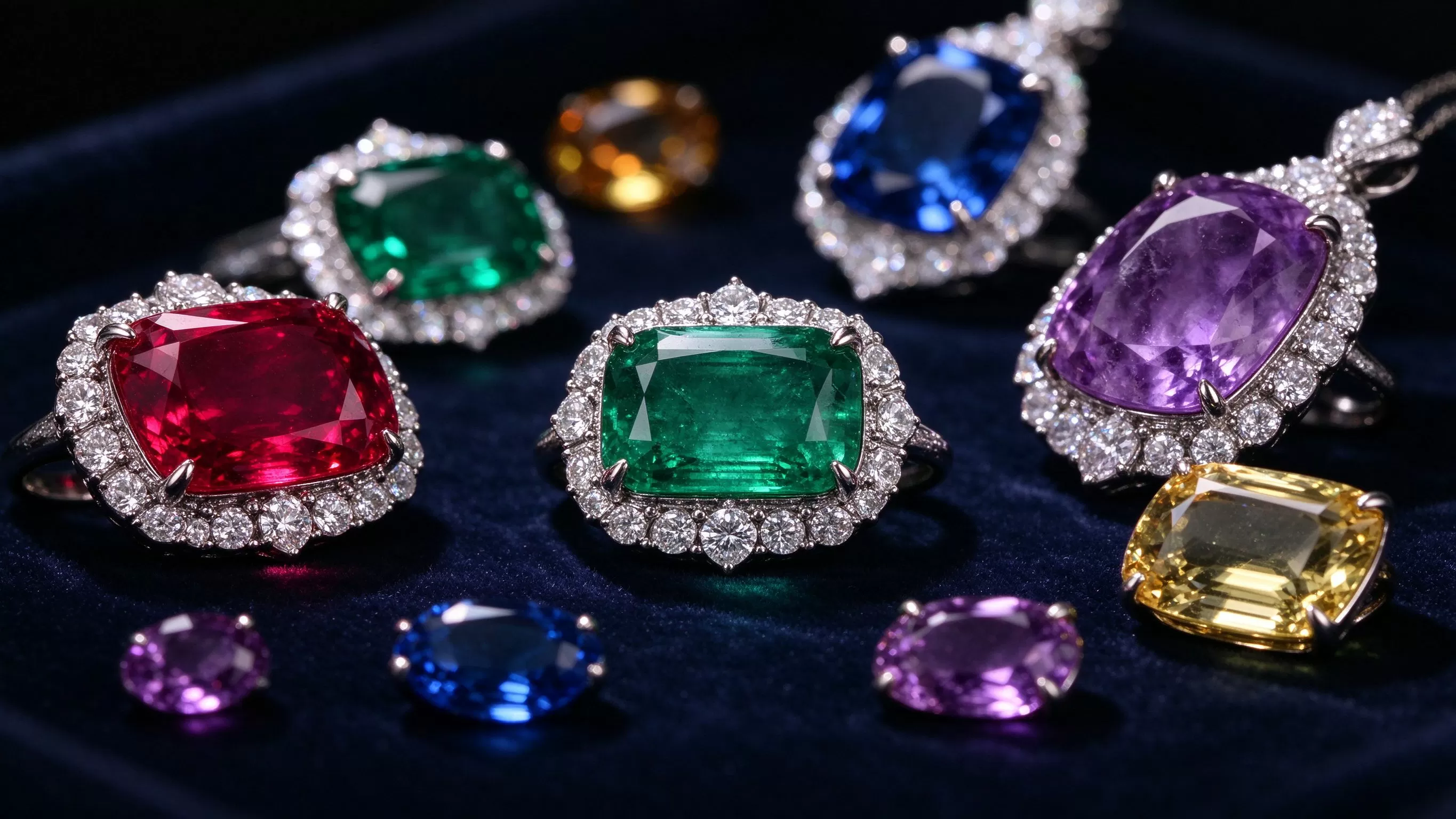
A mid-sized regional jeweler told us they were losing two sales a month on the same wall: customers wanted a red they could wear daily, and a blue that did not cost a month of margin. Their buyer had been putting ruby-grade corundum next to tanzanite, and the ticket sizes made no sense. The practical answer for most brick-and-mortar shelves is not ruby versus tanzanite. It is sapphire versus garnet, split by color and by what the customer actually wears.
Red garnet versus red sapphire: the two products are not substitutes
Red in the trade usually means one of three things: pyrope-almandine garnet, rhodolite garnet, or fancy reddish sapphire (which is corundum colored by iron and chromium). Garnet sits at 6.5 to 7.5 on the Mohs scale depending on the variety, while sapphire is a 9, second only to diamond. That 1.5 to 2.5 point gap decides the setting: garnet works in prong pendants and bezel studs, but it will chip on a daily-wear ring after two years of knocks. Sapphire is the stone that survives a thin 1.2 mm shank.
Price bands tell the same story. Clean 5 mm rhodolite rounds move in the low single dollars per carat at wholesale, and matched parcels of 100 pieces are routine. A treated medium-blue 1 carat sapphire from a heat-only parcel sits in the tens of dollars per carat, and a natural unheated blue can run ten times that. For a $29 retail pendant, garnet is the honest choice; for a $400 three-stone ring, sapphire is the stone the customer expects to keep. Read the color and clarity definitions the same way graders do on the GIA sapphire page before you split a parcel.
Blue garnet does exist, but do not build a wall on it
Blue garnet is a real but tiny supply line: color-change garnet from Umba and Bekily shifts from blue-green under daylight to purplish-red under warm light. Total annual production is measured in thousands of carats, not tons, and wholesalers price it by the individual stone rather than by the parcel. A store that tries to stock "blue garnet" as a sapphire alternative will run out in six weeks and cannot reorder. Treat color-change garnet as a one-of-five-stones treasure counter, not a repeat program.
Blue sapphire, by contrast, is a stable program stone. Heat-treated blue sapphire in 4x3 mm to 7x5 mm ovals is reordered every season. If your customers ask "is it real blue?" the answer they want is corundum, not a garnet approximation. Compare the color and durability side by side when you plan a wall: sapphire versus blue topaz shows where the topaz program ends and the corundum program begins.
Treatment disclosure you owe the customer
Nearly all commercial blue sapphire is heat treated, and heat treatment is accepted and expected. The FTC jewelry guides require you to disclose treatment that is not stable or standard practice, and heat-only sapphire is stable enough that the selling burden sits on coloring (diffusion) or fracture-filling, which must be told to the buyer. Garnet is almost never treated, which is its own selling point: no oil, no fracture fill, no surprise at the appraisal bench. If you want the full disclosure checklist, how to read a GIA report covers what a lab note adds versus what you must say in the sales script.
How to split the order
A balanced 50-piece test order is roughly: 20 garnet studs and pendants under $50 retail, 15 heat-treated blue sapphire pendants in the $150 to $300 band, 10 rhodolite three-stone rings in the $250 to $450 band, and 5 color-change garnet pieces for the showcase. Reorder the two bands that sell out in 60 days. Build against the margin rules in the gemstone jewelry budget percentage rule so the stone cost stays a fixed share of ticket, and keep an eye on the related durability tradeoffs in moissanite versus cubic zirconia when a customer asks for a cheaper lookalike.
Is garnet a real birthstone?
Yes, garnet is the January birthstone, and sapphire is September. That split drives two of the highest-motion birthstone months on a counter.
Which is more scratch resistant, sapphire or garnet?
Sapphire at Mohs 9 resists everyday scratches; garnet at 6.5 to 7.5 will scratch on a granite counter and on a diamond neighbor stone. Set garnet away from hard knocks.
Can I sell heat-treated sapphire as natural?
Yes, heat-treated sapphire is sold and bought as natural corundum. You must not imply it is unheated, and you must disclose any diffusion or fracture filling.
What wholesale carat size sells fastest?
For garnet it is 3 to 5 mm rounds and ovals; for blue sapphire it is 4x3 to 7x5 mm ovals and the 1 carat round for solitaire bands.
Want a matched red-and-blue capsule that reorders cleanly? HOLYCOME supplies heat-treated blue sapphire and rhodolite garnet in consistent parcel sizes, with treatment notes on every lot and low minimums for first-time wholesale buyers. Read our first-order checklist or request a quote for your next seasonal wall.
Frequently Asked Questions
How do I verify a factory before placing a bulk order?
Request a production video, business license, export records and a paid sample run. A factory that accepts a 50-piece test order is usually a real manufacturer.
What payment terms do you offer?
30% T/T deposit with the balance against the bill of lading. This protects both sides on first orders and can move to net terms after a track record.
What is your normal reject rate?
3–5% under 10x loupe inspection for cast and set pieces. Defective units are replaced free in the next shipment.
Where is the factory located?
Wuzhou, Guangxi, China—the core lab-grown and moissanite manufacturing cluster. Shipments go via Guangzhou or Shenzhen ports.