PVD Coating vs Electroplating: Why Factories Choose Each Finish
Walk into a jewelry store and pick up a black steel watch, a rose-gold stainless-steel band, and a shiny 18k gold necklace. On the surface they all look finished, but two completely different technologies put those colors there. Electroplating is the century-old bath that dissolves metal into solution and deposits it onto a piece by electric current. PVD, physical vapor deposition, is a vacuum-chamber process that blasts metal atoms onto a surface in a near-vacuum. Both produce a colored, protective layer, but they wear differently, cost differently, and suit different products. Understanding the gap between them explains why a cheap rose-gold ring fades in months while a PVD-coated one still looks new after years of daily wear.
This article compares PVD coating and electroplating from the manufacturer's side: how each process actually works, where each one wins on durability, cost, and color range, and what a wholesale buyer should specify in a production order to avoid the dreaded "it looked different in the sample" complaint. We will also clear up the marketing confusion, because many sellers label any thin colored layer "plated" whether it is electroplated, PVD, or something in between.
What Electroplating Actually Does
Electroplating is the older and more familiar process. The jewelry piece is submerged in a liquid bath containing dissolved metal salts, usually gold or rhodium, and a weak electric current runs between the piece and an anode. Metal ions migrate through the solution and bond to the surface of the jewelry, building up a layer over minutes. The thickness is controlled by time, current density, and bath chemistry, and a jeweler can plate a ring in a matter of minutes once the bath is tuned.
The layer that results is real metal, but it is thin. Commercial rhodium plating on white gold is typically only a fraction of a micron thick, and gold plating on fashion jewelry may be one to three microns. Because the layer is thin and the bond is largely mechanical, it wears away where the jewelry touches skin, clothing, and desks. Rhodium plating on an engagement ring starts to thin after a few years, which is why white gold rings gradually show their yellowish alloy underneath and need replating. This behavior is normal and expected; read our detail on why white gold turns yellow for the full picture. Electroplating also has a thickness ceiling: build it too thick and the layer becomes brittle and prone to peeling.
What PVD Coating Actually Does
PVD works in a vacuum chamber rather than a liquid bath. The jewelry is loaded into a sealed chamber, the air is pumped out, and a target metal or ceramic material is vaporized by an arc or sputtering process. The vaporized atoms travel through the vacuum and condense directly onto the jewelry surface as a thin, dense film. The most common jewelry PVD finishes are gold, rose gold, black, and gunmetal, applied over stainless steel, titanium, or brass. The word "vapor deposition" literally describes atoms landing out of the vapor phase and building up a layer.
The resulting film is thinner than electroplate, often well under a micron, but it is far denser and more tightly bonded because it forms at the atomic level in a vacuum. That density is the source of PVD's reputation for durability. A PVD-coated stainless-steel watch case resists scratches, tarnish, and everyday abrasion far better than an electroplated brass case of the same color, and it will not turn skin green or wash off in the shower. PVD also bonds well to modern base metals like stainless steel and titanium that electroplating struggles to coat evenly. For a deeper materials read, our PVD coating buyer guide covers the consumer side.
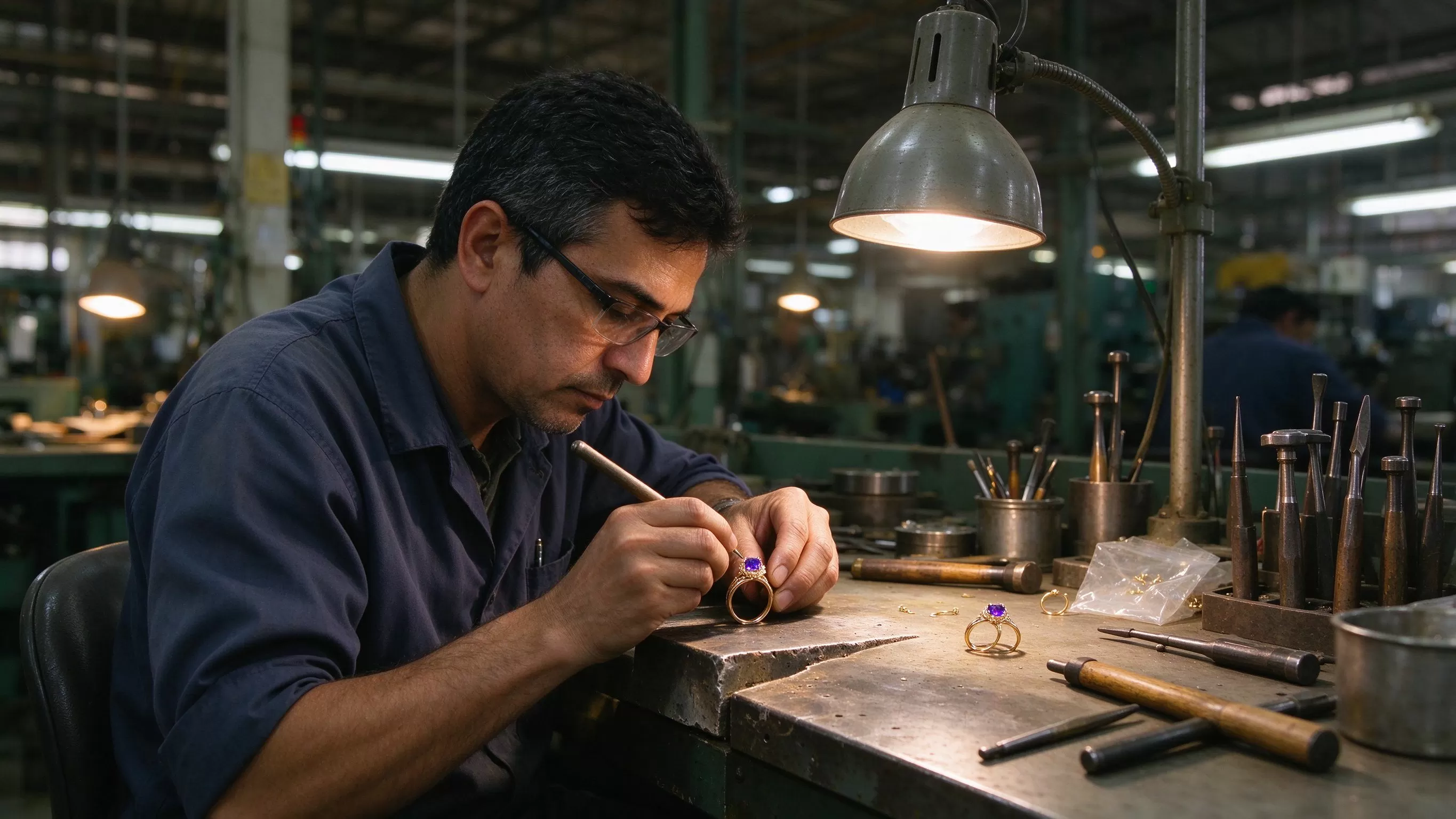
Durability: The Real Difference Buyers Feel
The single biggest reason factories switch to PVD is wear resistance. In controlled abrasion tests, PVD films survive far more rubbing than equivalent-thickness electroplate because the film is harder and denser. A PVD gold finish on a stainless-steel bracelet will keep its color through years of desk work, handwashing, and minor knocks, while an electroplated gold bracelet on brass may show base metal at the edges within months. This is why PVD dominates the watch, wedding band, and stainless-steel jewelry categories: those products are worn every day and cannot be replated easily by the customer.
Electroplating still wins in one durability scenario: repairability. A rhodium-plated white gold ring can be stripped and replated at any jeweler in ten minutes, restoring the finish like new. A PVD-coated piece cannot be touched up locally; if the film is scratched through, the whole piece must go back into the vacuum chamber to be recoated. So for fine jewelry that customers already service, replatable electroplate is a feature, not a flaw. For fashion and everyday jewelry where customers never visit a jeweler, the once-and-done durability of PVD is worth more than repairability.
Corrosion and skin contact are the other dividing line. PVD films are nearly impermeable, so they shield a reactive base metal from sweat and chemicals. Electroplate is slightly porous, which is why cheap plated brass can tarnish through to a green oxidation layer at the back of a ring band. Buyers selling to nickel-sensitive customers should read our note on hypoallergenic base metals; a dense PVD layer is often what makes a stainless-steel piece safe for sensitive skin, while thin electroplate on brass eventually breaks down.
Cost and Production Trade-Offs
PVD equipment is expensive up front. A vacuum chamber and its supporting pumps and power supplies cost many times a conventional plating line, and the process itself is slower because the chamber must be pumped down and vented between batches. Those fixed costs mean a factory needs steady volume to justify a PVD line. The per-piece cost on a large run, however, is competitive, because a chamber coats many pieces at once and there is no consumable plating bath to maintain. For a brand ordering thousands of the same band, PVD becomes affordable per unit.
Electroplating is cheaper to set up and more flexible for one-off or small-batch work. A plating shop can take a single ring and plate it gold or rhodium the same day, which is why repair shops and small custom houses rely on electroplating. It also handles the karat-rich yellow gold finishes that fine jewelry customers expect, because PVD gold is physically only a thin colored film and cannot deliver the deep, solid gold look of a heavy gold electroplate or a solid gold piece. If a customer asks for "18k gold," they almost always mean a thicker electroplate or solid gold, not a PVD film.
Lead time is another practical difference. Electroplating integrates tightly with the normal cast-and-polish workflow: polish, plate, pack. PVD requires an extra queue at the vacuum chamber, and because the chamber processes batches rather than singles, small orders wait for a batch to fill. Buyers planning a launch should build that chamber lead time into the schedule, and our guide to typical factory lead times explains where PVD sits in the overall timeline.
Color Range and Finish Options
Electroplating offers a wider and warmer range of gold tones because the bath chemistry can be tuned to produce 10k, 14k, or 18k-looking yellow, rose, or white gold finishes, and the layer can be built up to a richer depth. Rhodium, black ruthenium, and antique silver tones are all achievable in electroplating. For fine bridal jewelry where the customer expects a warm, rich gold that matches existing family pieces, electroplated gold remains the default.
PVD has become impressively broad, however. Modern PVD lines produce warm and cool golds, rose gold, matte and polished black, gunmetal, and even champagne and bronze tones, and the finish can be applied in matte, brushed, or polished versions that match a brushed metal texture perfectly. Where PVD lags is in the very warm, deep 18k yellow gold that electroplate achieves; PVD gold often reads slightly cooler or more metallic. Buyers who need an exact gold color should always approve a physical sample in the light their customers will wear it, because both processes render color differently on camera than in daylight.
One finish PVD owns outright is hard black. Electroplated black ruthenium looks good but wears through at high-contact edges, while PVD black stays uniform and scratch-resistant, which is why black wedding bands and black steel watches are almost always PVD. For men's and unisex everyday bands, that durable black finish is a major selling point, and it pairs naturally with the titanium and stainless steel base metals that PVD coats so well.
What to Specify in a Wholesale Order
The most common sourcing mistake is leaving the finish open-ended. A buyer who writes "gold plated" on a purchase order may receive one-micron electroplate on brass from the cheapest bidder, which looks like gold on day one but fades by season two. Instead, specify the process explicitly: whether you want electroplate or PVD, the base metal underneath, the color, the finish texture, and the expected thickness. A clear order says "PVD 1-micron warm gold on 316L stainless steel, brushed," not just "gold finish."
Thickness is the second field to pin down. For electroplated fashion jewelry, specify a minimum gold thickness, often written in microns or in microinches, because a two-micron plate lasts several times longer than a half-micron plate. For PVD, thickness is less variable but you should still confirm the process and the base alloy. Our detailed note on plating thickness specifications walks through the numbers factories use. Finally, ask for a sample approval piece worn through a few weeks of real use before committing to bulk, because a fresh sample always looks perfect; the difference between processes shows after wear, not on day one.
Return and warranty policy should reflect the process you chose. If you sell electroplated fashion jewelry, set customer expectations that the finish will wear and offer replating or replacement on a defined schedule. If you sell PVD-coated everyday bands, you can confidently advertise long-wear durability, because the film genuinely holds up. Matching the warranty to the real-world wear of the finish prevents the returns that sink a new jewelry brand.
Frequently Asked Questions
Is PVD coating better than gold plating? It depends on the product. PVD is far more scratch-resistant and durable on everyday stainless-steel and titanium pieces, but it cannot be touched up locally. Electroplated gold is thicker, warmer, and replatable, which suits fine gold jewelry.
Does PVD jewelry turn skin green? No. PVD forms a dense, nearly impermeable film that seals the base metal away from sweat. Skin-greening comes from porous electroplate on reactive brass, which PVD avoids.
How long does PVD coating last on jewelry? On a stainless-steel band or watch, PVD finishes commonly last five to ten years with normal wear. Electroplated fashion jewelry may wear through in months at high-contact edges.
Can PVD gold be replated like electroplated gold? Not locally. A scratched PVD piece must go back into the vacuum chamber to be stripped and recoated, which is why PVD is chosen for durable once-and-done finishes rather than maintenance-friendly fine jewelry.
Which is cheaper for a small custom order? Electroplating is cheaper and faster for one-off or small batches because the equipment is inexpensive and flexible. PVD pays off at high volume, where chamber batching lowers the per-piece cost.
Match the Finish to How the Piece Lives
PVD and electroplating are not competing technologies so much as tools for two different jobs. If a ring will be worn every day on a steel band, exposed to hands and showers, and never taken to a jeweler for servicing, PVD is the finish that survives. If a piece is fine gold bridal jewelry that customers already inspect and replate over decades, electroplate delivers the warm, repairable gold tone they expect. The mistake is choosing by price alone. Specify the base metal, the process, the thickness, and the color in writing, approve a worn-in sample, and the finish will match the promise on your product page. We produce both electroplated fine pieces and PVD-coated stainless collections in our workshop, and we will recommend the right finish for each design rather than pushing whichever line we happen to have running. For a quote on your collection, write to service@holycome.com and browse more Industry Insights behind the manufacturing floor.