Surat: The Diamond Cutting Capital of the World
Rough diamonds leave mines in Canada, Russia, Botswana, and Namibia, and by the time they reach a jewelry store most of them have passed through a single city on the west coast of India. Surat, Gujarat, is where the majority of the world's rough diamonds are cut, polished, and sorted before they ever reach a setting. The numbers are almost implausible: a very large share of all natural diamonds sold on Earth pass through Surat's factories, and the city's diamond polishing units employ hundreds of thousands of workers. Yet most shoppers have never heard the name, because Surat does not sell diamonds to the public; it makes them ready to be sold.
This article explains how a port city in western India became the engine of the global diamond trade, what actually happens inside a Surat cutting factory, how the rise of lab-grown diamonds is reshaping the city, and why a jewelry buyer or brand should care where their stones were polished. The story of Surat is the story of modern diamond economics: labor, precision, and a century of accumulated skill concentrated in one place.
How a City on the Coast Became the Diamond Hub
Diamond cutting in India is not new. Indian lapidaries were polishing and trading diamonds long before the great African mines opened, and Golconda diamonds, including stones whose descendants still sit in crown jewels, were cut and traded on the subcontinent. What changed Surat from a historic trading town into a global factory was a combination of affordable skilled labor, favorable business policy, and the willingness of large trading houses to centralize the work. Through the late twentieth century, as diamond demand exploded, major trading families moved more and more of the cutting and polishing work to Surat, where skilled workers could do at high quality what would cost far more in Europe or New York.
The advantage was never cheap labor alone. Cutting a diamond is delicate work that punishes sloppy hands: a single mistake ruins a thousand-dollar stone. Surat's strength is that it trained generations of workers who learned the trade from their families, building a depth of experienced cutters that no other region can match. A city that has cut diamonds for sixty years has an instinctive feel for how a rough stone should be oriented, how much to remove, and where the profit hides in the raw crystal. That accumulated knowledge is the real moat, not the wage rate. For context on the geometry being judged, our guide to how diamonds are cut and polished explains the physical work.
Amsterdam and Antwerp built their names on diamond trading and cutting in earlier centuries, and Antwerp still handles a huge share of the rough diamond trade and sight distribution. But the hands-on polishing migrated overwhelmingly to Surat, where the combination of skilled workers and scale made the finished stone cheaper to produce. Today Antwerp trades and Surat polishes, and the division of labor is so routine that a diamond may be bought as rough in Antwerp, flown to Surat, cut, and returned to global markets without most buyers thinking twice about the journey.
What Happens Inside a Surat Cutting Factory
A rough diamond arrives at a Surat unit as an unremarkable-looking octahedral crystal, often no larger than a pea. The first decision is the most valuable: planning. A trained planner examines the rough stone under magnification and decides how many polished diamonds it can yield, in what shapes and sizes, and where to saw it. This single decision can swing the value of the rough by double digits, because splitting a stone the wrong way wastes the best carat weight. The planner balances maximizing carat yield against maximizing the cut quality and color of the finished stones, and the best planners are highly paid, experienced specialists.
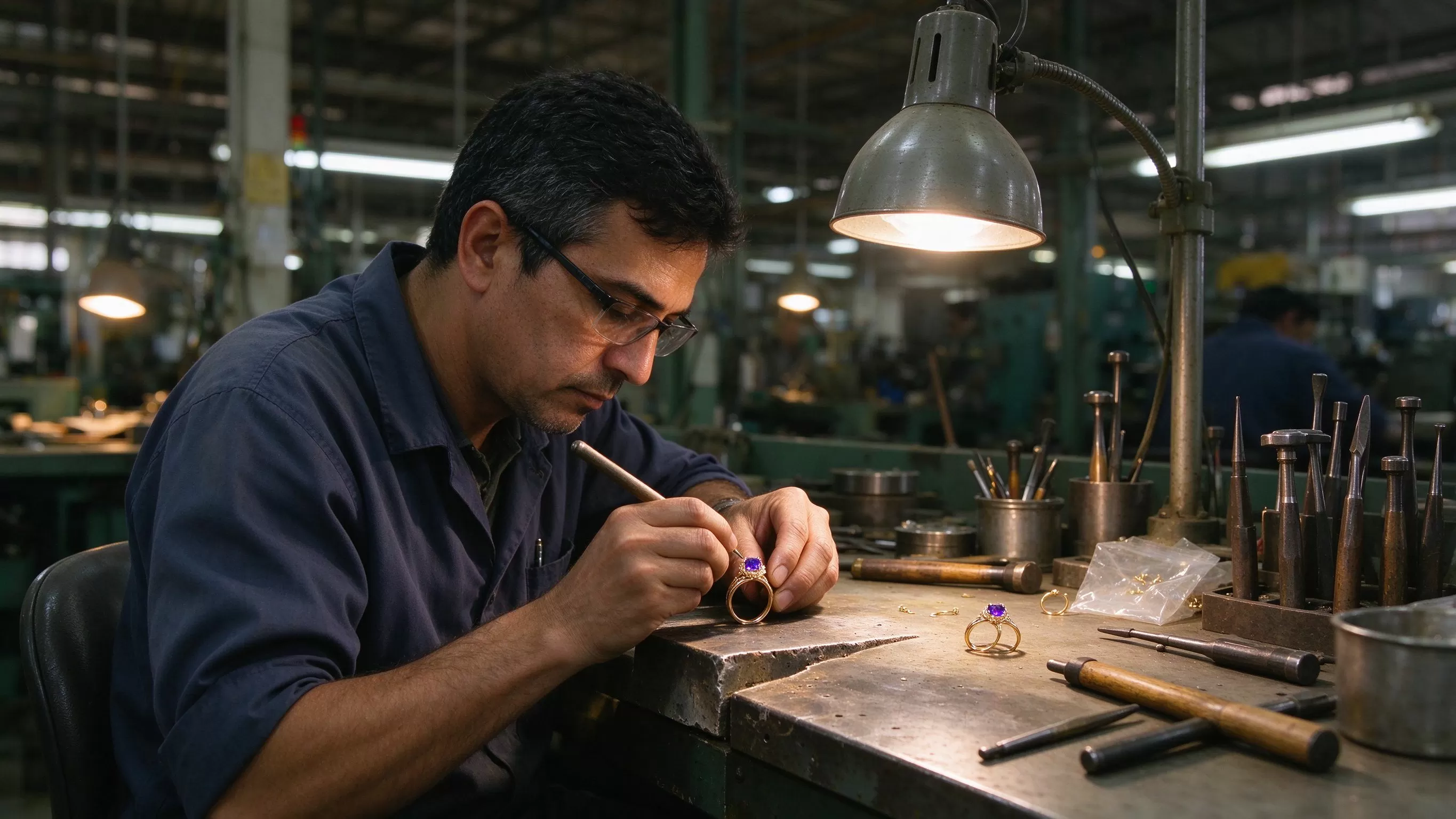
Once the stone is planned, it goes to sawing and bruting, where the rough is divided into pieces and the girdle, or outer edge, is rounded. Then the actual faceting begins. In a traditional Surat unit, workers sit at spinning polishing laps, each holding a small dop stick that grips a half-finished diamond. They apply the stone to a rotating cast-iron wheel charged with diamond powder, polishing one facet at a time. A single round brilliant takes dozens of facets, and a worker may spend hours or days on one larger stone. Modern factories mix this hand labor with semi-automated bruting and laser cutting equipment, but the final facet polishing still depends on human skill and patience.
After polishing, the stones are sorted by size, shape, color, and clarity, and sent for grading. A finished Surat-polished diamond may be shipped to a grading lab, supplied to a jewelry manufacturer, or traded through the bourse network. The city also has a large supporting ecosystem of diamond traders, dealers in small melee stones, and brokers who supply the huge numbers of tiny accent diamonds that go into pavé settings. That melee supply is itself a Surat specialty: the flood of small, cheap accent diamonds in modern jewelry exists because Surat can cut and sort thousands of tiny stones efficiently.
Why Surat Dominates Small and Melee Diamonds
Surat's historical strength is not in the giant, famous diamonds that make news. Those are still cut in specialist ateliers in New York, Antwerp, or Tel Aviv, where a single stone justifies weeks of high-touch work. Surat's dominance is in the enormous middle market: the half-carat to three-carat commercial stones that go into engagement rings, and especially the tiny melee stones that pave a band. Those small stones carry thin margins per piece, so they only make economic sense to cut at scale, with low per-unit labor cost and tight sorting. Surat built exactly that system.
This matters for a jewelry brand because the price of the accent stones in a pavé ring is not incidental. A halo ring or an eternity band can contain dozens of small diamonds, and the cost of those melee stones is determined largely by the efficiency of the Surat pipeline. Brands that can source their melee through the Surat network get consistent, well-sorted small stones at prices a boutique cutter cannot match. That is one reason pavé and eternity designs became so affordable in the last two decades: the supply of cheap, good small diamonds scaled up precisely because Surat industrialized their production. For a read on how that feeds into finished jewelry economics, see our overview of manufacturing cost and margin structure.
The flip side is consistency risk. Because Surat cuts so many stones at high speed, quality varies across factories, and a buyer who sources melee without inspection can receive batches where colors and clarities do not match from stone to stone. Reputable manufacturers sort their melee tightly and run the stones through inspection before setting, which is a step a cheap supplier may skip. The lesson for buyers is not "avoid Surat stones," but "audit the sorting and inspection," because the city produces both excellent and mediocre stones depending on the factory.
The Lab-Grown Revolution Hits Surat
For a century, Surat's business was built entirely on natural rough diamonds, and the city's prosperity tracked the natural diamond market. That equation is now being rewritten, and Surat is at the center of the change. Lab-grown diamonds can be produced in large, clean crystals at a fraction of the natural cost, and they still need to be cut and polished just like natural ones. Rather than being displaced by lab-grown diamonds, Surat has aggressively pivoted to cutting them, because the polishing skill and equipment are identical whether the rough grew in a mine or in a reactor.
In fact, Surat has become a global hub for lab-grown diamond processing, cutting stones grown in labs around the world and shipping them to markets. This has been a double-edged shift. On one hand, the city's cutting capacity found new demand and kept workers employed as natural diamond volumes softened. On the other hand, lab-grown diamonds are far cheaper, which compresses the per-carot cutting fee and squeezes margins. The manufacturers who thrived adapted quickly, investing in the polishing and grading of lab-grown stones and building relationships with the brands selling them. Our coverage of the lab-grown diamond market tracks how this shift is evolving.
For a buyer, the practical effect is that Surat is now the place where both natural and lab-grown polished diamonds are competitively produced. A brand can source a five-carat lab-grown round polished to high standards at a fraction of what an equivalent natural stone costs, and the polishing quality benefits from the same decades of accumulated Surat skill. The distinction between natural and lab-grown must always be disclosed and certified, but the cut quality of both is increasingly the work of the same city.
Quality, Ethics, and What Buyers Should Verify
Because Surat is a vast, decentralized ecosystem, a buyer cannot assume every stone coming out of the city meets the same standard. The cut quality of polished Surat diamonds ranges from commercial to excellent, and the difference shows in the proportions, finish, and symmetry. A well-cut stone returns light brilliantly; a poorly cut one, even with good color and clarity, looks dull. That is why buying a certified diamond matters: the grading report's cut grade reflects the work of the Surat factory, and our guide to diamond cut grades explains how to read it. For the cut itself, the same principles apply whether the stone is natural or lab-grown.
Ethical sourcing is the other concern buyers raise. The natural diamond trade built international certification schemes to assure conflict-free origins, and reputable Surat units participate in those systems. When sourcing Surat-cut stones, ask whether the supplier provides the relevant origin and grading documentation and whether the stones are backed by recognized certificates. For lab-grown stones, a clear lab report stating CVD or HPHT growth and treatment disclosure is the minimum. A manufacturer who cannot provide that paperwork is asking the buyer to absorb risk they cannot price.
Geography is the final point. Surat is part of a wider Indian jewelry and diamond corridor that includes the broader Gujarat jewelry manufacturing base, and it sits in the same region that powers much of the world's loose-stone supply. When a brand asks where its diamonds are cut, the honest answer is often Surat, and that is neither a red flag nor a guarantee. It is a description of a normal, efficient step in the global pipeline, and the buyer's job is to verify the cut grade, the certificate, and the sorting quality rather than the city on its own.
Frequently Asked Questions
Why is Surat called the diamond cutting capital? Because the vast majority of the world's rough diamonds are cut, polished, and sorted in Surat, India. The city combines decades of skilled lapidary tradition with the scale to process both large commercial stones and tiny accent melee.
Are Surat-cut diamonds lower quality than Antwerp-cut? Not inherently. Surat produces a wide range of cut quality, from commercial to excellent. The finished cut is judged by its proportions and grade, not the city; a well-certified Surat stone can outperform a poorly cut one from anywhere.
Does Surat also cut lab-grown diamonds? Yes. Surat has become a major processing hub for lab-grown diamonds, because the polishing skill and equipment are the same whether the rough grew in a mine or a reactor.
What are melee stones, and why does Surat dominate them? Melee are the small accent diamonds used in pavé and eternity settings. They carry thin per-piece margins, so they are economical to cut only at scale, which Surat's high-volume factories do efficiently.
How should a buyer verify Surat-sourced diamonds? Require a recognized grading report for cut, color, and clarity, confirm conflict-free or lab-grown disclosure, and inspect that accent stones in a batch are consistently sorted before setting.
A City You Have Heard Of, Even If You Have Not Heard of It
Surat is one of those places that touches almost every diamond sold on Earth while remaining invisible to the shopper. It is where rough crystals become the faceted stones that go into engagement rings, wedding bands, and pavé pendants, and it has quietly adapted from natural diamonds to lab-grown ones without losing its central role. For a brand or buyer, the takeaway is not to romanticize the city or to distrust it, but to understand that Surat is the default polishing step in the modern diamond pipeline. Verify the cut grade, the certificate, and the sorting, and the city behind the stone stops being a question and becomes just part of how the trade works. We source polished natural and lab-grown stones through established Surat channels and set them in our own workshop, and we can supply either with full grading documentation. For a quote or a conversation about a diamond project, write to service@holycome.com and read more in our Industry Insights series.