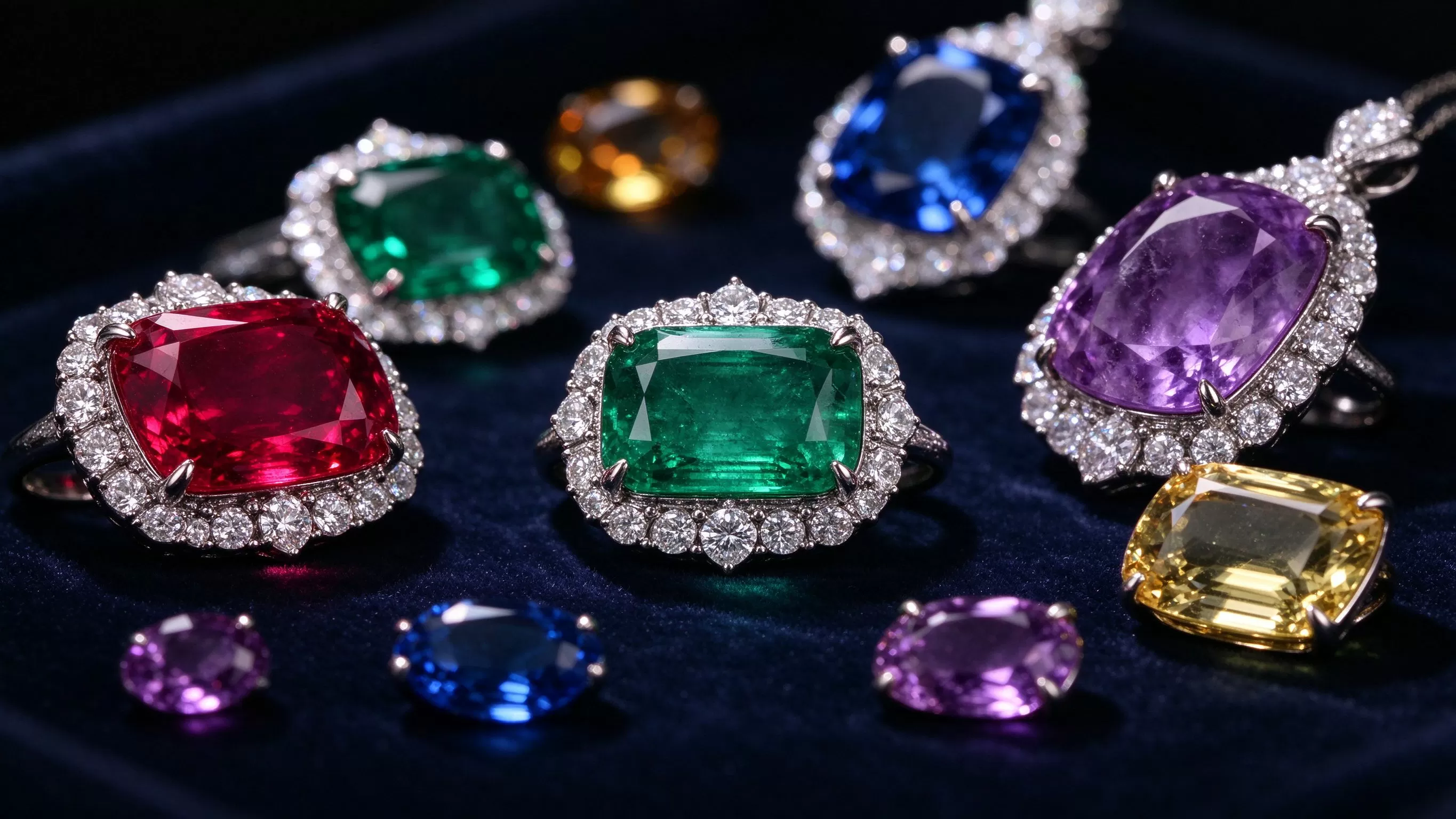
A first-time buyer walks into a store and says she wants a sapphire pendant at $500. The salesperson shows her a 1ct heat-treated sapphire in 10k gold at $480, and a 0.5ct heat-treated sapphire in 14k gold at $520. She walks out with neither. She came in with a price, not a budget. The difference is the percentage split between stone, metal and labor, and it is the same rule whether the ticket is $500 or $5,000.
This guide is for boutique owners and online retailers who need to teach customers how to set a gemstone budget by percentage, and for sourcing managers who need to match that budget to the right wholesale SKU. We cover the standard split, how treatment shifts the math, and where customers usually overspend.
The 40-30-30 split
Retail gemstone jewelry typically splits into three cost components: the stone, the metal and setting labor, and overhead plus margin. The trade-standard target for a mid-range piece is roughly 40 percent of retail going to the stone, 30 percent to metal and labor, and 30 percent to overhead, margin and sales commission. On a $500 pendant, that means about $200 of stone cost at wholesale. On a $5,000 engagement ring, that means about $2,000 of stone cost. The GIA 4Cs reference explains how color, clarity, cut and carat move that stone-cost number. The customer who asks what can I get for $500 is really asking what 40 percent stone can my budget buy. The salesperson who answers that question directly closes the sale. The one who shows a single SKU usually does not.
Treatment and price per carat
The same 1ct stone can cost 3 to 5 times more depending on treatment status. Heat-treated ruby in the 1ct band runs $120 to $260 wholesale. Unheated ruby in the same band runs $800 to $2,500. Oil-disclosed emerald runs $150 to $320 per stone. Heavily included, untreated emerald runs less, but it also returns more often. The GIA gemstone treatment reference outlines which treatments are accepted and which must be disclosed. We see stores that teach customers the treatment split on their website pre-sell 20 percent more stones in the mid band, because the customer understands why a 1ct heat-treated stone is $200 and a 1ct unheated stone is $2,000. For more on how treatment affects color expectation, see our notes on corundum family pricing and emerald versus ruby.
Where customers overspend
The most common overspend is on carat weight at the expense of color and cut. A customer will choose a 1.2ct pale sapphire over a 0.9ct vivid sapphire at the same price, because the carat number is visible on the listing. Within six months, she returns the pale stone because it looks washed out in daylight. The second most common overspend is on metal: a customer will step up from 10k to 14k gold on a $300 stone, which pushes the metal share above 40 percent and compresses the stone share below what the piece needs to look good. For context on how metal choice shifts the budget, see our rose gold versus yellow gold guide. For more on how gift budgets differ from self-purchase budgets, see buying jewelry on a budget.
Writing the budget on your site
Stores that publish a what to expect at $X guide on their category pages see lower bounce rates and higher add-to-cart rates. The guide should list the stone size band, treatment status, metal karat and a photo reference for each price point. It should also disclose the trade-standard split so the customer understands why a $500 piece has a $200 stone. For more on how to structure that page, see our online return policy checklist, which covers the disclosure language that reduces chargebacks.
Frequently asked questions
What percentage of a jewelry budget should go to the stone?
The trade-standard target is roughly 40 percent of retail going to the stone. Below 30 percent, the piece looks cheap at the price point. Above 50 percent, the metal and setting corners get cut.
Is it worth paying more for an untreated stone?
Only if the customer resells or collects. For everyday wear, heat-treated or oil-disclosed stones look identical to the eye and cost 3 to 5 times less.
Should I step up in karat or in color?
Step up in color first. A vivid 0.9ct stone outperforms a pale 1.2ct stone on the customer finger, and it returns less often.
What is the minimum budget for a real gemstone pendant?
Roughly $200 retail buys a heat-treated commercial stone in 10k gold. Below that, most pieces use composite stones or low-grade material that returns quickly.
Want a gemstone line that matches your price-band budget? HOLYCOME supplies heat-treated and oil-disclosed parcels with per-stone cost bands so you can hit the 40-30-30 split. Send us your target retail price points for a factory quote and parcel photos.
Frequently Asked Questions
How do I verify a factory before a bulk order?
Request a production video, business licence, export records and a paid sample run.
What payment terms do you offer?
30% T/T deposit with the balance against the bill of lading.
What is your normal reject rate?
3 to 5% under 10x loupe inspection; defective units are replaced free in the next shipment.
Where is the factory?
Wuzhou, Guangxi, China, with shipments via Guangzhou or Shenzhen.