Half Ring Sizes Explained: What They Mean and When to Use Them
Ring sizes are not whole numbers. Between a size 6 and a size 7 sits a 6.5, and between 7 and 8 a 7.5, and those half sizes matter more than most buyers expect. A ring that is a half size too small pinches and is hard to remove, while a ring that is a half size too large spins around the finger. Getting the half size right is the difference between a ring you forget you are wearing and one you constantly twist. This guide explains how half sizes work, when they matter, and how to decide between rounding up or down.
We will cover the actual measurement difference between whole and half sizes, when a half size is essential versus when it is overkill, how band width changes the calculation, and what to do if your measurement lands between half sizes. If you are starting from scratch, our ring size measurement guide covers how to measure, and our conversion chart lists international sizes.
What Is a Half Size, Exactly?
Ring sizes correspond to the circumference of the finger in millimeters, and each whole size moves the circumference by about 2.5 millimeters. A half size splits that difference, moving the circumference by roughly 1.25 millimeters. On the US scale, size 6 is about 52 millimeters around the finger, size 6.5 is about 53.3, and size 7 is about 54.6. That half-size gap sounds small, but on a finger it is the difference between a ring that slides on with slight resistance and one that glides.
The reason half sizes exist is that fingers do not fall neatly into whole sizes. Most adults measure somewhere between two whole sizes, and rounding to a whole size means the ring is either a little tight or a little loose. The half size lets you split the difference. For narrow bands, a half size is barely noticeable, but for wider bands it is critical, because width changes how the ring sits. Our band width guide explains why.
When a Half Size Matters Most
Half sizes matter most for wide bands. A 6mm or wider band feels tighter than a thin band at the same size, because more metal presses against the finger. If you measure a size 6 on a thin band, a wide comfort-fit band may feel like a 5.75, and you may need a 6.5. For this reason, wide-band buyers almost always benefit from a half size up. Our guide to wide band sizing covers this in detail.
Half sizes also matter for rings you wear all day. An engagement ring or wedding band that is a half size too small becomes uncomfortable by the afternoon, especially when your finger swells slightly. A half size up accommodates that swelling. Dress rings worn for a few hours can tolerate a looser fit, but everyday rings need precision.
Where half sizes matter less is for fashion rings worn occasionally, or for rings on fingers that fluctuate a lot day to day. If your finger swells and shrinks significantly, a half size precision is less useful than choosing a size that works across the range. Our swollen fingers guide helps with fluctuating sizes.
It also helps to understand that half sizes are not an exact science. Two different jewelers measuring the same finger may come up with a half size difference, depending on the tool, the time of day, and the method. The goal is not a perfect number but a comfortable range. If your measurement bounces between 6.5 and 7 across two tries, a 6.75 or a 7 with an adjuster both work. Do not obsess over a single digit; focus on how the ring feels when you try it.
Should You Round Up or Down?
If your measurement falls between a half size and a whole size, the safe rule is to round up. A ring that is slightly loose can be worn with a ring guard or adjuster, and it is more comfortable in warm weather when fingers swell. A ring that is too small is painful, hard to remove, and risks getting stuck. Most jewelers advise sizing up rather than down when you are between sizes.
The exception is if you are measuring with a wide band and your knuckle is larger than your finger base. In that case, you size for the knuckle, and the ring will be loose on the finger base. A ring adjuster or spring inside the band fixes that looseness. Our home measurement methods explain knuckle-based measuring.
Another exception is eternity rings, where all-around stones prevent resizing. If you are buying an eternity ring, measure carefully and size slightly up, because you cannot easily resize it later. Our eternity ring sizing guide covers the limits.
Quarter Sizes and Narrow Bands
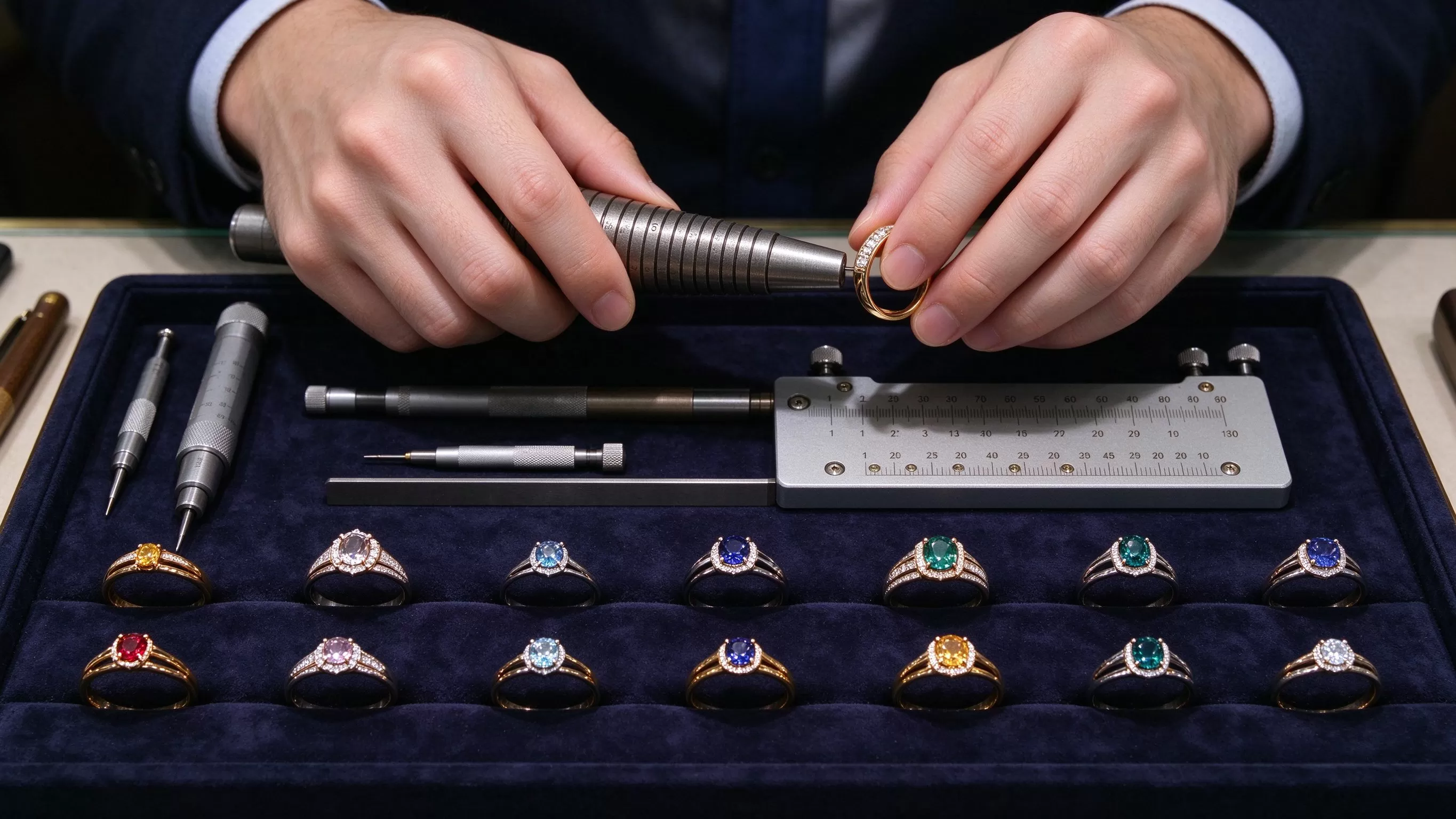
Some jewelers offer quarter sizes, such as 6.25 or 6.75. These are useful for people whose fingers fall exactly between half sizes, or for very narrow bands where a half size feels too big. Quarter sizes are less common, and most people are perfectly well served by half sizes. If a jeweler offers them and your measurement is between half sizes, a quarter size gives a closer fit.
For most buyers, ordering a half size is precise enough. The difference between a half and quarter size is less than a millimeter of circumference, and finger size changes more than that between morning and evening. Worrying about quarter sizes is usually unnecessary unless you have a very specific fit need.
Half Sizes Across International Scales
Half sizes exist on the US and Canadian scale, but other regions handle increments differently. The UK scale uses letters and half-letters, such as L and L.5. The European scale uses inside circumference in millimeters, so half sizes correspond to half-millimeter increments. If you are converting between scales, our conversion chart maps half sizes across systems.
When buying online from an international brand, check which scale they use. A US 6.5 is an EU 53 and a UK M. Getting the half size right in the right scale prevents ordering a ring that is a full size off. Many international retailers print both scales on their size guides.
What If You Cannot Get the Half Size?
If a ring comes only in whole sizes and your measurement is a half size, size up and use a ring adjuster. These are small silicone or metal inserts that fit inside the band, reducing the effective size by about a half. They are removable and inexpensive. This is a common solution for fashion rings that skip half sizes. Our ring fit guide explains when an adjuster is needed.
If the ring is solid and resizable, you can also have a jeweler resize it to the exact half size. Most solid gold, silver, and platinum rings can be resized up or down by a half size or more, as our resizing guide explains. Eternity rings and bands with all-around stones cannot be resized, so measure carefully for those. The resizing cost is modest, and it is far cheaper than wearing a ring that does not fit.
How Temperature Affects Half Size Fit
Your finger size changes with temperature, and that changes whether a half size feels right. In cold weather, fingers shrink, and a ring that fit snugly in summer may spin around. In hot weather, fingers swell, and a half size that felt perfect in winter may pinch. This is normal, and it is why jewelers measure fingers in the middle of the day, at room temperature, not first thing in the morning or after a hot shower. Our temperature sizing guide goes deeper.
For this reason, a half size that feels slightly loose in an air-conditioned room may feel perfect by mid-afternoon when your finger is warm. If you measure in a cold jewelry store, size up a little. If you measure after a workout or a hot day, wait until your finger cools before deciding. The goal is a fit that works across the temperature range, not one that is perfect in one moment.
Sizing Across Different Fingers
Your fingers are not all the same size. The ring finger on your dominant hand is often larger than the same finger on your other hand, and your middle finger is larger than your pinky. Never assume a ring size from one finger fits another. Measure the actual finger the ring will go on, especially if you are buying a pinky ring or a middle-finger ring. Our average ring sizes guide shows the range.
For stacked rings or midi rings, size each ring separately. A midi ring worn above the knuckle is smaller than a regular ring on the same finger, and a pinky ring is smaller still. Stacking rings also sit close together, so they need to share space without squeezing the finger. Our stacking ring sizing guide explains the clearance needed.
When to Re-Measure
Ring size is not permanent. Weight changes, age, pregnancy, and medication can all change finger size over years. If your ring suddenly feels tight or loose, re-measure rather than assume you bought the wrong size. Many people find their ring size shifts half a size over ten years. Our weight and ring size guide covers these changes.
If you are buying a ring as a surprise, borrow one of the person's existing rings on the correct finger and measure it. This is more reliable than asking, and our surprise sizing guide explains the sneaky methods. The half size matters here too, because a surprise ring that is a half size off is noticeable.
Frequently Asked Questions
What is a half ring size? A half size is halfway between two whole sizes, such as 6.5 between 6 and 7, giving a closer fit.
Should I size up or down if my ring is between sizes? Size up. A slightly loose ring is safer and more comfortable than a tight one.
Do half sizes make a big difference? Yes, roughly half a millimeter of circumference, which is the difference between comfortable and tight for everyday rings.
Are there quarter sizes? Some jewelers offer them, but half sizes are the standard and enough for most people.
Can a half size be resized? Yes, any size including half sizes can be resized if the band design allows.
Half Sizes Make the Fit
Half ring sizes are not a technical detail for experts. They are the difference between a ring that fits and one that pinches or spins. Measure carefully, account for band width, round up when in doubt, and use an adjuster or resizing if the half size is not available. For everyday rings, especially wide bands, the half size is worth getting right.
Many people never think about half sizes until they buy a ring that is slightly off, and then they notice it every day. A ring that is a half size too small feels tight in the afternoon, and a ring that is a half size too large spins around the finger, catching on clothing and twisting the setting. Neither is dangerous, but both are annoying, and both are avoidable by ordering the half size rather than rounding. When in doubt, size up, because a half size loose is far easier to live with than a half size tight. If the ring is resizable, the jeweler can fine-tune it afterward. If it is not, like an eternity band, the half size is your only shot, so measure twice.
The good news is that modern online jewelers and workshops list half sizes as standard, so ordering a 6.5 or 7.5 is no harder than ordering a whole size. Use the measurement method you trust, write down the half size, and do not round it away. We manufacture rings in full and half sizes in our Shenzhen workshop in Henggang, Longgang, and we can custom-size to quarter increments if needed. Email service@holycome.com for a size-specific quote. More sizing guides live in our Sizing Guide library.