Weight Loss and Gain: How Your Ring Size Changes With Your Body
If you have lost or gained weight recently, your ring likely does not fit the way it did. A wedding band that slid on easily now spins around the finger, or a favorite ring that used to feel perfect now resists coming off. This is normal, and it is one of the most common reasons people resize rings. But the relationship between body weight and finger size is not as simple as the scale suggests, and timing the resize matters. This guide explains how weight changes move your ring size, when to wait, and when to take the ring to a jeweler.
We will cover how much weight loss actually changes finger size, why fingers shrink slowly even when the scale drops fast, when to resize versus when to use a temporary adjuster, and what happens with weight gain. We will also cover pregnancy, aging, and fluid retention, which are often mistaken for weight changes. If you are trying to decide whether your ring is permanently loose or just in a fluctuating phase, our swollen fingers guide helps, and our resizing guide covers the process.
How Much Does Weight Change Ring Size?
There is no exact formula, but as a rough rule, significant weight loss of 20 to 30 pounds often changes finger size by about half to a full ring size. More extreme weight loss can move the size by two or more sizes. This is because fingers hold a layer of fat under the skin, and as that fat decreases, the finger circumference shrinks. But the change is not linear with the scale, and it does not happen overnight.
Some people lose weight in their face and fingers first, while others lose it later. If you are seeing a smaller size on the scale but your ring still fits, give it time. Finger fat and fluid adjust over months, and the ring may loosen a few months after the weight stabilizes. If you have lost a lot of weight and your ring still fits, you may be one of the people whose fingers hold size longer.
Weight gain works in reverse. Gaining 20 to 30 pounds can add half to a full ring size, especially if the gain includes fluid retention. A ring that fit perfectly can become tight, and in some cases stuck. If your ring suddenly feels tight after weight gain, do not force it off; see the section below on stuck rings.
Why Fingers Change Slowly
The slow change is frustrating for people who want to resize right away. But resizing too early is a common mistake. If you lose weight quickly, your fingers may continue to shrink for months afterward, and a ring resized today may be too loose in six months. The advice from jewelers is to wait until your weight is stable for at least three months before resizing. This means after you have reached your goal and held there, not while you are still losing.
During the waiting period, use a ring adjuster, a small silicone insert that fits inside the band, to keep a loose ring from spinning off. This is a cheap, temporary solution while your finger settles. Once your weight and finger size are stable, measure the finger and resize once. Our ring fit guide explains when an adjuster is needed.
If you are losing weight through exercise, remember that fingers also hold fluid after workouts, and exercise can build hand and forearm muscle. Some people find their fingers stay the same size or even grow slightly despite weight loss, because muscle and fluid offset the fat loss. This is normal, and it reinforces waiting for a stable measurement.
When to Resize After Weight Loss
The trigger for resizing is simple: the ring spins around the finger, slips off without pressure, or catches on clothing. If it is still comfortable and stays in place, no resize is needed, even if it feels looser than before. A ring that stays put is fine. Once it starts sliding off on its own, or turning so the setting faces the wrong way, it is time to either use an adjuster or resize.
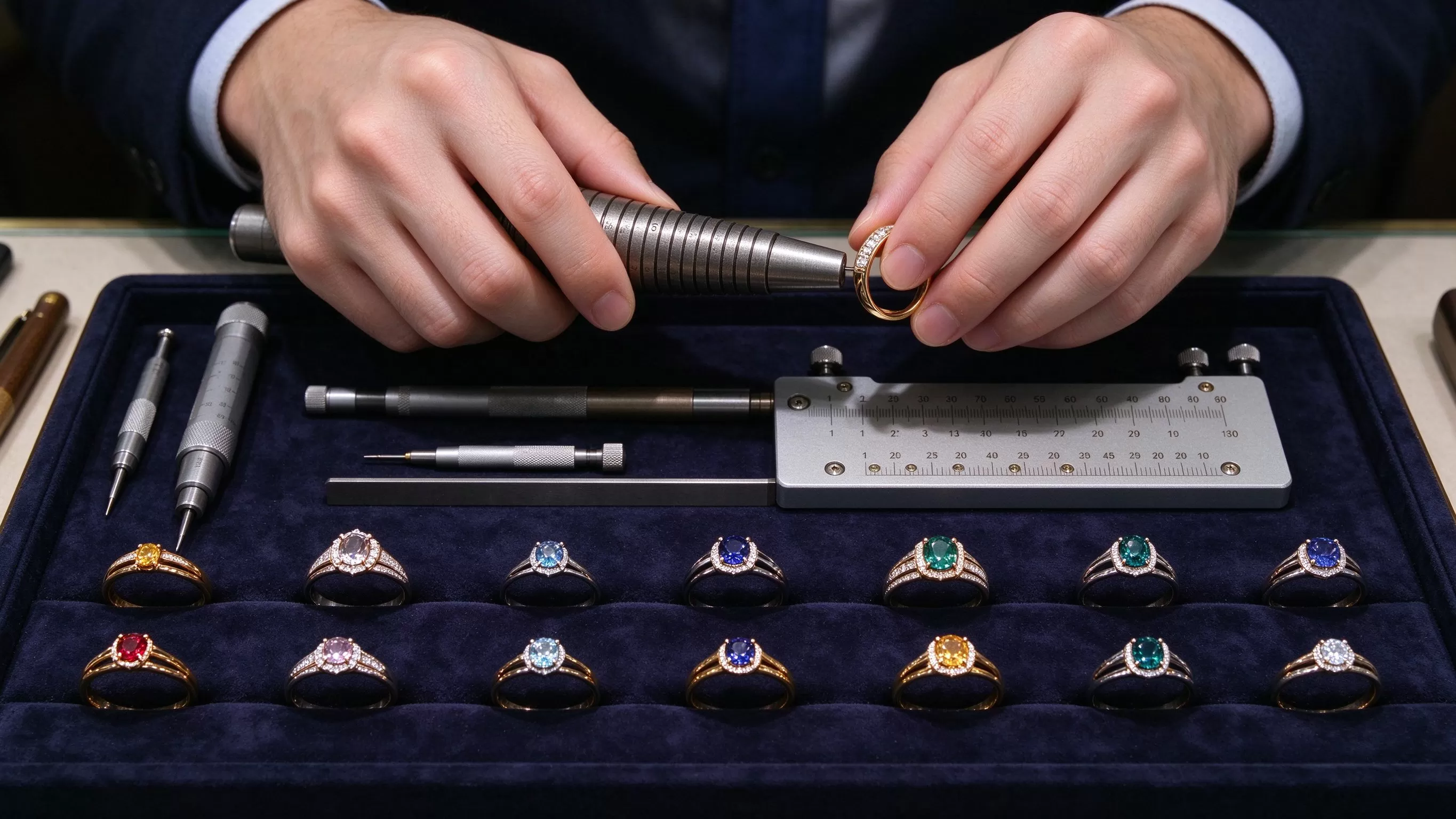
For most solid rings, resizing down is straightforward and inexpensive. A jeweler cuts out a small section of the band and solders it back together. The cost depends on the metal and the design, but it is modest for plain bands. Our resizing guide lists what to expect. Eternity bands and rings with stones all around the band cannot be resized, because cutting the band would damage the stones, covered in our eternity ring sizing guide.
When a Ring Gets Tight From Weight Gain
A tight ring is more urgent than a loose one. If a ring resists coming off, do not soap and twist hard, because that can bend the band or damage the setting. Remove rings before showering when they feel tight, and elevate the hand to reduce swelling. If the ring is stuck, a jeweler can remove it safely with a ring cutter, which does not damage the finger.
For weight gain, the solution is the opposite: the ring needs to be sized up. If you are still gaining, wait until the weight stabilizes before sizing up, because you may need a larger size later. In the meantime, stop wearing the tight ring rather than forcing it on. Our swollen fingers guide covers temporary tightness from heat, pregnancy, and salt.
Pregnancy and Finger Size
Pregnancy is a special case of temporary finger swelling. Many women find their rings get tight in the second and third trimesters, due to fluid retention. The advice is to stop wearing rings during late pregnancy rather than sizing up, because the swelling is temporary and the rings will likely fit again after birth. A ring sized up during pregnancy may be too loose afterward. Many women switch to a necklace on a chain during pregnancy, or a larger silicone band. Our size chart includes pregnancy guidance.
After giving birth, finger size can take months to return to normal, and sometimes it settles at a slightly different size than before pregnancy. If your ring still does not fit six months after birth, that is the time to re-measure and resize.
Age and Finger Size
Beyond weight, age changes fingers. Knuckles often enlarge with age, while the base of the finger may shrink. This means a ring that used to slide over the knuckle snugly now has to be sized for the knuckle, leaving it loose on the finger base. This is a common fit complaint for older adults, and the solution is a ring adjuster or a sizing that accounts for the knuckle. Our knuckle sizing guide explains this in detail.
Some older adults also notice their fingers become thinner overall, shifting ring size down half to a full size over decades. If a ring you have worn for years suddenly spins, age and finger thinning may be the cause, not weight change.
Fluid Retention and Salt
Not every tight ring is weight gain. Fluid retention from a salty meal, a hot day, or a menstrual cycle can swell fingers by half a size or more, making a perfectly fitted ring feel tight for a day or two. This is temporary. If your ring feels tight after a salty dinner, wait a day, drink water, and see if it loosens. Measuring your finger on a swollen day gives a falsely large size, which is why jewelers measure at midday, at room temperature, and not after exercise or a heavy meal.
Certain medications also cause fluid retention in the hands, including some blood pressure medications and anti-inflammatories. If your rings suddenly get tight and your weight has not changed, consider whether a medication change is the cause. In those cases, the finger size may settle, or it may stay elevated, and you may need a permanently larger size. Our temperature guide covers the daily fluctuations.
Swelling From Exercise and Injury
After a tough workout, especially lifting or gripping, fingers swell from blood flow and fluid. A ring that fit in the morning may feel tight after the gym, which is why many people remove rings before exercise. Our gym care guide explains this. If your ring is tight only after workouts, it is not a weight change, and you should not resize for it. Remove the ring before exercising and put it back on when the hand cools.
An injury, like a jammed or broken finger, changes the size permanently if swelling or scar tissue develops. If you injure a finger, stop wearing the ring on that finger until it heals, and re-measure afterward. Some people find their injured finger is a half size larger after healing, and they keep the ring on the other hand or resize it.
When a Ring Is Stuck
If a ring will not come off, do not panic and do not keep forcing it. Elevate the hand above heart level for a few minutes to reduce swelling, then try a little lotion or soap as lubricant, gently wiggling the ring from side to side rather than pulling straight. If it still will not move, see a jeweler or emergency service, who can cut the ring off in seconds without injuring the finger. A cut ring can usually be repaired, but a stuck ring left on too long can cut off circulation.
Prevention is better: if a ring feels tight, remove it before bed, before exercise, and before hot weather. A ring that is a half size too small is a future stuck ring, and sizing up is far cheaper than a ring-cutting visit.
Sizing for a Future Change
If you are planning a major weight change, surgery, or a pregnancy, do not buy a ring in anticipation. Buy it after the change, or plan to resize. For engagement rings, many couples wait until after the wedding and honeymoon to resize, because weight and fluid from the wedding week can temporarily change finger size. A ring that fits the day you get engaged may feel different by the wedding, and resizing after the big day is normal.
For people who know their weight fluctuates often, a comfort-fit band or a slightly larger size with an adjuster is more practical than resizing back and forth every season. The goal is a ring that fits across the range of your normal fluctuations, not one that is perfect on one day. Our comfort fit guide explains why those bands fit looser.
Frequently Asked Questions
Does losing weight make rings looser? Yes, finger size shrinks, usually half to a full size after significant weight loss.
When should I resize my ring after weight loss? Wait until your weight is stable for three months, then re-measure.
Can rings be made smaller after weight loss? Yes, most solid rings can be resized down. Eternity bands cannot.
Does gaining weight make rings tight? Yes. If a ring gets stuck, see a jeweler rather than forcing it.
Do fingers shrink with age? Sometimes, while knuckles can enlarge, changing the fit.
Time Your Resize Right
Weight changes your ring size, but the finger moves slower than the scale. Wait until your weight is stable, use an adjuster in the meantime, and resize once when the fit is clearly too loose or too tight. Do not resize mid-diet, and do not size up during pregnancy. If you are unsure, measure your finger and compare it to the ring's current size. Most people only need one resize after a major weight change, and the ring then fits comfortably for years. If the ring is engraved or wide, ask the jeweler whether the resize affects the engraving, and plan for a possible re-engraving. We resize and remake rings in our Shenzhen workshop in Henggang, Longgang, and we can advise on whether a resize is worth it or whether a adjuster will do. Email service@holycome.com for a resize quote. More sizing guides live in our Sizing Guide library.