Jewelry Packaging: Why Presentation Is Part of the Product
The customer never touches the ring for the first time inside the ring itself. They touch the box. The moment a jewelry box opens, the velvet insert gives, the lid lifts with a satisfying weight, and the piece settles into a shaped recess, the customer has already formed an impression of what the jewelry inside is worth. That impression is engineered, not accidental. Jewelry packaging is an entire industry of its own, and smart brands treat it as part of the product rather than a box to stuff the jewelry into. A fine piece in a flimsy box feels like a bargain; a modest piece in a carefully designed box feels like a gift. Packaging is the first and last thing a customer experiences, and it quietly sets the price expectation for everything that comes after.
This guide looks at jewelry packaging from the manufacturer and brand side: what makes packaging part of the product, the materials and structures that convey quality, how private-label packaging builds a brand, the cost trade-offs, and the sustainability questions buyers now face. It is an often-overlooked lever in jewelry, and getting it right is one of the cheapest ways to make a collection feel more expensive without changing a single design.
The Unboxing Is Part of the Purchase
Modern retail has made unboxing a deliberate moment. A customer buying jewelry, especially online, experiences the product through the package long before they wear it. The shipping box, the outer wrap, the inner jewelry box, the insert, the care card, and the thank-you note are all touchpoints, and each one shapes how the customer feels when the ring finally appears. Brands that understand this design the whole sequence so the opening feels like an event, which is why so many direct-to-consumer jewelry brands spend heavily on unboxing even though the packaging is discarded within minutes.
That feeling matters because jewelry is emotional, not functional. Nobody buys an engagement ring because they need a piece of metal on their finger; they buy it for the meaning and the moment. The packaging is where that moment begins. A rigid box with a magnetic lid and a velvet insert signals that the piece inside is precious, which primes the customer to perceive it as such. A flimsy cardboard box signals that the piece is disposable. This is not manipulative; it is how expectation works, and it explains why two rings of identical quality can land with very different perceived value depending on how they arrive. For the brand side, our note on private-label jewelry shows how packaging extends the brand identity.
The practical consequence is that packaging cannot be an afterthought chosen at the end of a product development cycle. It should be designed alongside the jewelry, because the dimensions, the weight, and the protection needs of the piece dictate the box, and the brand's aesthetic dictates the materials and print. A pendant on a long chain needs a box with a chain well; a chunky ring needs a deeper insert; a delicate earring pair needs secure carded slots. Designing the packaging last usually means compromises that show up as a piece rattling loosely in an oversized box.
Materials and Structure That Convey Quality
Quality in jewelry packaging is communicated through materials and structure before any logo is read. Rigid boxes, made from thick board wrapped in paper or fabric, feel substantial because they have weight and they close with a solid magnetic or clasp mechanism. Flimsy folding cartons, by contrast, feel light and cheap no matter how pretty the print is. The insert material carries the next signal: velvet feels traditional and luxurious, suede-feel microfiber feels modern and soft, rigid card slots feel minimal. Customers read these textures instantly, even when they cannot articulate what they are responding to.
Structure details add up. A box that opens with a smooth magnetic close, holds the lid at a perfect angle, and cradles the piece in a shaped recess communicates care. A box whose lid warps, whose insert slides around, or whose piece rattles communicates the opposite. These details cost very little to get right at the manufacturing level but pay off enormously in the customer's hands. When a brand asks a manufacturer for custom packaging, the first questions are about board weight, lining material, and closure type, because those choices set the price tier of the unboxing before the jewelry is even considered.
Printing and finishing on the box then layer the brand identity. Foil-stamped logos, embossed textures, custom color-matched papers, and a matte lamination all raise the perceived quality. A simple debossed logo on a heavy textured box reads as quietly premium, while a box covered in loud print can read as promotional. The packaging print should match the brand's tone, and it should feel expensive in a way that does not fight the jewelry inside. Our overview of how brands build their look ties packaging into the broader manufacturing picture.
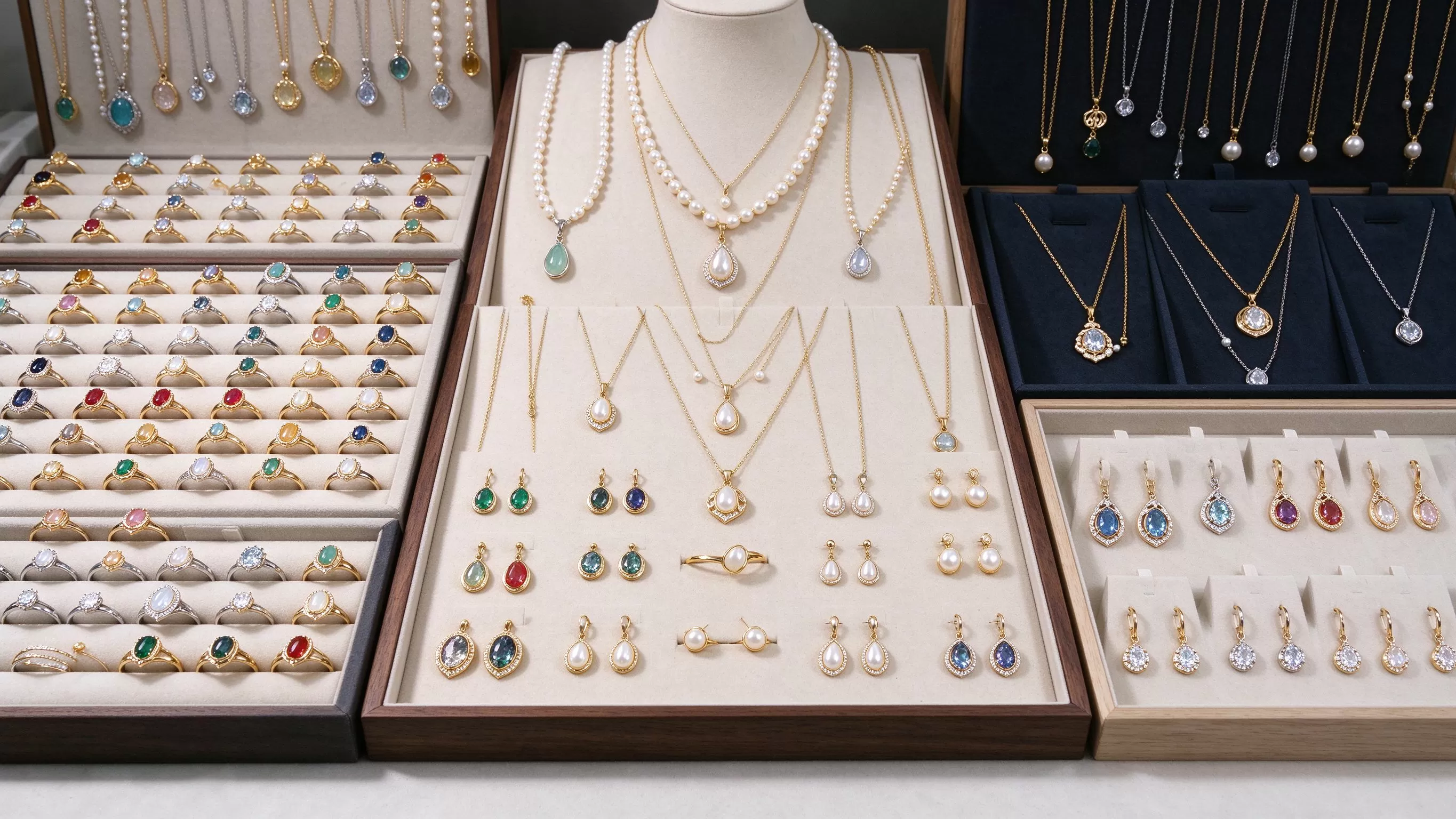
Private-Label Packaging and Brand Control
For a wholesale brand, custom packaging is one of the most powerful private-label tools available. A generic jewelry box with a generic insert, supplied by a factory as a freebie, makes a brand look like everyone else. The same factory's packaging service, with the brand's logo foil-stamped on a color-matched box and a printed care card tucked inside, makes the collection look like a deliberate, own-brand product. Because packaging is so visible in unboxing photos and social shares, branded packaging also does quiet marketing: customers photograph beautiful boxes, and the logo travels with the image.
Private-label packaging usually scales with order volume. A brand can start with stock boxes printed with a small logo, then move to fully custom rigid boxes once the line is selling. The MOQ for custom rigid boxes is higher than for generic packaging, because the tooling and board setup have to be amortized, but per-unit cost drops quickly at volume. A manufacturer who offers packaging as part of the service simplifies the whole chain: the jewelry is set, inspected, and packed into the branded box in one place, ready to ship. This is far smoother than ordering jewelry from one supplier and boxes from another and trying to marry them yourself.
There is a subtlety worth flagging: packaging should be specified, not assumed. A supplier's default "free box" is often a very basic stock box chosen to be cheap, and it can undersell a line you have invested in. Ask to see the actual box you will receive, in hand, before bulk, because packaging photos online flatter. Confirm the board weight, the lining, the closure, and the logo placement, and approve a physical sample. The unboxing experience is too visible to leave to a default. Our guide to sample order strategy applies just as much to packaging as to the jewelry itself.
Cost Trade-Offs and the Bottom Line
Packaging cost is deceptively small per unit but meaningful at volume. A basic stock box may cost under a dollar, while a custom rigid magnetic box with foil stamping can cost several dollars each. Over a thousand orders, that difference adds up to real money, which is why brands tier their packaging. A everyday, affordable line can ship in a tasteful stock box with a printed sticker, while a premium bridal or gift line justifies the custom rigid box. The mistake is spending custom-rigid money on a budget line where the product price cannot absorb it, or skimping to a generic box on a premium line where the box undersells the jewelry.
The smart middle path is tiered packaging. Use the nicer box for your hero, giftable, or high-average-order pieces, and a simpler but still branded box for everyday replenishment. This matches packaging investment to the emotional moment: an engagement ring deserves the moment; a simple stud pair that arrives in a mailer needs protection and a clean presentation, not an elaborate ceremony. Customers understand this intuitively, and a brand that tiers its packaging feels considered rather than cheap or wasteful.
Shipping packaging is a separate but important cost. The inner jewelry box needs an outer shipping carton and padding that protects the piece in transit, because a crushed box undoes all the unboxing work. Jewelry is small and high-value, so shipping protection should be robust without being bulky. Brands that over-package in layers of filler look wasteful; brands that under-package risk damaged returns. The balance is a snug outer box with just enough padding, and it is worth testing a few shipments to yourself to confirm the inner box arrives pristine. Our note on logistics covers the shipping side beyond the box itself.
Sustainability in Jewelry Packaging
Packaging is where the sustainability conversation in jewelry is most visible, because customers see and dispose of the box immediately. Traditional jewelry packaging often relied on plastics: foam inserts, laminated coatings, single-use plastic bags inside the box. As customers demand less waste, brands are shifting to recycled board, FSC-certified papers, biodegradable inserts, and reduced plastic. A box that can be recycled or reused is now an expectation rather than a luxury, and many customers actively notice when packaging is thoughtfully minimal.
The sustainable challenge is that the very materials that feel luxurious, like thick velvet inserts and glossy laminates, are often the hardest to recycle. Brands navigate this by choosing recycled-content boards, soy-based inks, and inserts that are recyclable or reusable, while keeping the unboxing feel through design rather than plastic. A reusable jewelry box, one the customer keeps for storage, is itself a sustainability win because it extends the life of the package. Our broader coverage of sustainable manufacturing places packaging within the wider responsible-sourcing picture.
The honest balance is that sustainability should not come at the cost of protection. A jewelry box that is fully recyclable but fails to protect a delicate piece in transit creates returns that are far less sustainable than a slightly more packaged parcel. The goal is thoughtful reduction, not austerity: remove the unnecessary plastic, choose recyclable materials, and design a box that either protects well or is reused, rather than a box that looks green but damages the product. Customers reward this balance, and they see through greenwashing as readily as they see through a flimsy box.
Frequently Asked Questions
Does packaging really affect how jewelry is perceived? Yes. Customers form an impression of a piece's value the moment they open the box. A rigid, well-designed package primes a premium perception, while a flimsy box undersells even a well-made piece.
What makes a jewelry box feel luxurious? Weighty rigid board, a smooth magnetic or clasp closure, a soft velvet or microfiber insert, and clean foil-stamped or debossed branding. Structure and materials signal quality before the jewelry is seen.
Can I get custom branded packaging as a small brand? Often yes. Start with stock boxes printed with your logo, then move to fully custom rigid boxes as volume grows. Many manufacturers offer packaging as part of private-label production.
How much should packaging cost? It depends on the tier. Basic stock boxes are inexpensive, while custom rigid foil-stamped boxes cost more per unit. Tier the packaging: nicer boxes for giftable hero pieces, simpler branded boxes for everyday items.
Is jewelry packaging recyclable? Increasingly yes, as brands move to recycled board and reduced plastic. The balance is choosing recyclable materials without sacrificing the protection a valuable piece needs in transit.
The Box Is the First Piece of Jewelry They Own
Jewelry packaging is easy to ignore because it is thrown away, but in the moments that matter it is the first and last impression a customer has of a brand. A well-designed box sets the price expectation, carries the logo into social photos, and turns a transaction into a moment. For a brand, packaging is one of the highest-return levers available: it costs far less than redesigning a piece, yet it changes how the whole collection feels. We supply private-label jewelry with custom rigid and stock branded packaging, designed to fit each piece and ready to ship, so your unboxing matches the quality of the jewelry inside. For a quote on a packaged collection, write to service@holycome.com and explore more of our Industry Insights behind the workshop.