The Skilled Bench Jeweler Shortage: Who Will Make Tomorrow's Jewelry
For all the talk about CAD software, 3D printers, and automation, the jewelry industry still runs on people. A bench jeweler who can set a tiny row of pavé without cracking a stone, repair a decades-old chain invisibly, or hand-finish a cast ring so it looks like a single continuous piece is one of the most specialized craftspeople in manufacturing. And across much of the world, that aging workforce is not being replaced at the rate it is retiring. The skilled bench jeweler shortage is the quiet crisis behind the shiny storefronts: demand for well-made jewelry keeps growing, but the hands trained to make it are thinning out in the traditional workshop hubs.
This guide explains why the shortage exists, what kinds of skills are actually disappearing, how factories are adapting, and why a buyer should care about who is making their jewelry. It is not a story about robots replacing artisans; it is the opposite. The more the industry automates the easy steps, the more valuable the human bench jeweler becomes, and the harder it is to find good ones.
What a Bench Jeweler Actually Does
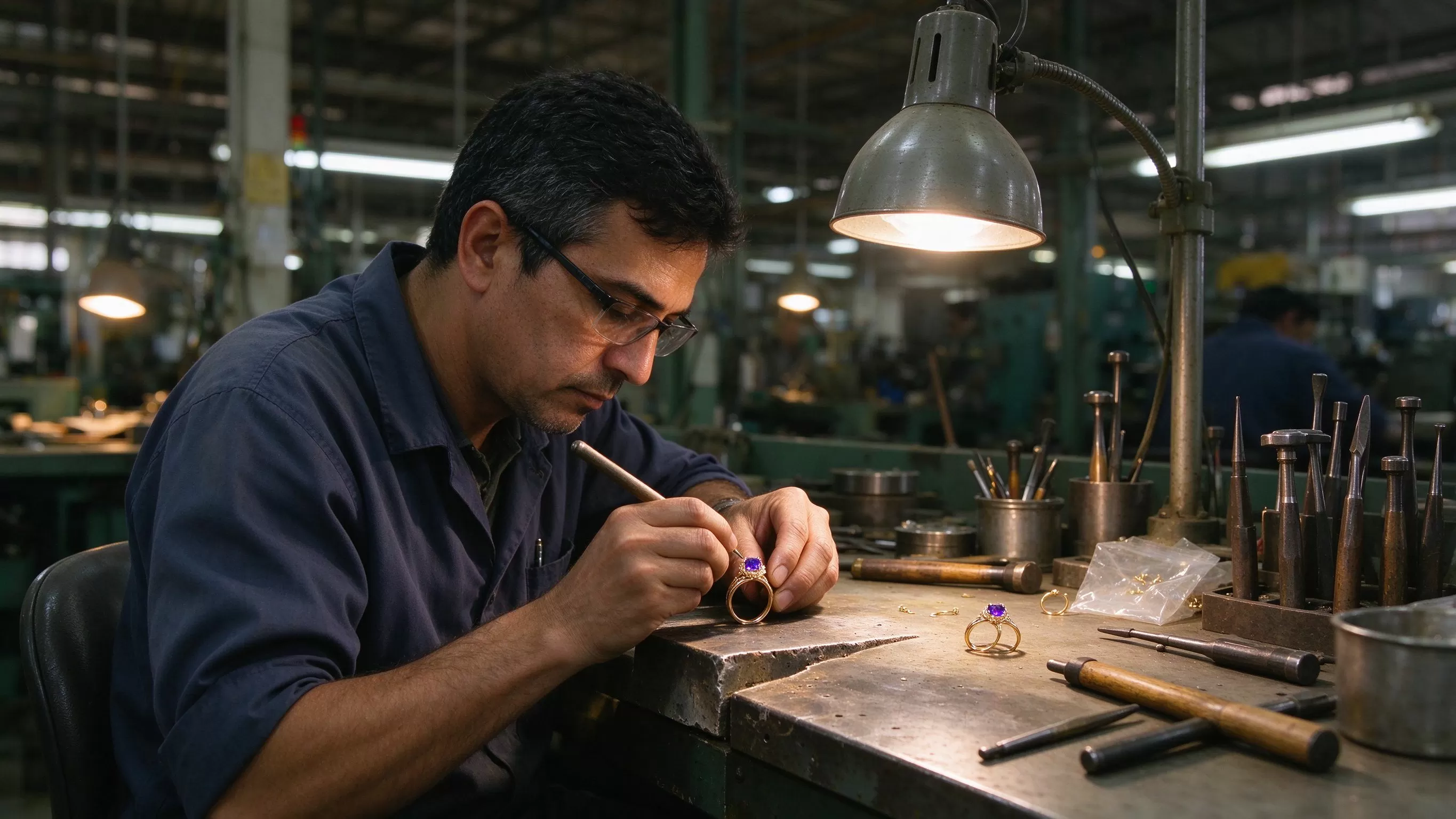
The term "bench jeweler" covers a range of hands-on skills that most customers never see. At the broadest, a bench jeweler can take a cast metal piece and bring it to finished, wearable condition: trimming sprues, filing seams, soldering, fitting stones, and polishing. Within that, specialists emerge. Stone setters focus exclusively on seating and securing gems, often under magnification, and they are among the highest-paid bench workers because a slip can ruin an expensive stone. Finishers perfect the surface to a high polish or a chosen texture. Engravers cut designs by hand. Repairers take in broken, aged pieces and restore them without changing their character.
What ties these roles together is that they cannot be fully automated. A 3D printer can produce a near-net shape, but the seams and sprues from casting still need a human file. A machine can brut a diamond girdle, but seating a row of mismatched melee in a curved pavé pattern requires eyes and fingers. CAD can model a setting, but the final prong tips have to be burnished over a stone by hand. These are delicate, judgment-driven tasks that reward decades of muscle memory, and they resist the kind of automation that has transformed, say, automobile assembly. Our overview of the full manufacturing sequence shows exactly where the bench fits.
Because the skills are specialized, they are also slow to learn. A new bench worker does not become a master setter in a year; it takes years of practice to develop the touch needed to set valuable stones without damage. That long apprenticeship is the root of the shortage: even when factories want to train new workers, the pipeline takes half a decade to produce a skilled hand, and the training itself is expensive and slow. Demand does not wait that long.
Why the Shortage Is Biting Now
Several forces converged to create the current squeeze. The first is demographics. The artisans who built the industry's postwar manufacturing base are reaching retirement age, and younger generations in traditional jewelry-making regions have not been drawn into bench work in the same numbers. Apprenticeship enrollments declined as young people pursued other careers, leaving a gap between retiring masters and qualified replacements. In some historic jewelry towns, the average age of a bench jeweler has climbed sharply, and the pool of qualified hands has shrunk even as output per worker has risen.
The second force is demand. Even as manufacturing moved toward digital tools, consumer demand for well-crafted, personalized jewelry did not slow; it expanded. Bridal commissions, custom engagement rings, and small-batch branded lines all require bench labor. Online sales lowered the barrier to starting a jewelry brand, which multiplied the number of small orders that need skilled hand work, rather than reducing it. So the industry simultaneously lost experienced workers and gained more demand for their exact skills. That combination is what turned a quiet trend into a noticeable shortage.
The third force is the migration of manufacturing itself. As production centralized in efficient hubs, some small workshops closed, and their skilled workers retired or left the trade rather than relocating. This does not mean the skills are lost globally; rather, they are concentrated. A buyer looking for bench skill now has to go to the places where the workforce did survive, which is part of why hubs like the Shenzhen manufacturing corridor and established Indian and Thai centers remain so important. The work has not disappeared; it has consolidated.
Which Skills Are Rarest
Not all bench skills are equally scarce. High-volume, repetitive tasks have been absorbed by machinery and by less-specialized labor, so the shortage is not uniform. The rarest skills are the ones that combine delicacy, speed, and judgment. Master stone setters, especially those who can set invisible, flush, or micro-pavé settings accurately, are in persistent demand across the industry. Hand engravers who can cut fine script and scrollwork are even scarcer, because the craft is taught through long apprenticeships and few young people enter it. Repair specialists who can fix antique pieces without harming them are a shrinking group, because repairing old work demands broad knowledge of techniques no longer used.
Polishing and finishing is the other pressure point. A beautiful design is undermined by a sloppy finish, yet good finishers, who can bring a cast piece to a uniform high polish without rounding its edges, take years to train. Factories that chase cheap labor often skimp on finishing, and the result is visible: pieces that look correct on screen but feel cheap in the hand. This is where the shortage directly affects product quality. The buyer who notices that a competitors' rings look slightly dull or uneven is often seeing a workforce gap, not a design problem. Our guide to metal finishes explains what that finishing step should achieve.
For a brand, the practical implication is that you are not just buying manufacturing capacity; you are buying access to skilled hands. Two factories can have identical CAD files and casting equipment, yet produce very different finished pieces, because one employs experienced setters and finishers while the other relies on entry-level labor. When you audit a supplier, asking about the bench team's experience and seeing the finishing area matters as much as checking the casting floor. A factory that invests in training its bench workers is positioning itself for the shortage, not being a victim of it.
How Factories Are Adapting
The industry's response to the shortage is not to wish for more artisans; it is to change how work is organized. One adaptation is specialization. Rather than expecting one generalist bench jeweler to do everything, modern factories break work into clear stations, where a setter sets, a finisher finishes, and a repairer repairs. Specialization lets less-experienced workers become very good at one narrow task, and it stretches the expertise of the rare masters by focusing their time on the hardest pieces. This is how high-volume output maintains quality despite a thinner bench: the work is structured around the skills available.
Another adaptation is training investment. Forward-thinking manufacturers run their own apprentice programs, pairing new workers with senior artisans and creating clear paths from simple tasks to complex ones. This is expensive and slow in the short run, but it builds a loyal, skilled bench that competitors cannot easily copy. Factories in major hubs now treat training as a strategic asset rather than an afterthought, because they know that as the shortage tightens, a trained workforce is a durable competitive advantage. Brands that work with these factories benefit indirectly, because the quality of the bench is reflected in every reorder.
A third adaptation is using technology to remove the tasks that do not need human judgment. Modern casting and CAD reduce the amount of hand carving, and mechanical polishing and tumbling handle the rough work, leaving skilled bench workers free for the precise, value-adding steps. This is not automation replacing the artisan; it is automation doing the drudgery so the artisan can spend their hours where judgment matters. The result is that a smaller bench can produce more finished pieces, but the people on that bench have to be better trained, not less. For the human side of why craft still matters, our note on production methods compares where machines stop and hands begin.
What This Means for Buyers and Brands
The bench shortage changes how a brand should choose a manufacturer. The cheapest quote often comes from a factory that underinvests in its bench, because labor is its biggest controllable cost. But the savings show up later in loose stones, uneven finishes, and high return rates. In a market where skilled hands are scarce, a factory that can actually deliver consistent, well-finished pieces is worth paying a little more for, because the alternative is chasing low prices and rebuilding a line from returns. Vet the finishing and setting bench directly rather than judging a factory on its equipment list.
It also means planning production around bench reality. Custom and intricate pieces take longer not because the factory is slow, but because a skilled setter has to do the work by hand. Asking for a complex pavé ring in a week is asking for an overworked setter to rush a delicate job, which is how stones get cracked. Build realistic lead times that respect the bench, and you will get better work than brands that try to compress every timeline. Our guide to typical lead times helps set those expectations.
Finally, value craft in your marketing. As mass production becomes cheaper and more uniform, a piece made by experienced bench hands is genuinely differentiated. Brands that can honestly describe hand-set pavé, hand finishing, and small-batch craftsmanship are selling something that automated competitors cannot easily copy. The bench shortage is, in a strange way, an opportunity for brands that partner with skilled workshops, because the quality gap between a skilled hand and a rushed one is widening rather than closing.
Frequently Asked Questions
What is causing the bench jeweler shortage? An aging artisan workforce that is not being replaced at the same rate, combined with rising demand for custom and hand-finished jewelry. Long apprenticeships mean new skilled hands take years to produce.
Which bench skills are hardest to find? Master stone setters, especially for micro-pavé and flush settings, hand engravers, antique repair specialists, and experienced finishers are the scarcest. Repetitive tasks have been automated, so the shortage concentrates on delicate, judgment-driven work.
Is automation replacing bench jewelers? No. Automation handles carving and rough polishing, but delicate setting, engraving, and hand finishing still require trained hands. Technology removes the drudgery so skilled bench workers focus where judgment matters.
How can a buyer tell if a factory has a strong bench? Visit or inspect the finishing and setting area, ask about the team's experience and training, and examine sample pieces closely for even prongs, uniform polish, and securely seated stones.
Why does a skilled bench affect the price? Experienced setters and finishers command higher labor costs, but they produce consistent, low-return pieces. The cheapest options often underinvest in the bench and show it through loose stones and uneven finishes.
Protect the Hands, Protect the Quality
The bench jeweler shortage is not a headline crisis that will be solved by a new machine. It is a structural shift in an industry that suddenly needs more delicate handwork while losing the artisans who traditionally supplied it. The winners will be the factories that train, specialize, and respect their bench teams, and the brands that choose those factories over the cheapest quote. When you next hold a well-finished ring, remember that the even prongs and the uniform polish are the product of scarce hands, not software. We invest in a trained setting and finishing bench in our Shenzhen workshop, because we know the difference a skilled hand makes in a reorder. For a quote on a line that prioritizes consistent craft, write to service@holycome.com, and read more about how jewelry is really made in our Industry Insights series.