Jewelry Finishing: Polishing, Tumbling, and Buffing Explained
A freshly cast ring comes out of the mold looking nothing like the gleaming piece in a store window. It is dull, gray, covered in plaster residue, crisscrossed with sprues and seams, and rough to the touch. The process that transforms that gray shell into a mirror-bright or deliberately textured piece is finishing, and it is one of the most underrated steps in jewelry making. Two rings with identical castings can end up looking and feeling completely different depending on how they were finished. A rushed finish leaves dull patches, rounded edges, and a flat surface; a careful finish produces the depth and luster that makes gold look expensive. Yet shoppers almost never think about finishing, because they see only the result.
This guide walks through jewelry finishing from the manufacturer's side: the sequence of steps from raw casting to polished piece, the difference between high polish, brushed, and hammered finishes, how tumbling and buffing work, and why the finishing step decides whether a piece looks cheap or crafted. It is the step where the bench jeweler's hand has the last word, and it is where the skilled-labor shortage bites hardest.
From Gray Casting to Polished Piece
The finishing sequence begins the moment a casting comes free of its investment. First, the sprues, the wax tree branches that fed metal into the piece, are cut off flush with a saw or disc. The leftover stump is then filed down until it disappears, blending into the surrounding metal. This is slow, careful work, because file too deep and you gouge the piece, file too little and a visible nub remains. After spruing, the casting's seams, the lines where the mold halves met, are removed with files and abrasives. At this stage the piece begins to look like the object it is meant to be, though it is still matte and rough.
Next comes the progression of abrasives. Finishing moves from coarse to fine, never skipping a grit, because a deep scratch left by a coarse abrasive cannot be removed by a fine one. Technicians use files, sanding sticks, and abrasive wheels that step through increasingly fine grades, smoothing out each previous scratch pattern. This step, called prepolishing, is where most of the work happens. A ring that will be high-polished must be brought to a uniform, scratch-free surface before the final buff, because the final polish only amplifies whatever is underneath. Our overview of the full manufacturing sequence shows where finishing sits between casting and setting.
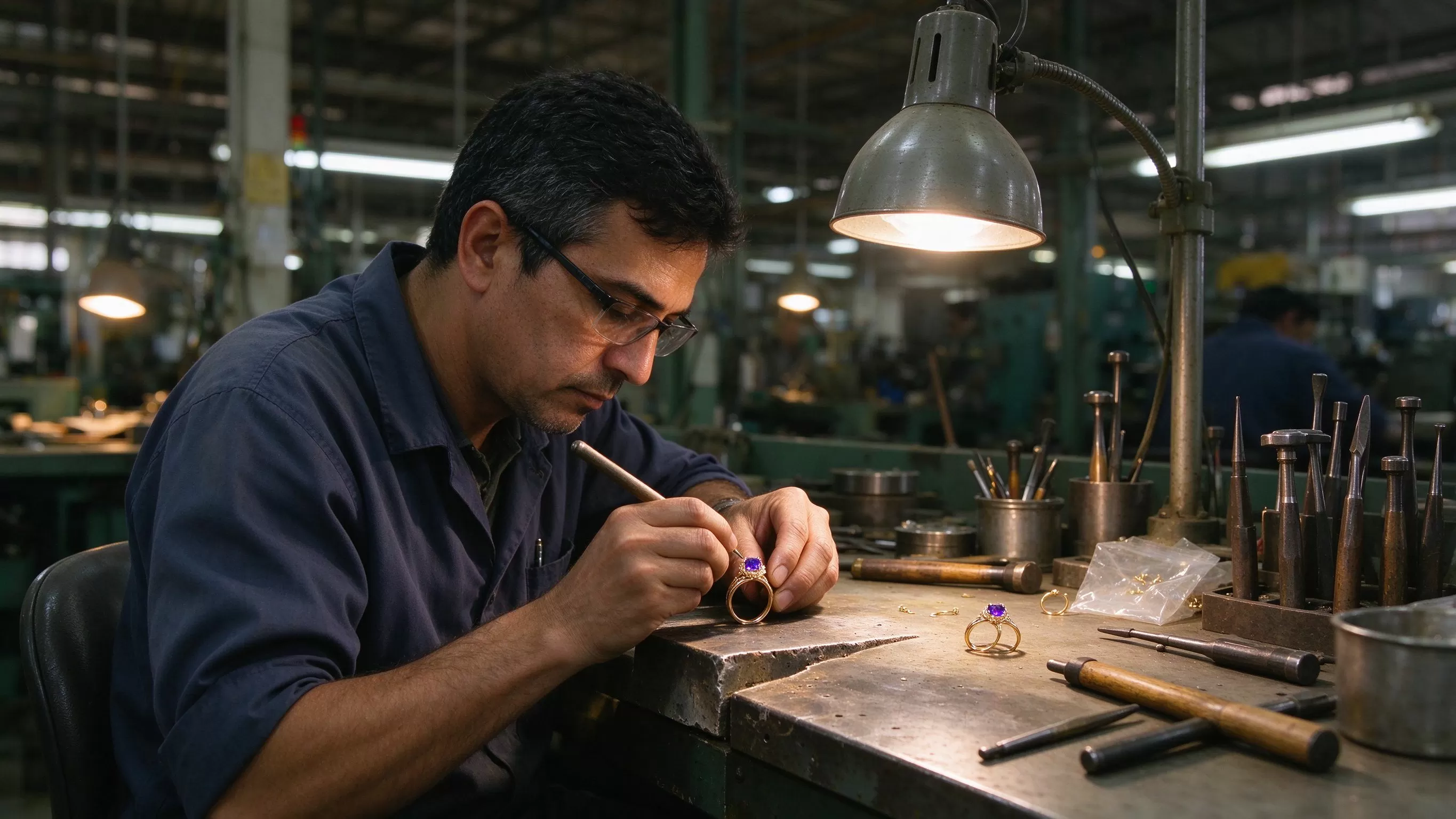
Only after the surface is uniformly smooth does the piece reach the final polish. At that point the finishing specialist uses soft buffing wheels and polishing compounds to bring the metal to its intended luster. The difference between a pre-polished surface and a final buff is dramatic: the metal suddenly goes from matte and gray to rich, reflective gold. The whole process is labor-intensive, and it is why two factories with the same casting can charge different prices: the cheaper one spends less time on prepolishing and buffing, and the surface shows it.
High Polish, Brush, Satin, and Hammered
"Finishing" is not only about making metal shiny. It is about choosing a surface character, and jewelry offers a deliberate menu of finishes. High polish is the mirror-like, reflective surface most people picture, achieved with soft buffs and rouge compound. It shows every fingerprint and scratch, but it also makes gold look its richest and brightest. Brushed or satin finishes run a fine directional texture across the metal, which hides scratches and fingerprints and reads as modern and understated. A brushed wedding band is popular precisely because it does not show wear the way a high-polish one does. Our guide to metal finishes catalogs the full range.
Hammered and textured finishes take a different direction. Rather than smoothing the surface, the finisher deliberately creates texture, tapping the metal with a hammer or using a textured wheel, producing a handmade, dimensional look. This is a craft finish, because each hammer mark is placed by hand, and it reads as artisanal rather than machine-made. Antique or matte finishes oxidize the recesses to emphasize texture, which is popular for vintage-style and men's pieces. Choosing the right finish is a design decision: high polish for bold, bright jewelry; brush and satin for modern everyday pieces; hammered for artisanal character.
The finish also interacts with the stones. A high-polished setting around a diamond makes the whole piece look new, but it wears down quickly on a ring that takes knocks. A brushed band hides the micro-scratches of daily wear, so it looks newer longer. Buyers choosing a finish should think about how the piece will live, not just how it looks in the case. A ring worn at a desk can be high polished; a ring worn gardening will show it fast, and a satin or hammered finish ages more gracefully. This is the practical wisdom behind the styling choices covered in our Trends and Styles library.
Tumbling and Mass Finishing for Small Parts
Not every piece is finished by hand on a buffing motor. Small, simple parts like earring backs, chains, studs, and charms are finished in bulk by tumbling. The pieces are loaded into a rotating barrel with abrasive media and sometimes polishing compounds, and the whole mass tumbles together, gently abrading and burnishing every surface at once. Tumbling is a mass-finishing technique: it cannot create a high mirror polish, but it reliably deburrs and brightens large quantities of small parts cheaply. That is why simple studs and charms feel smooth and uniform: they were tumbled by the hundreds, not hand-buffed one by one.
Vibratory finishing is the gentler cousin of tumbling, using vibration rather than rotation to work the media around delicate pieces. It is preferred for parts that would bang against each other and mark up in a tumbler. Both mass-finishing methods are workhorses of affordable jewelry production, because they replace hours of individual hand work on simple shapes. The trade-off is that mass finishing produces a softer, less brilliant surface than hand buffing, which is fine for simple studs but not for a hero ring. Knowing whether a piece was hand-finished or mass-finished explains a lot about its price and its surface quality.
For a wholesale brand, the lesson is to specify the finish process where it matters. A high-end bridal ring should be hand-buffed, because the mirror surface and crisp edges are part of the product. A tray of simple silver studs can be tumbled, because the customer expects a smooth, affordable surface and will not compare it to a hand polish. Mixing the two deliberately, hand-finishing the signature pieces and mass-finishing the basics, is how a brand balances quality and cost. The mistake is hand-buffing everything, which prices the brand out, or tumbling the hero pieces, which undersells them.
Why Finishing Decides Perceived Quality
There is a reason finishers are among the most prized bench workers: the surface is what a customer touches first. A ring that looks correct but has rounded, dull edges feels cheap, even if the metal weight and stones are fine. The eye reads sharp, clean transitions and a uniform luster as "well made," and it reads fuzzy edges and uneven polish as "mass produced." This is subjective but consistent, and it is why skilled finishing is one of the strongest signals of quality a piece sends. Two rings can be photographed to look identical, but in the hand the better-finished one wins.
This is also where cost-cutting hides most visibly. A factory under pressure on price often skips grit steps or shortens the buffing time, because finishing is slow and easy to compress. The result passes inspection for structure and size but looks slightly flat. Customers may not be able to name what is wrong, but they feel the piece is not as luxurious as the price suggests. A buyer vetting a supplier should look at the finish under magnification: crisp prong tips, uniform polish, no leftover scratches, and clean transitions are the marks of a factory that respects this step. Our quality control checklist includes exactly these finish checks.
Finishing also affects how plating and coatings sit. A rhodium-plated or PVD-coated piece only looks as good as the surface underneath, because any scratch or roughness shows through the thin coating. That is why a poorly finished white gold ring will look dull even after fresh rhodium: the coating amplifies the underlying surface. Investing in a better prepolish before plating is one of the highest-return quality steps a brand can take, and it is often where the difference between a mid-range and a premium piece actually lives. For the coating side, see our rhodium plating guide.
The Finishing Step in an Automated World
As the skilled bench shortage tightens, factories are automating finishing where they can. Mechanical polishing machines, abrasive flow systems, and robotic buffing handle repeatable shapes, which reduces reliance on scarce human finishers for simple pieces. But the final, high-value pieces still need a human eye and hand, because a robotic buff cannot judge when a surface is uniformly right or recover a tricky corner. The trend is the same as across the workshop: machines remove the repetitive finishing labor, and skilled finishers focus on the final touches that make a piece premium. This means the gap between a machine-finished and a hand-finished piece is widening, not closing.
For a brand, that widening gap is an opportunity. As automation commoditizes the basic polish, a brand that partners with a finisher who can deliver exceptional hand work has a genuine differentiator. Customers increasingly compare pieces online and touch them in person, and the ones with the crisper, richer finish win. Treating finishing as a throwaway cost, the way many factories do, is leaving that differentiator on the table. Specify the finish, inspect it under magnification, and pay the small premium for it, because it shows up in every review and every repeat purchase.
Storage and handling after finishing matter as much as the work itself. A freshly buffed ring is easily marked if it is tossed into a tray with other pieces, so careful factories wrap or bag finished items individually before they move on to plating or packaging. That attention to handling is another quiet signal of a shop that respects its own work. A finisher who buffs a ring to a mirror shine and then drops it into a jumbled tray has wasted the whole effort, and the buyer who receives scratched pieces can usually trace the damage to handling rather than the original polish.
Frequently Asked Questions
What is jewelry finishing? It is the process that turns a rough, gray casting into a smooth, lustrous piece: removing sprues and seams, progressing through fine abrasives, and then polishing, brushing, or otherwise texturing the surface to its intended look.
Is a high polish always the best finish? No. High polish looks bright but shows every scratch and fingerprint. Brushed, satin, or hammered finishes hide daily wear and suit pieces that are worn hard, while high polish suits pieces kept protected.
What is tumbling used for? Tumbling mass-finishes small parts like studs and charms in a rotating barrel with abrasive media, deburring and brightening them cheaply in bulk. It produces a softer surface than hand buffing.
How can I tell a well-finished piece? Look under magnification for crisp edges, uniform luster, no leftover scratches, and clean transitions between surfaces. Rounded, dull edges and uneven polish signal rushed finishing.
Does finishing matter under plating? Yes. Plating and PVD coatings only look as good as the surface underneath. A rough prepolish shows through even a fresh rhodium coating, so better finishing improves the final coated look.
The Last Word Belongs to the Finisher
Finishing is the unsung final act that decides whether a casting becomes jewelry that feels expensive. It is a sequence of careful abrasion, a choice of surface character, and a test of the bench finisher's judgment, and it is the step most likely to be skimped when a factory chases the lowest price. For a buyer, the practical lesson is to inspect the surface as closely as the stones and the metal weight, because the finish is what your customers will feel every day. We hand-finish our hero pieces and tumble the simple parts deliberately, matching the finishing method to how each piece will be worn. For a quote on a line where the surface quality is part of the brand, write to service@holycome.com, and read more behind the workshop in our Industry Insights series.