Metal Stamping vs Casting: How Jewelry Is Mass Produced
Walk through a jewelry factory and you will see two very different ways a ring or pendant can become physical metal. One team pours molten gold into molds made from printed wax, the ancient lost-wax method that shapes complex three-dimensional forms. Another team feeds flat sheets of metal into heavy presses that punch and stamp the design out in seconds. Both produce real jewelry, but they are built around opposite assumptions: casting for intricate, detailed, lower-volume pieces, and stamping for simple, flat, high-volume ones. Most shoppers cannot tell which method made their necklace, but the method behind it dictates the price, the weight, the durability, and even the look of the piece.
This guide compares metal stamping and investment casting from the manufacturer's perspective: how each process works, where each one wins, the cost and quality trade-offs, and how a wholesale buyer should choose between them for a given design. Understanding the two routes explains why some jewelry feels solid and substantial while other pieces look similar but feel thin and cheap.
How Investment Casting Shapes Complex Forms
Investment casting, the lost-wax process, is the default for detailed three-dimensional jewelry. A wax or 3D-printed pattern of the piece is attached to a tree, encased in plaster-like investment, burned out, and filled with molten metal. When the investment is broken away, the metal has taken the exact shape of the original pattern, including undercuts, galleries, and textured surfaces. This is why a cast ring can be a single, integrated sculptural object with curves and open space that no press could form from flat sheet. Our detailed walkthrough of the lost-wax process covers the mechanics.
Casting's strength is geometry. It can reproduce almost any shape a CAD designer can imagine, from a flower's open petals to a ring's intricate shoulders. It also lets a factory combine pieces: a ring head and shank can cast as one unit rather than being soldered together. That flexibility makes casting the natural choice for engagement rings, ornate pendants, and any piece with depth, dimension, or moving parts. The cost is that casting has more steps and more hand finishing afterward, so it is slower and more labor-intensive per piece, though the digital pattern step has compressed that time.
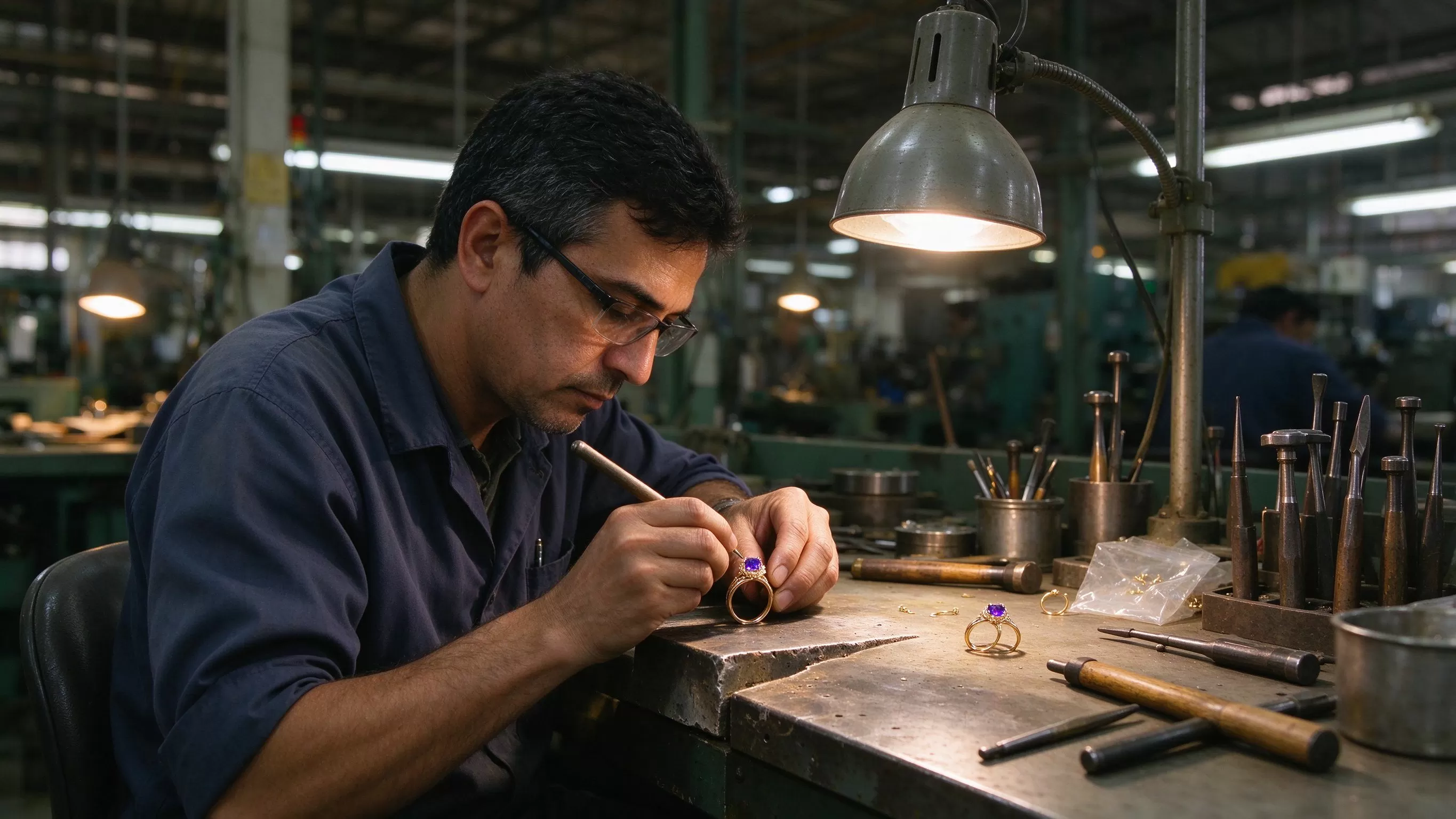
Casting also imposes a minimum wall thickness. Metal cast too thin can develop voids or break, so cast pieces tend to have a certain structural weight. That is one reason cast jewelry often feels more substantial than stamped jewelry of the same design: the metal has to be thick enough to flow and survive. A well-cast ring has heft. The downside is that cast pieces require more cleanup, including removing sprues and filing seams, which is where the bench work comes in. For a broader view of where casting sits, our comparison of production methods adds the handmade dimension.
How Metal Stamping Shapes Flat Designs Fast
Metal stamping works the opposite way. Instead of pouring metal into a mold, a factory takes flat sheet metal and cuts and forms it with steel dies under a mechanical press. A die is a precision-cut steel tool that, when pressed into the sheet, punches out the shape and can emboss or bend it in the same motion. A pendant, a pair of simple earrings, or a flat charm can be stamped out dozens per minute as the press cycles. There is no molten metal, no tree, and almost no waiting: once the die is made, production is fast and continuous.
Stamping excels at flat, uniform designs. A disc pendant, a simple band, a flat tag, or a pair of stud earrings is ideally suited to stamping, because the part starts as flat sheet and stays roughly flat. The die cuts the outline and can add a stamped texture or logo in one hit. This is why stamped jewelry is affordable: the per-piece labor is tiny once the die exists, and the material waste is limited to the scrap between punched shapes. High-volume fashion brands rely on stamping precisely because it scales cheaply and consistently. Our note on finishes shows how stamped sheets then get their surface texture.
The limitation of stamping is depth. A press can only form sheet metal so far; it cannot create the undercuts, open galleries, and rounded three-dimensional volume that casting handles effortlessly. A stamped ring is essentially a flat strip curled and soldered into a circle, which is why simple stamped bands have a uniform width and lack the sculptural shoulders of a cast ring. If a design needs dimension, curves, or integrated complexity, stamping reaches its limit quickly. That constraint is the dividing line between the two processes.
Weight, Feel, and the Quality Difference Shoppers Notice
The most visible difference between stamped and cast jewelry is weight and feel. Cast pieces, because they need structural thickness and often have three-dimensional volume, tend to feel solid and substantial. Stamped pieces, because they start as thin sheet, can feel light and even thin-walled, especially if the gauge is kept low to cut cost. A buyer holding a stamped and a cast version of a similar design will often describe the stamped one as "thin" or "tinny" and the cast one as "substantial." That difference is not a matter of taste; it is a direct result of how the metal was formed.
This is also where cost-cutting hides. A factory can stamp a pendant from very thin sheet to save material, producing a piece that looks identical on a website photo but flexes and dents in the hand. The same pendant cast in proper metal weight feels durable. For a brand, specifying the metal gauge or wall thickness is how you prevent a beautiful design from arriving feeling cheap. Our guide to metal weight explains how gauge and heft translate to perceived quality. Stamping is not inherently low quality; it is that thin stamping is an easy way to cut cost, and buyers should specify gauge to avoid it.
Durability follows the same logic. A cast ring with integrated shoulders distributes stress across solid metal, while a stamped band is a strip curled into a circle with a soldered seam, which can be a weak point if the soldering is poor. For everyday pieces that take knocks, casting generally produces a more durable result. For flat, low-stress pieces like pendants and earrings, stamping is perfectly durable, because those parts do not flex under load. Matching the process to the part's job is the key, rather than assuming one method is always better.
Cost, Tooling, and When Each Makes Sense
The economics of the two methods turn on tooling versus per-piece labor. Stamping requires an expensive precision steel die, which is a one-time tooling cost, but then produces pieces extremely cheaply. That trade-off favors high volumes: a brand ordering ten thousand of the same stamped pendant spreads the die cost across so many units that each piece is very cheap. For small runs, though, the die fee makes stamping uneconomical, because the tooling dominates the total cost.
Casting has a lower upfront barrier because the pattern, whether hand-carved or CAD-printed, costs far less than a steel die. But each cast piece carries more labor, because of cleanup, spruing, and hand finishing. That makes casting the natural choice for small batches, custom work, and intricate designs where per-piece volume is low. A single custom engagement ring is always cast, never stamped, because stamping a die for one piece would be absurd. Our guide to production methods and our note on process steps both help frame these choices.
For a wholesale brand, the decision comes down to volume and design. A flat, simple design that will sell in large quantities should usually be stamped, because the die pays off and the unit cost drops. An intricate, three-dimensional, lower-volume design should be cast. Many brands use both: casting the hero, detailed pieces in a collection and stamping the simple flat earrings and charms at high volume. The mistake is trying to stamp a design that needs depth, or casting a flat high-volume piece that would be far cheaper stamped. A manufacturer who understands both methods will steer you to the right one rather than pushing whichever line they happen to run.
Design Freedom and Limitations
Beyond cost, the two processes allow different design languages. Casting invites sculptural, organic, and complex forms: openwork, textured surfaces, integrated details, and pieces that change profile from every angle. It is the process behind avant-garde and bridal design, where the whole point is a distinctive three-dimensional object. If a design relies on dimension and detail, casting is not just convenient; it is the only practical way to make it at all.
Stamping, by contrast, encourages a clean, graphic, flat aesthetic. It suits tags, discs, simple shapes, and pieces that read well as silhouettes. Stamped designs also stack well with enameling, engraving, and hand stamping of patterns on the flat surface. Many successful fashion brands build entire lines around this flat, graphic look, because it is affordable, consistent, and fast to bring to market. The design is not "lesser" for being stamped; it is optimized for the process. When a design fights its process, though, the result suffers, which is why matching the design language to the method matters.
Hybrid approaches are common. A factory might stamp a flat disc, then bend or form it, solder on a cast detail, and set a stone by hand. Most finished jewelry is not purely stamped or purely cast but a combination, because each method does what it does best. For a buyer, the practical takeaway is not to ask "is this stamped or cast" as a binary quality judgment, but to understand which parts of a design were made which way, and whether the metal weight and construction suit how the piece will be worn. A well-executed stamped piece outlasts a poorly cast one every time.
Spotting the Method on a Finished Piece
If you want to know whether a piece in your hand was stamped or cast, look for the clues rather than guessing. A stamped piece usually shows a uniform wall thickness, a visible soldered seam where a strip was curled into a circle, and a flat back that mirrors the front. A cast piece shows more three-dimensional volume, integrated shoulders, and often a slightly textured cast interior that has been cleaned up but never perfectly smoothed. Weight is the quickest tell: pick up two similar pieces, and the stamped one will usually feel lighter and thinner unless it was deliberately made in a heavy gauge. These signs help you judge whether a quoted price matches the construction, so you are not paying cast-level prices for a thin stamped piece.
Frequently Asked Questions
Is cast jewelry better than stamped jewelry? It depends on the design and wear. Cast pieces are better for intricate, three-dimensional, everyday-worn pieces because they feel substantial and distribute stress. Stamped pieces are better for flat, simple, high-volume designs where they are affordable and durable.
Why does stamped jewelry sometimes feel thin? Because it starts as thin sheet metal, and factories often reduce the gauge to cut cost. A well-specified stamped piece in proper gauge feels solid; a thin-gauge one flexes and dents. Specify the metal thickness.
Which is cheaper for a large order? Stamping is cheaper per piece at high volume because the expensive steel die is spread across many units. For small batches or custom work, casting is cheaper because it needs no die.
Can any design be stamped? No. Stamping works for flat, simple shapes. Designs needing depth, undercuts, open galleries, or sculptural volume must be cast, because a press cannot form those from sheet.
Do most pieces use only one method? Often no. Many finished pieces are hybrids: stamped flat parts combined with cast details, then soldered, set, and finished by hand.
Match the Method to the Piece
Metal stamping and investment casting are not rivals for one prize; they are tools for two different kinds of jewelry. Casting builds the detailed, substantial, three-dimensional pieces that define bridal and designer work, while stamping builds the affordable, flat, graphic pieces that fill high-volume fashion lines. A buyer who understands the difference can specify the right method, demand the right metal weight, and stop paying a casting price for a thin stamped piece or a stamping price for a design that needed casting. We cast intricate custom pieces and stamp high-volume flat designs in our own workshop, and we will recommend the method that fits each design and order size. For a quote on a collection, write to service@holycome.com and read more in our Industry Insights series.