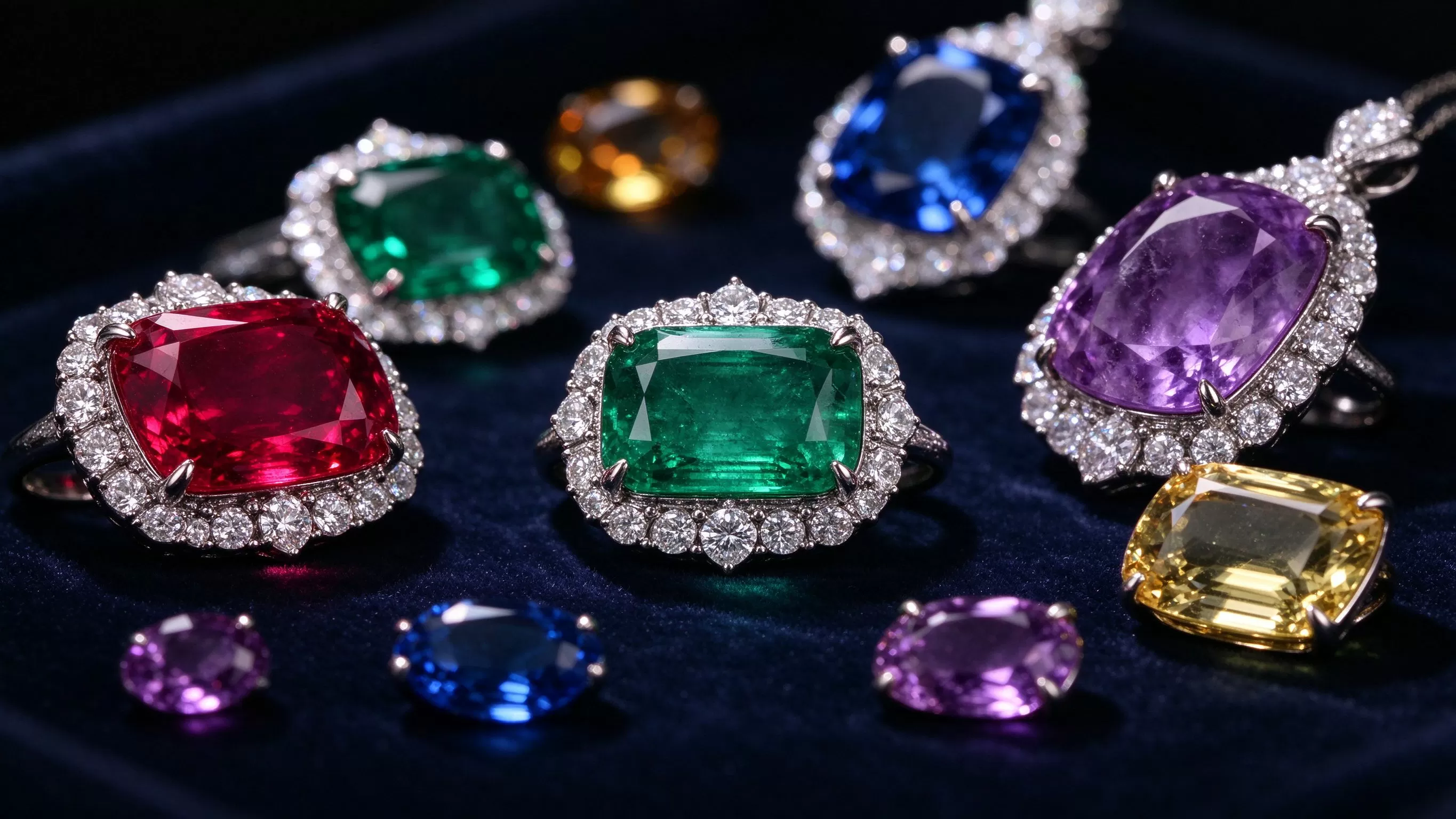
A small chain that runs a green wall display every spring asked us a direct question last year: should the pendant hooks be filled with emerald or with jade? The two stones read as the same color from three feet away, and the buyer mood board could not tell them apart. On the bench and at the till, however, they are different products. This guide breaks down the color origin, hardness, and price bands so a store stocks the right green for the right price point.
Where the green comes from and how it grades
Emerald is the green variety of beryl, colored by trace chromium and sometimes vanadium. The trade grades emerald by hue, tone, and saturation; a vivid, slightly bluish green from Colombia commands the top of the market, while a yellowish or grayish green drops a tier. Emerald is also heavily included by nature, and those jardin inclusions are so expected that a clean stone is treated with suspicion rather than celebration. Jade splits into two minerals: jadeite, the finer and more valuable kind, and nephrite, the tougher, cheaper kind. Jadeite is graded by translucency and color, with vivid imperial green sitting at the top. The GIA gem encyclopedia entry on emerald documents the inclusion-driven grading that wholesale parcels are sorted by, while the jade article on Wikipedia explains the jadeite-versus-nephrite split that many retail tags ignore.
For merchandising, that means emerald sells on vivid color and a hand-included look, while jadeite sells on translucency. A customer who wants a bright, faceted sparkle wants emerald. A customer who wants a smooth, carved bangle wants nephrite or jadeite. Do not substitute one for the other on a display, because the return reasons will differ completely.
Hardness and what each stone can be set into
Emerald sits at 7.5 to 8 on the Mohs scale, but its inclusions make it brittle. It chips under impact and dislikes sudden temperature swings, which is why most fine emerald is sold in a bezel or a halo that protects the girdle. Nephrite jade is far tougher than its 6.0 to 6.5 hardness suggests; it was historically carved into axe blades, and it will survive knocks that shatter emerald. That toughness is why jade works for bangles and carved pendants, where a brittle emerald would not. Cross-reference the same care logic in our notes on storing jewelry to avoid scratches and tarnish, and on field tests that separate emerald from green glass.
The practical rule: set emerald in protective mounts for rings, and reserve open prong rings for jade. If a customer asks for an emerald everyday ring, quote it in a bezel and warn them about ultrasonic and steam exposure, which we cover in which stones tolerate ultrasonic cleaning.
Price bands and what to actually stock
Emerald prices per carat swing hard with color and clarity. A standard 6mm emerald of medium color might cost a wholesaler tens of dollars per carat, while a fine Colombian stone of the same size can cost many times that. Jade prices move with material type: nephrite is affordable and steady, commercial jadeite is mid-range, and imperial-green jadeite reaches prices that rival fine emerald. For a store, nephrite bangles and pendants are a low-risk repeat order, faceted emerald studs are a margin play on color, and top jadeite belongs in a locked case rather than an open wall.
When you order, ask for a neutral 5500K lightbox photo of the actual parcel, because phone cameras push jade too gray and emerald too dark. Read how stones move from rough to shelf in the gemstone supply chain from mine to retail.
FAQ: Emerald vs jade for stockists
Which green stone is more valuable per carat?
It depends on grade. Fine Colombian emerald and fine imperial-green jadeite both reach premium prices, while commercial nephrite and light-green emerald are affordable. Do not assume one mineral is always more expensive than the other.
Can jade be worn as an everyday ring?
Nephrite is tough enough for bangles and pendants, but ring settings still expose it to impact. Jadeite is harder but more brittle under knock. Spec protective mounts and set customer expectations.
Is emerald oiled or treated?
Most commercial emerald is oiled or resin-treated to fill surface fissures, and this is accepted industry practice. Oil level, from none to significant, changes value, so ask the parcel grader for the treatment note.
Which is better for a first-time wholesale order?
Nephrite pendants and bangles carry the lowest risk because supply is steady and the customer buys on feel, not on inclusion grading. Emerald rewards a buyer who can sort color themselves.
Want a matched green-stone program for your spring wall? HOLYCOME supplies faceted emerald and carved nephrite in consistent lots, with parcel-level color and treatment notes and low minimums for first-time wholesale buyers. Read our first-order checklist or request a quote for your next seasonal capsule.
Frequently Asked Questions
How do I verify a factory before placing a bulk order?
Request a production video, business license, export records and a paid sample run. A factory that accepts a 50-piece test order is usually a real manufacturer.
What payment terms do you offer?
30% T/T deposit with the balance against the bill of lading. This protects both sides on first orders and can move to net terms after a track record.
What is your normal reject rate?
3–5% under 10x loupe inspection for cast and set pieces. Defective units are replaced free in the next shipment.
Where is the factory located?
Wuzhou, Guangxi, China—the core lab-grown and moissanite manufacturing cluster. Shipments go via Guangzhou or Shenzhen ports.