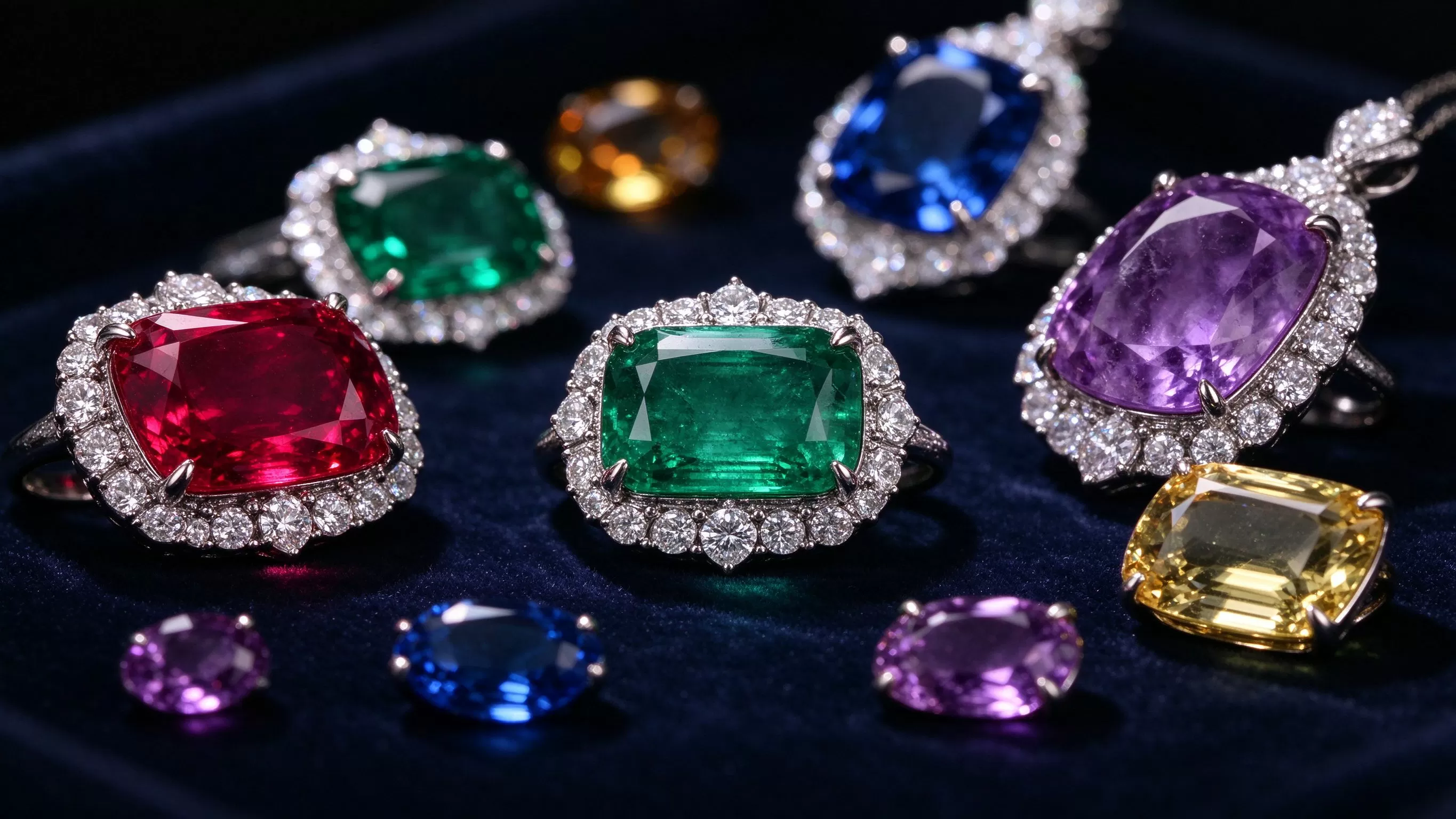
A buyer building a colorless stone under diamond price display kept asking whether to fill the hooks with moissanite or white sapphire. Both sit well below diamond per carat, both can look white in a case, and both are marketed as ethical alternatives. But on the customer hand they read completely differently, and the store that mixes them without explaining why ends up with confused return reasons. This comparison sets out the fire, hardness, and display-cost tradeoffs for a stockist.
Fire and what the eye actually sees
Moissanite is silicon carbide, and it refracts light more strongly than diamond, which gives it a colorful, rainbow fire that some customers love and others read as too much. White sapphire is the colorless variety of corundum. It is bright and white but has far less fire than moissanite, so it reads as a quiet, diamond-like white rather than a sparkle bomb. The Wikipedia entry on moissanite documents the refractive-index difference that drives that fire, and the GIA sapphire entry covers the corundum family. For a window display, moissanite catches light and sells on sparkle; white sapphire sells to the customer who wants a subtle white stone without the rainbow flash.
Hardness, durability, and everyday wear
Moissanite scores about 9.25 on the Mohs scale, just under ruby and sapphire at 9, and far above quartz at 7. That makes it durable enough for rings, with the note that its double refraction can look slightly soft to a trained eye and that some early moissanite stones had a yellow or green tint that newer cuts have largely fixed. White sapphire at 9 is equally durable and tougher under chip, but it often reads slightly gray or milky in larger sizes because colorless corundum can carry subtle silk inclusions. We explain the moissanite rating in why moissanite sits at 9.25 on Mohs and compare it to another common alternative in moissanite versus cubic zirconia.
The practical stocking call: put moissanite in studs and solitaire rings where sparkle is the pitch, and put white sapphire in stackable and everyday bands where a quiet white is wanted. Neither needs special ultrasonic caution the way emerald does, but check cleaning guidance in which stones tolerate ultrasonic cleaning.
Price, display cost, and margin
Moissanite sells at a higher ticket than white sapphire because of its sparkle and its lab-grown story, but its cost per carat to the buyer is still a fraction of diamond. White sapphire is cheaper and supply is broad, so it anchors entry-priced colorless programs. For a store, the margin play is to show the two side by side in the same light so customers feel the difference in fire rather than reading about it. A customer who sees the rainbow flash will self-select; the one who prefers the quiet white will take the sapphire, and your return rate drops because the choice was made in the case.
For merchandising, display the two under the same neutral light and let the eye decide. Moissanite is the higher-ticket, higher-margin story, and customers who ask about it usually already want the sparkle and the conflict-free, lab-grown origin. White sapphire is the quiet, lower-price entry point that suits a customer who dislikes the look of a flashy stone or who wants a white stone that reads more like a classic diamond. Stocking both means a buyer does not lose either shopper, and it avoids the common mistake of pushing moissanite on a customer who actually wanted the calmer white. On price-to-story, moissanite commands roughly two to three times the ticket of comparable white sapphire in many markets, while white sapphire anchors the under-100 dollar impulse shelf; match the display height to those price points so the right customer lands on the right hook, and label each stone plainly so shoppers compare on facts rather than assumptions.
FAQ: Moissanite vs white sapphire
Which one looks more like diamond?
White sapphire reads quieter and whiter, which some buyers find more diamond-like. Moissanite has stronger rainbow fire that some customers love and others find flashy.
Is moissanite durable enough for an engagement ring?
At roughly 9.25 Mohs, yes. It is second only to ruby and sapphire for hardness, and it resists scratching in everyday wear.
Does white sapphire stay colorless?
Good colorless sapphire stays white, but larger stones can read slightly gray or carry silk. Sort parcels by face-up color under neutral light.
Which gives better wholesale margin?
White sapphire carries a lower ticket and predictable supply for entry programs. Moissanite commands a higher ticket on the sparkle story, so margin depends on how you merchandize it.
Building a colorless-alternative case? HOLYCOME supplies graded moissanite and white sapphire in matched cuts, with parcel color notes and wholesale minimums for retail jewelers. Read our first-order checklist or request a quote for your alternative-stone program.
Frequently Asked Questions
Is moissanite a good diamond alternative for retail buyers?
Yes for price-sensitive customers who want brilliance and hardness. Moissanite ranks 9.25 on the Mohs scale, holds up to daily wear and costs a fraction of a natural diamond of the same size, so it resells fast in bridal and fashion lines.
What is the minimum order for wholesale moissanite?
MOQ starts at 50 pieces per design for stock items. Custom cuts and private-label settings usually start at 100–300 pieces depending on the mold.
Do you provide certificates with moissanite stones?
Yes. Every parcel ships with GRA or IGI documentation listing carat weight, color grade and cut. We recommend passing the certificate to your end customer for trust.
How long does sample and bulk production take?
Samples ship in 3–5 days. Bulk runs take 15–20 days under 500 pieces, and 25–30 days for custom work.